

146
G. Yang and Y. Huang
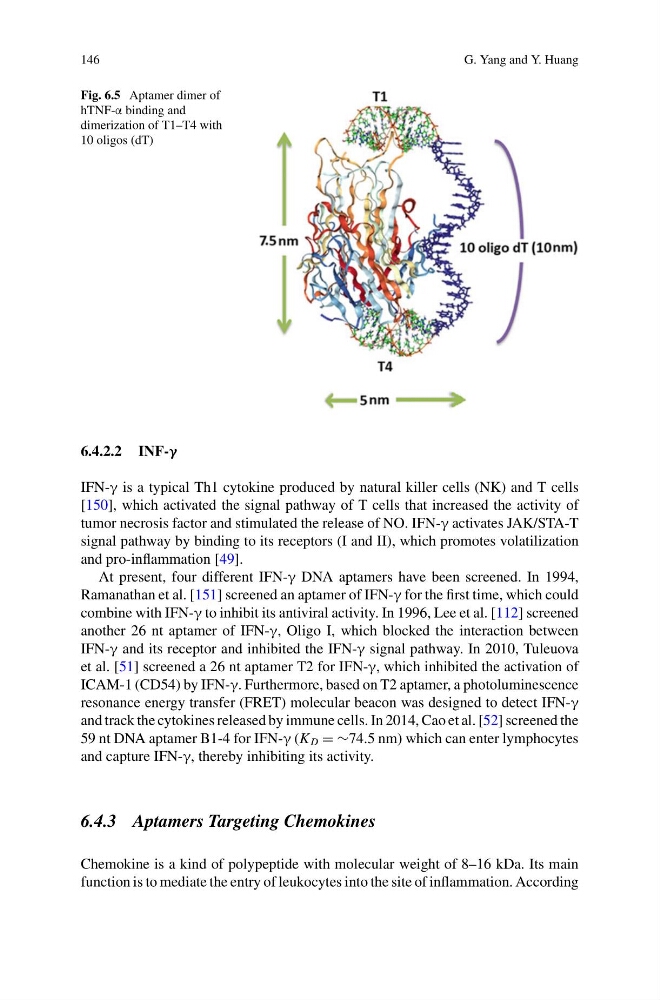
Fig. 6.5 Aptamer dimer of
hTNF-α binding and
dimerization of T1–T4 with
10 oligos (dT)
6.4.2.2 INF-γ
IFN-γ is a typical Th1 cytokine produced by natural killer cells (NK) and T cells
[150], which activated the signal pathway of T cells that increased the activity of
tumor necrosis factor and stimulated the release of NO. IFN-γ activates JAK/STA-T
signal pathway by binding to its receptors (I and II), which promotes volatilization
and pro-inflammation [49].
At present, four different IFN-γ DNA aptamers have been screened. In 1994,
Ramanathan et al. [151] screened an aptamer of IFN-γ for the first time, which could
combine with IFN-γ to inhibit its antiviral activity. In 1996, Lee et al. [112] screened
another 26 nt aptamer of IFN-γ, Oligo I, which blocked the interaction between
IFN-γ and its receptor and inhibited the IFN-γ signal pathway. In 2010, Tuleuova
et al. [51] screened a 26 nt aptamer T2 for IFN-γ, which inhibited the activation of
ICAM-1 (CD54) by IFN-γ. Furthermore, based on T2 aptamer, a photoluminescence
resonance energy transfer (FRET) molecular beacon was designed to detect IFN-γ
and track the cytokines released by immune cells. In 2014, Cao et al. [52] screened the
59 nt DNA aptamer B1-4 for IFN-γ (K D = ∼74.5 nm) which can enter lymphocytes
and capture IFN-γ, thereby inhibiting its activity.
6.4.3 Aptamers Targeting Chemokines
Chemokine is a kind of polypeptide with molecular weight of 8–16 kDa. Its main
function is to mediate the entry of leukocytes into the site of inflammation. According
G. Yang and Y. Huang
Fig. 6.5 Aptamer dimer of
hTNF-α binding and
dimerization of T1–T4 with
10 oligos (dT)
6.4.2.2 INF-γ
IFN-γ is a typical Th1 cytokine produced by natural killer cells (NK) and T cells
[150], which activated the signal pathway of T cells that increased the activity of
tumor necrosis factor and stimulated the release of NO. IFN-γ activates JAK/STA-T
signal pathway by binding to its receptors (I and II), which promotes volatilization
and pro-inflammation [49].
At present, four different IFN-γ DNA aptamers have been screened. In 1994,
Ramanathan et al. [151] screened an aptamer of IFN-γ for the first time, which could
combine with IFN-γ to inhibit its antiviral activity. In 1996, Lee et al. [112] screened
another 26 nt aptamer of IFN-γ, Oligo I, which blocked the interaction between
IFN-γ and its receptor and inhibited the IFN-γ signal pathway. In 2010, Tuleuova
et al. [51] screened a 26 nt aptamer T2 for IFN-γ, which inhibited the activation of
ICAM-1 (CD54) by IFN-γ. Furthermore, based on T2 aptamer, a photoluminescence
resonance energy transfer (FRET) molecular beacon was designed to detect IFN-γ
and track the cytokines released by immune cells. In 2014, Cao et al. [52] screened the
59 nt DNA aptamer B1-4 for IFN-γ (K D = ∼74.5 nm) which can enter lymphocytes
and capture IFN-γ, thereby inhibiting its activity.
6.4.3 Aptamers Targeting Chemokines
Chemokine is a kind of polypeptide with molecular weight of 8–16 kDa. Its main
function is to mediate the entry of leukocytes into the site of inflammation. According