

140
G. Yang and Y. Huang
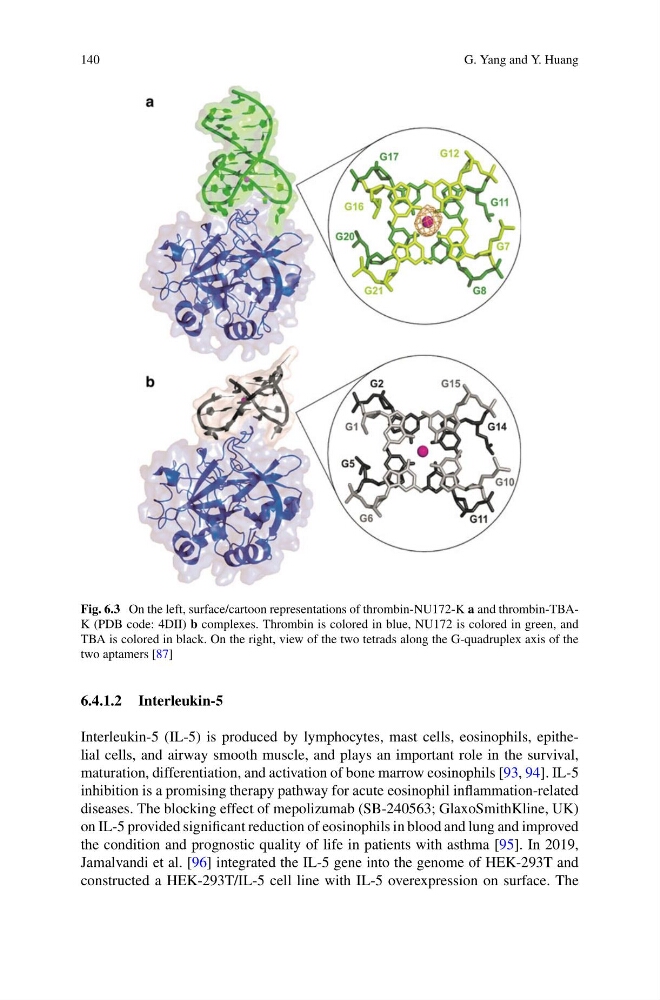
Fig. 6.3 On the left, surface/cartoon representations of thrombin-NU172-K a and thrombin-TBAK (PDB code: 4DII) b complexes. Thrombin is colored in blue, NU172 is colored in green, and
TBA is colored in black. On the right, view of the two tetrads along the G-quadruplex axis of the
two aptamers [87]
6.4.1.2 Interleukin-5
Interleukin-5 (IL-5) is produced by lymphocytes, mast cells, eosinophils, epithelial cells, and airway smooth muscle, and plays an important role in the survival,
maturation, differentiation, and activation of bone marrow eosinophils [93, 94]. IL-5
inhibition is a promising therapy pathway for acute eosinophil inflammation-related
diseases. The blocking effect of mepolizumab (SB-240563; GlaxoSmithKline, UK)
on IL-5 provided significant reduction of eosinophils in blood and lung and improved
the condition and prognostic quality of life in patients with asthma [95]. In 2019,
Jamalvandi et al. [96] integrated the IL-5 gene into the genome of HEK-293T and
constructed a HEK-293T/IL-5 cell line with IL-5 overexpression on surface. The
G. Yang and Y. Huang
Fig. 6.3 On the left, surface/cartoon representations of thrombin-NU172-K a and thrombin-TBAK (PDB code: 4DII) b complexes. Thrombin is colored in blue, NU172 is colored in green, and
TBA is colored in black. On the right, view of the two tetrads along the G-quadruplex axis of the
two aptamers [87]
6.4.1.2 Interleukin-5
Interleukin-5 (IL-5) is produced by lymphocytes, mast cells, eosinophils, epithelial cells, and airway smooth muscle, and plays an important role in the survival,
maturation, differentiation, and activation of bone marrow eosinophils [93, 94]. IL-5
inhibition is a promising therapy pathway for acute eosinophil inflammation-related
diseases. The blocking effect of mepolizumab (SB-240563; GlaxoSmithKline, UK)
on IL-5 provided significant reduction of eosinophils in blood and lung and improved
the condition and prognostic quality of life in patients with asthma [95]. In 2019,
Jamalvandi et al. [96] integrated the IL-5 gene into the genome of HEK-293T and
constructed a HEK-293T/IL-5 cell line with IL-5 overexpression on surface. The