

116
B. Liu et al.
• intended for use in the diagnosis of disease or other conditions, or in the cure,
mitigation, treatment, or prevention of disease, in man or other animals,
• or intended to affect the structure or any function of the body of man or other
animals, and which does not achieve its primary intended purposes through chemical action within or on the body of man or other animals and which is not dependent upon being metabolized for the achievement of any of its primary intended
purposes [2].”
In ancient times, humans lived in very difficult conditions and suffered from
several kinds of diseases. Therefore, they made simple tools to keep healthy and
relieve diseases. Archaeologists found that as early as in the Neolithic Period,
some stone medical tools were already made for heating, massage and other treatments, which were the early prototypes of medical devices. In ancient China, Huangdi
Neijing (The Inner Canon of the Yellow Emperor), written about 2,500 years ago,
recorded the use of stone needles as instruments for acupuncture. In 1816, Rene
Laennec, a doctor in Paris, France, rolled a piece of paper tightly into a cylinder
through which the patient’s heartbeat could be clearly heard. This was the prototype
of stethoscope, whose invention and clinical application was regarded as one of the
landmark events in the beginning of modern medical device. The ~200 years after
that have witnessed the rapid development of medical devices. The progresses in
science and technology have given birth to variety patterns of medical devices, such
as X-ray machine (1895), electrocardiograph (1903), ventilator (1915), cardiac pacemaker (1932), and patient monitor (1964). After the wide application of computers,
the development of medical devices entered a new era, bringing the time of modern
biomedical engineering technology.
With the aging tendency of the global population and the increasing pursuit of
health, the demand for medical devices has undergone a fast escalation. According
to the 2016 edition of the EvaluateMedTech® World Preview, the global medtech
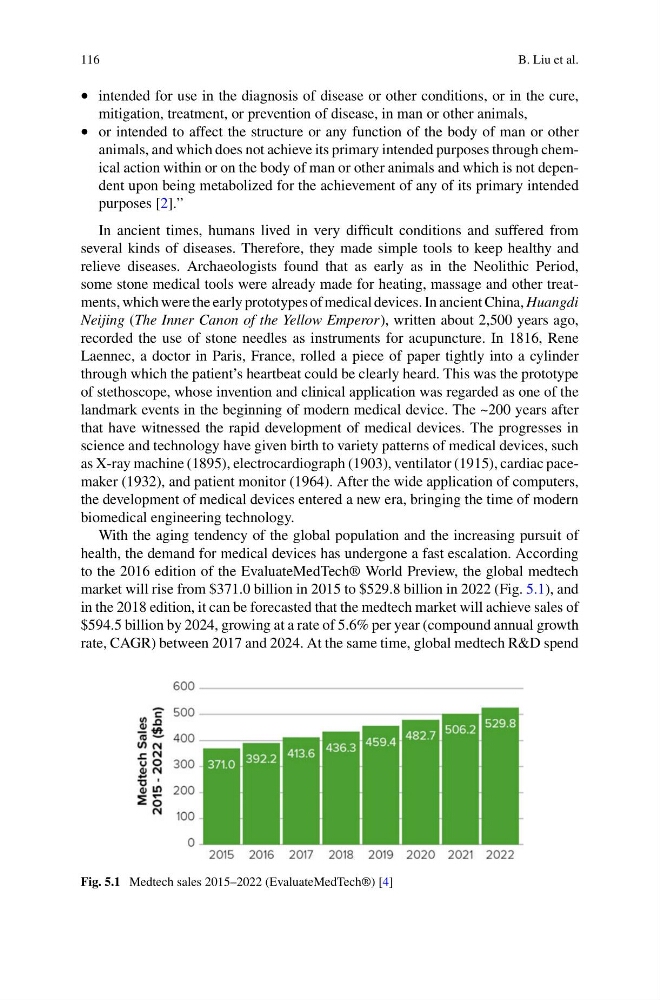
market will rise from $371.0 billion in 2015 to $529.8 billion in 2022 (Fig. 5.1), and
in the 2018 edition, it can be forecasted that the medtech market will achieve sales of
$594.5 billion by 2024, growing at a rate of 5.6% per year (compound annual growth
rate, CAGR) between 2017 and 2024. At the same time, global medtech R&D spend
Fig. 5.1 Medtech sales 2015–2022 (EvaluateMedTech®) [4]
B. Liu et al.
• intended for use in the diagnosis of disease or other conditions, or in the cure,
mitigation, treatment, or prevention of disease, in man or other animals,
• or intended to affect the structure or any function of the body of man or other
animals, and which does not achieve its primary intended purposes through chemical action within or on the body of man or other animals and which is not dependent upon being metabolized for the achievement of any of its primary intended
purposes [2].”
In ancient times, humans lived in very difficult conditions and suffered from
several kinds of diseases. Therefore, they made simple tools to keep healthy and
relieve diseases. Archaeologists found that as early as in the Neolithic Period,
some stone medical tools were already made for heating, massage and other treatments, which were the early prototypes of medical devices. In ancient China, Huangdi
Neijing (The Inner Canon of the Yellow Emperor), written about 2,500 years ago,
recorded the use of stone needles as instruments for acupuncture. In 1816, Rene
Laennec, a doctor in Paris, France, rolled a piece of paper tightly into a cylinder
through which the patient’s heartbeat could be clearly heard. This was the prototype
of stethoscope, whose invention and clinical application was regarded as one of the
landmark events in the beginning of modern medical device. The ~200 years after
that have witnessed the rapid development of medical devices. The progresses in
science and technology have given birth to variety patterns of medical devices, such
as X-ray machine (1895), electrocardiograph (1903), ventilator (1915), cardiac pacemaker (1932), and patient monitor (1964). After the wide application of computers,
the development of medical devices entered a new era, bringing the time of modern
biomedical engineering technology.
With the aging tendency of the global population and the increasing pursuit of
health, the demand for medical devices has undergone a fast escalation. According
to the 2016 edition of the EvaluateMedTech® World Preview, the global medtech
market will rise from $371.0 billion in 2015 to $529.8 billion in 2022 (Fig. 5.1), and
in the 2018 edition, it can be forecasted that the medtech market will achieve sales of
$594.5 billion by 2024, growing at a rate of 5.6% per year (compound annual growth
rate, CAGR) between 2017 and 2024. At the same time, global medtech R&D spend
Fig. 5.1 Medtech sales 2015–2022 (EvaluateMedTech®) [4]