

94
Z. Liu and Y. Liu
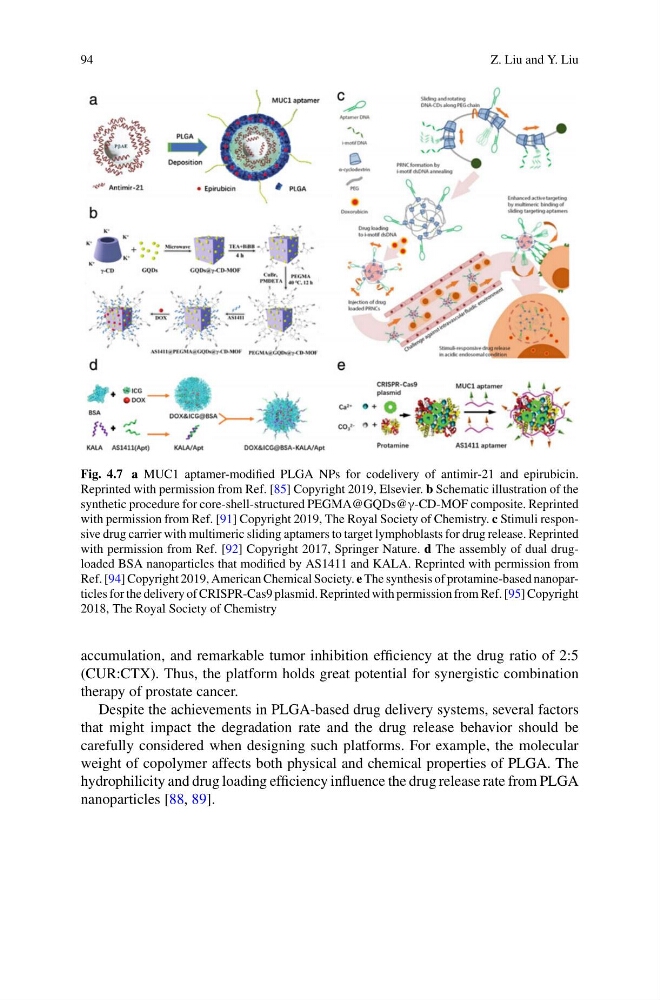
Fig. 4.7 a MUC1 aptamer-modified PLGA NPs for codelivery of antimir-21 and epirubicin.
Reprinted with permission from Ref. [85] Copyright 2019, Elsevier. b Schematic illustration of the
synthetic procedure for core-shell-structured PEGMA@GQDs@γ-CD-MOF composite. Reprinted
with permission from Ref. [91] Copyright 2019, The Royal Society of Chemistry. c Stimuli responsive drug carrier with multimeric sliding aptamers to target lymphoblasts for drug release. Reprinted
with permission from Ref. [92] Copyright 2017, Springer Nature. d The assembly of dual drugloaded BSA nanoparticles that modified by AS1411 and KALA. Reprinted with permission from
Ref. [94] Copyright 2019, American Chemical Society. e The synthesis of protamine-based nanoparticles for the delivery of CRISPR-Cas9 plasmid. Reprinted with permission from Ref. [95] Copyright
2018, The Royal Society of Chemistry
accumulation, and remarkable tumor inhibition efficiency at the drug ratio of 2:5
(CUR:CTX). Thus, the platform holds great potential for synergistic combination
therapy of prostate cancer.
Despite the achievements in PLGA-based drug delivery systems, several factors
that might impact the degradation rate and the drug release behavior should be
carefully considered when designing such platforms. For example, the molecular
weight of copolymer affects both physical and chemical properties of PLGA. The
hydrophilicity and drug loading efficiency influence the drug release rate from PLGA
nanoparticles [88, 89].
Z. Liu and Y. Liu
Fig. 4.7 a MUC1 aptamer-modified PLGA NPs for codelivery of antimir-21 and epirubicin.
Reprinted with permission from Ref. [85] Copyright 2019, Elsevier. b Schematic illustration of the
synthetic procedure for core-shell-structured PEGMA@GQDs@γ-CD-MOF composite. Reprinted
with permission from Ref. [91] Copyright 2019, The Royal Society of Chemistry. c Stimuli responsive drug carrier with multimeric sliding aptamers to target lymphoblasts for drug release. Reprinted
with permission from Ref. [92] Copyright 2017, Springer Nature. d The assembly of dual drugloaded BSA nanoparticles that modified by AS1411 and KALA. Reprinted with permission from
Ref. [94] Copyright 2019, American Chemical Society. e The synthesis of protamine-based nanoparticles for the delivery of CRISPR-Cas9 plasmid. Reprinted with permission from Ref. [95] Copyright
2018, The Royal Society of Chemistry
accumulation, and remarkable tumor inhibition efficiency at the drug ratio of 2:5
(CUR:CTX). Thus, the platform holds great potential for synergistic combination
therapy of prostate cancer.
Despite the achievements in PLGA-based drug delivery systems, several factors
that might impact the degradation rate and the drug release behavior should be
carefully considered when designing such platforms. For example, the molecular
weight of copolymer affects both physical and chemical properties of PLGA. The
hydrophilicity and drug loading efficiency influence the drug release rate from PLGA
nanoparticles [88, 89].