

416
L. Zhu et al.
This capability, equivalent to solving the ‘kidnapped robot’ problem, is a recognised challenge for autonomous navigation systems, especially if only monocular
visual information is available. Recognising a location from the current visual
input can be difficult due to high variability across viewpoints, weather conditions, time of day, and seasons [13], yet insects provide an existence proof that
it is possible using low-resolution vision and relatively limited neural processing.
Improved visual recognition has been achieved on robots by matching
sequences of images [14,15] along a route. This reduces the impact of individual mismatches and demonstrates the benefit of incorporating the temporality
of visual data in the learning regime. To date, bioinspired navigation models
(with the possible exception of [5]) have largely overlooked the potential benefits of temporal cues for visual recognition, instead relying on repeated static
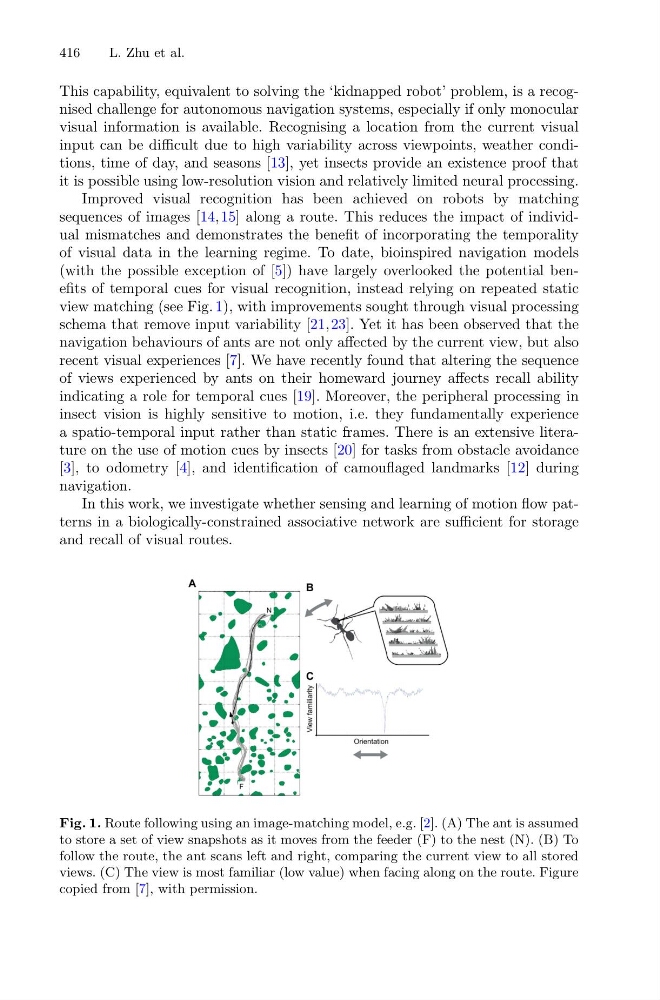
view matching (see Fig. 1), with improvements sought through visual processing
schema that remove input variability [21,23]. Yet it has been observed that the
navigation behaviours of ants are not only affected by the current view, but also
recent visual experiences [7]. We have recently found that altering the sequence
of views experienced by ants on their homeward journey affects recall ability
indicating a role for temporal cues [19]. Moreover, the peripheral processing in
insect vision is highly sensitive to motion, i.e. they fundamentally experience
a spatio-temporal input rather than static frames. There is an extensive literature on the use of motion cues by insects [20] for tasks from obstacle avoidance
[3], to odometry [4], and identification of camouflaged landmarks [12] during
navigation.
In this work, we investigate whether sensing and learning of motion flow patterns in a biologically-constrained associative network are sufficient for storage
and recall of visual routes.
Fig. 1. Route following using an image-matching model, e.g. [2]. (A) The ant is assumed
to store a set of view snapshots as it moves from the feeder (F) to the nest (N). (B) To
follow the route, the ant scans left and right, comparing the current view to all stored
views. (C) The view is most familiar (low value) when facing along on the route. Figure
copied from [7], with permission.
L. Zhu et al.
This capability, equivalent to solving the ‘kidnapped robot’ problem, is a recognised challenge for autonomous navigation systems, especially if only monocular
visual information is available. Recognising a location from the current visual
input can be difficult due to high variability across viewpoints, weather conditions, time of day, and seasons [13], yet insects provide an existence proof that
it is possible using low-resolution vision and relatively limited neural processing.
Improved visual recognition has been achieved on robots by matching
sequences of images [14,15] along a route. This reduces the impact of individual mismatches and demonstrates the benefit of incorporating the temporality
of visual data in the learning regime. To date, bioinspired navigation models
(with the possible exception of [5]) have largely overlooked the potential benefits of temporal cues for visual recognition, instead relying on repeated static
view matching (see Fig. 1), with improvements sought through visual processing
schema that remove input variability [21,23]. Yet it has been observed that the
navigation behaviours of ants are not only affected by the current view, but also
recent visual experiences [7]. We have recently found that altering the sequence
of views experienced by ants on their homeward journey affects recall ability
indicating a role for temporal cues [19]. Moreover, the peripheral processing in
insect vision is highly sensitive to motion, i.e. they fundamentally experience
a spatio-temporal input rather than static frames. There is an extensive literature on the use of motion cues by insects [20] for tasks from obstacle avoidance
[3], to odometry [4], and identification of camouflaged landmarks [12] during
navigation.
In this work, we investigate whether sensing and learning of motion flow patterns in a biologically-constrained associative network are sufficient for storage
and recall of visual routes.
Fig. 1. Route following using an image-matching model, e.g. [2]. (A) The ant is assumed
to store a set of view snapshots as it moves from the feeder (F) to the nest (N). (B) To
follow the route, the ant scans left and right, comparing the current view to all stored
views. (C) The view is most familiar (low value) when facing along on the route. Figure
copied from [7], with permission.