

The Use of Social Sensorimotor Contingencies in Humanoid Robots
385
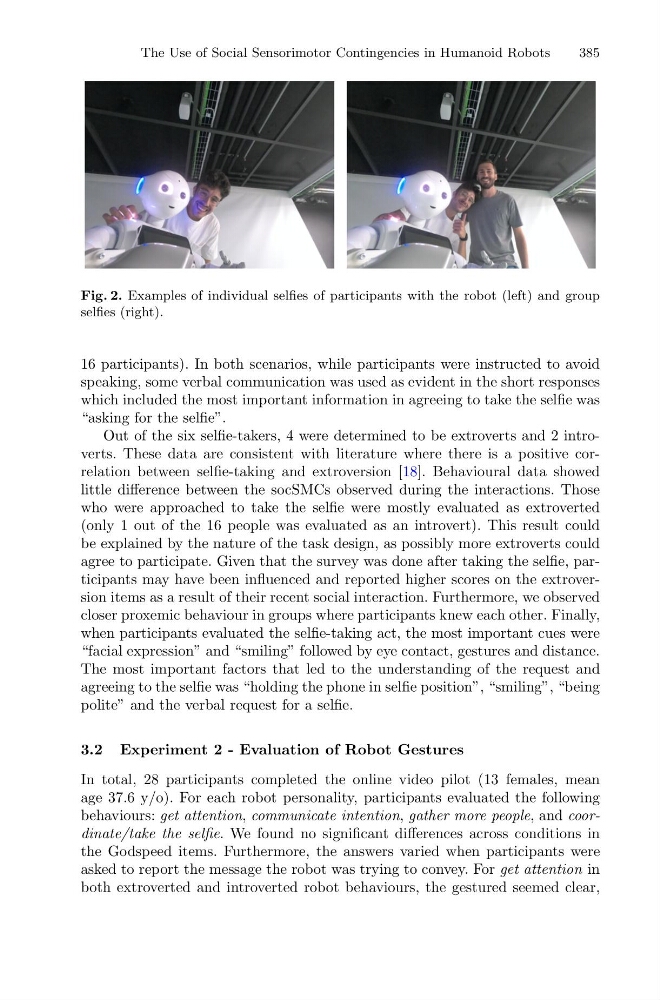
Fig. 2. Examples of individual selfies of participants with the robot (left) and group
selfies (right).
16 participants). In both scenarios, while participants were instructed to avoid
speaking, some verbal communication was used as evident in the short responses
which included the most important information in agreeing to take the selfie was
“asking for the selfie”.
Out of the six selfie-takers, 4 were determined to be extroverts and 2 introverts. These data are consistent with literature where there is a positive correlation between selfie-taking and extroversion [18]. Behavioural data showed
little difference between the socSMCs observed during the interactions. Those
who were approached to take the selfie were mostly evaluated as extroverted
(only 1 out of the 16 people was evaluated as an introvert). This result could
be explained by the nature of the task design, as possibly more extroverts could
agree to participate. Given that the survey was done after taking the selfie, participants may have been influenced and reported higher scores on the extroversion items as a result of their recent social interaction. Furthermore, we observed
closer proxemic behaviour in groups where participants knew each other. Finally,
when participants evaluated the selfie-taking act, the most important cues were
“facial expression” and “smiling” followed by eye contact, gestures and distance.
The most important factors that led to the understanding of the request and
agreeing to the selfie was “holding the phone in selfie position”, “smiling”, “being
polite” and the verbal request for a selfie.
3.2 Experiment 2 - Evaluation of Robot Gestures
In total, 28 participants completed the online video pilot (13 females, mean
age 37.6 y/o). For each robot personality, participants evaluated the following
behaviours: get attention, communicate intention, gather more people, and coordinate/take the selfie. We found no significant differences across conditions in
the Godspeed items. Furthermore, the answers varied when participants were
asked to report the message the robot was trying to convey. For get attention in
both extroverted and introverted robot behaviours, the gestured seemed clear,
385
Fig. 2. Examples of individual selfies of participants with the robot (left) and group
selfies (right).
16 participants). In both scenarios, while participants were instructed to avoid
speaking, some verbal communication was used as evident in the short responses
which included the most important information in agreeing to take the selfie was
“asking for the selfie”.
Out of the six selfie-takers, 4 were determined to be extroverts and 2 introverts. These data are consistent with literature where there is a positive correlation between selfie-taking and extroversion [18]. Behavioural data showed
little difference between the socSMCs observed during the interactions. Those
who were approached to take the selfie were mostly evaluated as extroverted
(only 1 out of the 16 people was evaluated as an introvert). This result could
be explained by the nature of the task design, as possibly more extroverts could
agree to participate. Given that the survey was done after taking the selfie, participants may have been influenced and reported higher scores on the extroversion items as a result of their recent social interaction. Furthermore, we observed
closer proxemic behaviour in groups where participants knew each other. Finally,
when participants evaluated the selfie-taking act, the most important cues were
“facial expression” and “smiling” followed by eye contact, gestures and distance.
The most important factors that led to the understanding of the request and
agreeing to the selfie was “holding the phone in selfie position”, “smiling”, “being
polite” and the verbal request for a selfie.
3.2 Experiment 2 - Evaluation of Robot Gestures
In total, 28 participants completed the online video pilot (13 females, mean
age 37.6 y/o). For each robot personality, participants evaluated the following
behaviours: get attention, communicate intention, gather more people, and coordinate/take the selfie. We found no significant differences across conditions in
the Godspeed items. Furthermore, the answers varied when participants were
asked to report the message the robot was trying to convey. For get attention in
both extroverted and introverted robot behaviours, the gestured seemed clear,