

The Use of Social Sensorimotor Contingencies in Humanoid Robots
383
asked the individuals who were approached for the selfie to complete the 10-item
Big Five survey and evaluate which sensorimotor information allowed them to
understand the request and agree to take the selfie. Finally, we asked the “selfietakers” to report any actions they did to make the request clearer and result
in taking a selfie. All interactions were filmed on an iPhone by the researcher,
while participants took the selfies with their phones.
Experiment 2 - Evaluation of Robot Gestures. To assess the comprehension and perception of the information provided through socSMCs, we conducted an online study where participants rated the robot’s behaviour based
on the Godspeed questionnaire [17], and it’s perceived personality. The Godspeed questionnaire is among the standard questionnaires used in HRI to evaluate the interaction and the human’s perception of the robot in the following
categories: perceived intelligence, animacy, anthropomorphism, likeability and
perceived safety. The Godspeed items selected were Artificial – Lifelike (anthropomorphism), Inert – Interactive (Animacy), Unfriendly – Friendly (likeability),
and Foolish – Sensible (perceived intelligence), based upon their relevance to the
task of selfie-taking. Finally, we asked participants to provide a short response
indicating what they believed the robot was trying to communicate based on the
exhibited gestures alone. The only additional contextual information provided
was that they could imagine the robot holding a camera in its right hand for the
duration of the videos. Participants watched 8 videos in randomised order of the
robotic gestures corresponding to the four defined selfie-taking behaviours: get
attention, communicate intention, gather more people, and coordinate/take the
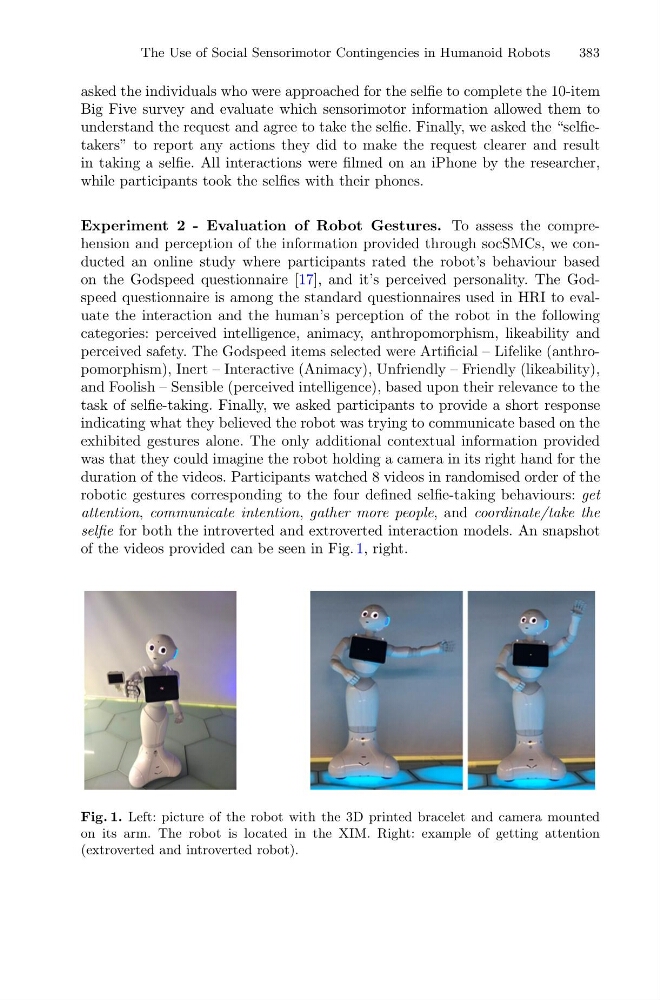
selfie for both the introverted and extroverted interaction models. An snapshot
of the videos provided can be seen in Fig. 1, right.
Fig. 1. Left: picture of the robot with the 3D printed bracelet and camera mounted
on its arm. The robot is located in the XIM. Right: example of getting attention
(extroverted and introverted robot).
383
asked the individuals who were approached for the selfie to complete the 10-item
Big Five survey and evaluate which sensorimotor information allowed them to
understand the request and agree to take the selfie. Finally, we asked the “selfietakers” to report any actions they did to make the request clearer and result
in taking a selfie. All interactions were filmed on an iPhone by the researcher,
while participants took the selfies with their phones.
Experiment 2 - Evaluation of Robot Gestures. To assess the comprehension and perception of the information provided through socSMCs, we conducted an online study where participants rated the robot’s behaviour based
on the Godspeed questionnaire [17], and it’s perceived personality. The Godspeed questionnaire is among the standard questionnaires used in HRI to evaluate the interaction and the human’s perception of the robot in the following
categories: perceived intelligence, animacy, anthropomorphism, likeability and
perceived safety. The Godspeed items selected were Artificial – Lifelike (anthropomorphism), Inert – Interactive (Animacy), Unfriendly – Friendly (likeability),
and Foolish – Sensible (perceived intelligence), based upon their relevance to the
task of selfie-taking. Finally, we asked participants to provide a short response
indicating what they believed the robot was trying to communicate based on the
exhibited gestures alone. The only additional contextual information provided
was that they could imagine the robot holding a camera in its right hand for the
duration of the videos. Participants watched 8 videos in randomised order of the
robotic gestures corresponding to the four defined selfie-taking behaviours: get
attention, communicate intention, gather more people, and coordinate/take the
selfie for both the introverted and extroverted interaction models. An snapshot
of the videos provided can be seen in Fig. 1, right.
Fig. 1. Left: picture of the robot with the 3D printed bracelet and camera mounted
on its arm. The robot is located in the XIM. Right: example of getting attention
(extroverted and introverted robot).