

326
J. Stankiewicz and B. Webb
optical flow percepts which are computed with matched filters: “ensembles of
neurons which extract crucial components of stimuli while ignoring irrelevant
information.” [6]. While neurons with receptive fields that resemble matched
filters for rotational motion are well documented, circuits for inferring translational motion are less well understood. A problem with estimating translatory
egomotion from optic flow is that flow magnitude is inversely proportional to
the distance to the flow inducing surface (depth). In [2] the average horizontal
flight depth value per photoreceptor is used to weight flow according to viewing
direction. Here, we suggest that one reliable depth estimate can be used to adaptively tune all photoreceptor depth weights. We show that this approach can be
successfully integrated to the CX circuit to produce effective PI behaviour for
an MAV operating in real outdoor conditions.
2 Methods
2.1 Robotic Platform
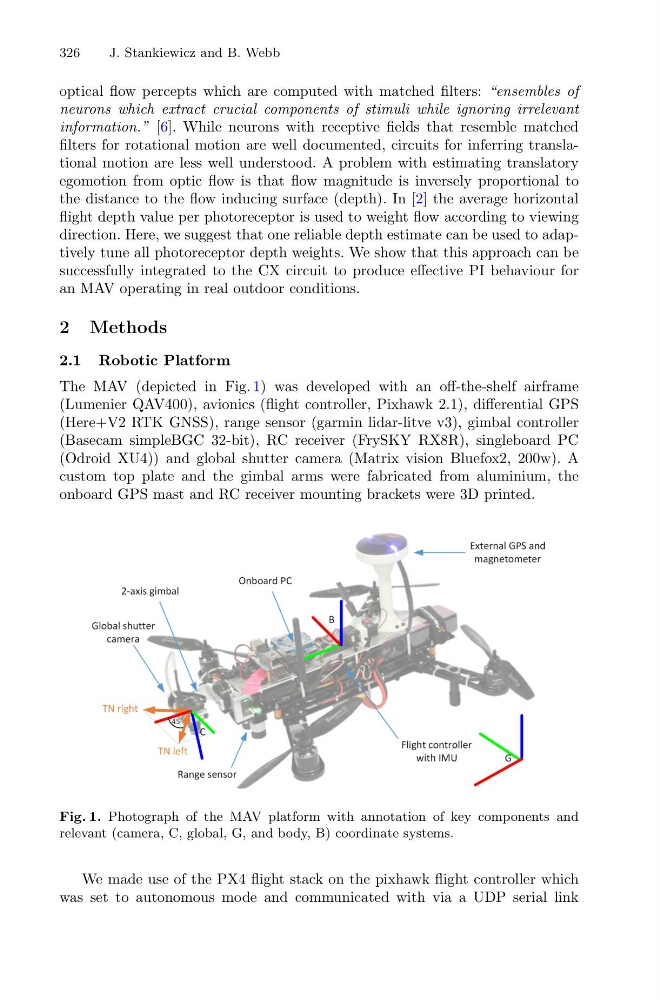
The MAV (depicted in Fig. 1) was developed with an off-the-shelf airframe
(Lumenier QAV400), avionics (flight controller, Pixhawk 2.1), differential GPS
(Here+V2 RTK GNSS), range sensor (garmin lidar-litve v3), gimbal controller
(Basecam simpleBGC 32-bit), RC receiver (FrySKY RX8R), singleboard PC
(Odroid XU4)) and global shutter camera (Matrix vision Bluefox2, 200w). A
custom top plate and the gimbal arms were fabricated from aluminium, the
onboard GPS mast and RC receiver mounting brackets were 3D printed.
Fig. 1. Photograph of the MAV platform with annotation of key components and
relevant (camera, C, global, G, and body, B) coordinate systems.
We made use of the PX4 flight stack on the pixhawk flight controller which
was set to autonomous mode and communicated with via a UDP serial link
J. Stankiewicz and B. Webb
optical flow percepts which are computed with matched filters: “ensembles of
neurons which extract crucial components of stimuli while ignoring irrelevant
information.” [6]. While neurons with receptive fields that resemble matched
filters for rotational motion are well documented, circuits for inferring translational motion are less well understood. A problem with estimating translatory
egomotion from optic flow is that flow magnitude is inversely proportional to
the distance to the flow inducing surface (depth). In [2] the average horizontal
flight depth value per photoreceptor is used to weight flow according to viewing
direction. Here, we suggest that one reliable depth estimate can be used to adaptively tune all photoreceptor depth weights. We show that this approach can be
successfully integrated to the CX circuit to produce effective PI behaviour for
an MAV operating in real outdoor conditions.
2 Methods
2.1 Robotic Platform
The MAV (depicted in Fig. 1) was developed with an off-the-shelf airframe
(Lumenier QAV400), avionics (flight controller, Pixhawk 2.1), differential GPS
(Here+V2 RTK GNSS), range sensor (garmin lidar-litve v3), gimbal controller
(Basecam simpleBGC 32-bit), RC receiver (FrySKY RX8R), singleboard PC
(Odroid XU4)) and global shutter camera (Matrix vision Bluefox2, 200w). A
custom top plate and the gimbal arms were fabricated from aluminium, the
onboard GPS mast and RC receiver mounting brackets were 3D printed.
Fig. 1. Photograph of the MAV platform with annotation of key components and
relevant (camera, C, global, G, and body, B) coordinate systems.
We made use of the PX4 flight stack on the pixhawk flight controller which
was set to autonomous mode and communicated with via a UDP serial link