

320
A. Sedlackova et al.
The Robot Successfully Tracks a Background Pattern via the Optomotor Response.
Figure 5 shows that the complete, closed-loop system can generate a functional optomotor response even as the movement of the background increases in frequency. The
velocity of the neck tracks that of the background, even though the absolute orientation
of the head and background are different. This is because the visual system has no specific landmarks to track. Because the system is closed-loop, neck rotation impacts the
observed velocity of the background.
4 Discussion
In this manuscript, we built a synthetic nervous system (SNS) model of parts of the
insect optic lobe, and used it to model the optomotor response observed in insects
[3, 6–8]. We applied the functional subnetwork approach [15] to tune the known and
hypothesized anatomical structure of the insect optic lobe without any machine learning
or optimization. The resulting network can process video data in real time (albeit more
slowly and at lower resolution than its biological counterparts), enhance its contrast,
compute its motion, and control the motion of a “head” as it attempts to stabilize its
gaze on the background. Such a system serves as a robotic model of visual processing in
insects, which can be used to consolidate results from different experiments and species
into one self-consistent model. Additionally, this system will form the basis of more
sophisticated visually-guided robotic behaviors in the future.
Despite the detail of our model, some known features of insect visual systems are not
yet incorporated. To reduce the complexity of the model, we modeled one-dimensional
(azimuthal, or left-right) vision only. Insects possess dedicated processing pathways to
see along the vertical axis as well [3], and thus our future work will expand the structure
of this network into an additional dimension. To further reduce the complexity of the
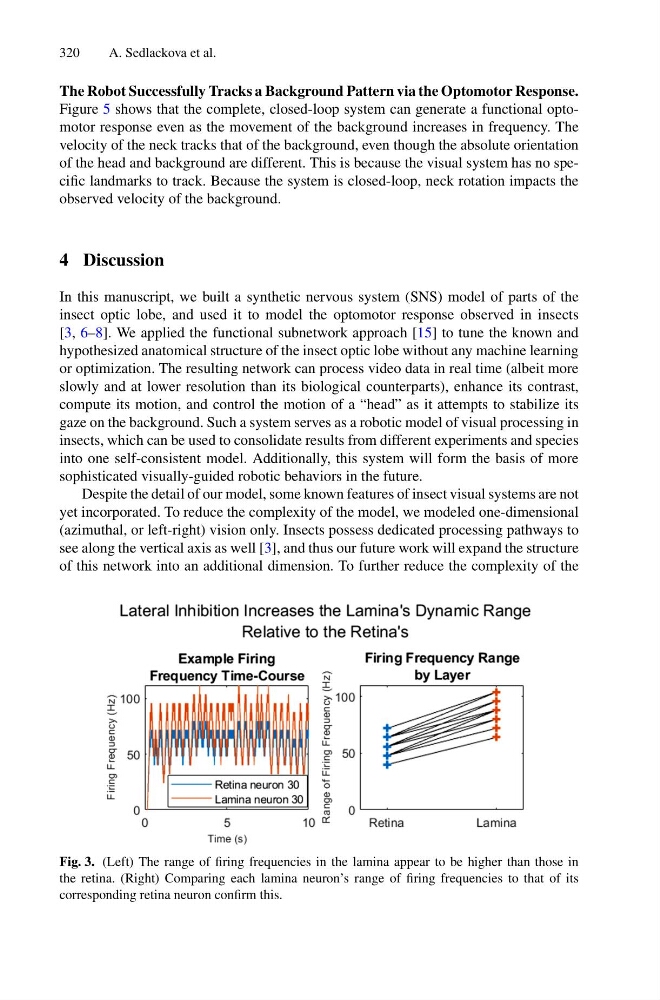
Fig. 3. (Left) The range of firing frequencies in the lamina appear to be higher than those in
the retina. (Right) Comparing each lamina neuron’s range of firing frequencies to that of its
corresponding retina neuron confirm this.
A. Sedlackova et al.
The Robot Successfully Tracks a Background Pattern via the Optomotor Response.
Figure 5 shows that the complete, closed-loop system can generate a functional optomotor response even as the movement of the background increases in frequency. The
velocity of the neck tracks that of the background, even though the absolute orientation
of the head and background are different. This is because the visual system has no specific landmarks to track. Because the system is closed-loop, neck rotation impacts the
observed velocity of the background.
4 Discussion
In this manuscript, we built a synthetic nervous system (SNS) model of parts of the
insect optic lobe, and used it to model the optomotor response observed in insects
[3, 6–8]. We applied the functional subnetwork approach [15] to tune the known and
hypothesized anatomical structure of the insect optic lobe without any machine learning
or optimization. The resulting network can process video data in real time (albeit more
slowly and at lower resolution than its biological counterparts), enhance its contrast,
compute its motion, and control the motion of a “head” as it attempts to stabilize its
gaze on the background. Such a system serves as a robotic model of visual processing in
insects, which can be used to consolidate results from different experiments and species
into one self-consistent model. Additionally, this system will form the basis of more
sophisticated visually-guided robotic behaviors in the future.
Despite the detail of our model, some known features of insect visual systems are not
yet incorporated. To reduce the complexity of the model, we modeled one-dimensional
(azimuthal, or left-right) vision only. Insects possess dedicated processing pathways to
see along the vertical axis as well [3], and thus our future work will expand the structure
of this network into an additional dimension. To further reduce the complexity of the
Fig. 3. (Left) The range of firing frequencies in the lamina appear to be higher than those in
the retina. (Right) Comparing each lamina neuron’s range of firing frequencies to that of its
corresponding retina neuron confirm this.