

290
P. Sakagiannis et al.
bouts, while the distribution of activity bouts remains unaffected. This observation hints towards a neural mechanism that generates the alternating switches
between activity and rest where tonic modulatory input from the brain regulates
the activity/rest balance according to environmental conditions and possibly
homeostatic state.
Here we analyze intermittency in a large experimental dataset and present a
conceptual model that generates alternation between rest and activity, capturing
empirically observed power-law and non-power-law distributions. We discuss a
plausible neural mechanism for the alternation between rest and activity and
the regulation of the animal’s activity/rest ratio via modulation of the restbout power-law exponent by top-down modulatory input. Our approach seeks
to elaborate on the currently prevailing view that these patterns result from
intrinsic neural noise [8].
2 Materials and Methods
2.1 Experimental Dataset
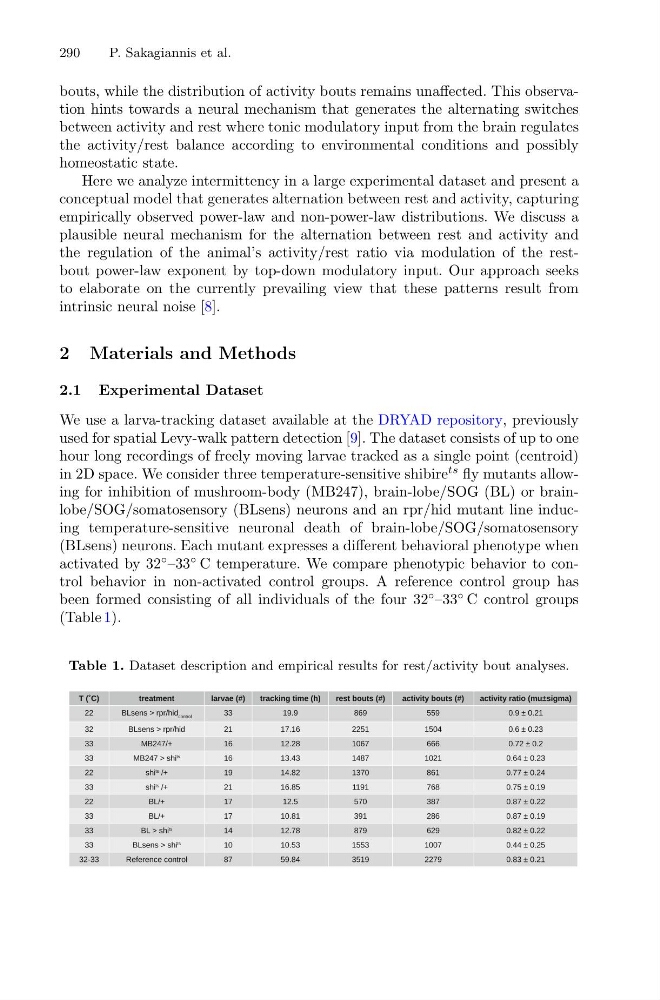
We use a larva-tracking dataset available at the DRYAD repository, previously
used for spatial Levy-walk pattern detection [9]. The dataset consists of up to one
hour long recordings of freely moving larvae tracked as a single point (centroid)
in 2D space. We consider three temperature-sensitive shibire
ts fly mutants allowing for inhibition of mushroom-body (MB247), brain-lobe/SOG (BL) or brainlobe/SOG/somatosensory (BLsens) neurons and an rpr/hid mutant line inducing temperature-sensitive neuronal death of brain-lobe/SOG/somatosensory
(BLsens) neurons. Each mutant expresses a different behavioral phenotype when
activated by 32
◦ –33
◦ C temperature. We compare phenotypic behavior to control behavior in non-activated control groups. A reference control group has
been formed consisting of all individuals of the four 32
◦ –33
◦ C control groups
(Table 1).
Table 1. Dataset description and empirical results for rest/activity bout analyses.
P. Sakagiannis et al.
bouts, while the distribution of activity bouts remains unaffected. This observation hints towards a neural mechanism that generates the alternating switches
between activity and rest where tonic modulatory input from the brain regulates
the activity/rest balance according to environmental conditions and possibly
homeostatic state.
Here we analyze intermittency in a large experimental dataset and present a
conceptual model that generates alternation between rest and activity, capturing
empirically observed power-law and non-power-law distributions. We discuss a
plausible neural mechanism for the alternation between rest and activity and
the regulation of the animal’s activity/rest ratio via modulation of the restbout power-law exponent by top-down modulatory input. Our approach seeks
to elaborate on the currently prevailing view that these patterns result from
intrinsic neural noise [8].
2 Materials and Methods
2.1 Experimental Dataset
We use a larva-tracking dataset available at the DRYAD repository, previously
used for spatial Levy-walk pattern detection [9]. The dataset consists of up to one
hour long recordings of freely moving larvae tracked as a single point (centroid)
in 2D space. We consider three temperature-sensitive shibire
ts fly mutants allowing for inhibition of mushroom-body (MB247), brain-lobe/SOG (BL) or brainlobe/SOG/somatosensory (BLsens) neurons and an rpr/hid mutant line inducing temperature-sensitive neuronal death of brain-lobe/SOG/somatosensory
(BLsens) neurons. Each mutant expresses a different behavioral phenotype when
activated by 32
◦ –33
◦ C temperature. We compare phenotypic behavior to control behavior in non-activated control groups. A reference control group has
been formed consisting of all individuals of the four 32
◦ –33
◦ C control groups
(Table 1).
Table 1. Dataset description and empirical results for rest/activity bout analyses.