

Bioinspired Navigation Based on Distributed Sensing in the Leech
281
of stimuli to navigate, lateral inhibition ensures that the stimuli eliciting the
strongest neural response will be used for the navigational decision making.
An example of the elliptical generation is displayed in Fig. 2 - panel 3.
Note that because we are using the absolute value of the difference between
two ellipses, the integrated/effective ellipse may have a shape that is not truly
elliptical, as there can be multiple lobes in this distribution [11]. We use the
term integrated/effective ellipse for simplicity.
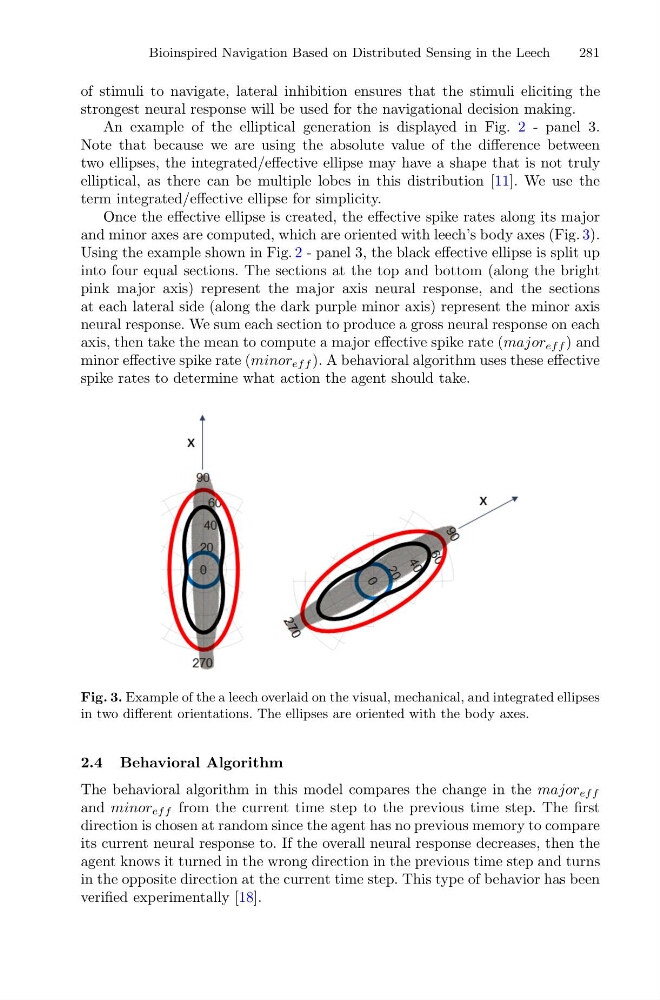
Once the effective ellipse is created, the effective spike rates along its major
and minor axes are computed, which are oriented with leech’s body axes (Fig. 3).
Using the example shown in Fig. 2 - panel 3, the black effective ellipse is split up
into four equal sections. The sections at the top and bottom (along the bright
pink major axis) represent the major axis neural response, and the sections
at each lateral side (along the dark purple minor axis) represent the minor axis
neural response. We sum each section to produce a gross neural response on each
axis, then take the mean to compute a major effective spike rate (major ef f ) and
minor effective spike rate (minor ef f ). A behavioral algorithm uses these effective
spike rates to determine what action the agent should take.
Fig. 3. Example of the a leech overlaid on the visual, mechanical, and integrated ellipses
in two different orientations. The ellipses are oriented with the body axes.
2.4 Behavioral Algorithm
The behavioral algorithm in this model compares the change in the major ef f
and minor ef f from the current time step to the previous time step. The first
direction is chosen at random since the agent has no previous memory to compare
its current neural response to. If the overall neural response decreases, then the
agent knows it turned in the wrong direction in the previous time step and turns
in the opposite direction at the current time step. This type of behavior has been
verified experimentally [18].
281
of stimuli to navigate, lateral inhibition ensures that the stimuli eliciting the
strongest neural response will be used for the navigational decision making.
An example of the elliptical generation is displayed in Fig. 2 - panel 3.
Note that because we are using the absolute value of the difference between
two ellipses, the integrated/effective ellipse may have a shape that is not truly
elliptical, as there can be multiple lobes in this distribution [11]. We use the
term integrated/effective ellipse for simplicity.
Once the effective ellipse is created, the effective spike rates along its major
and minor axes are computed, which are oriented with leech’s body axes (Fig. 3).
Using the example shown in Fig. 2 - panel 3, the black effective ellipse is split up
into four equal sections. The sections at the top and bottom (along the bright
pink major axis) represent the major axis neural response, and the sections
at each lateral side (along the dark purple minor axis) represent the minor axis
neural response. We sum each section to produce a gross neural response on each
axis, then take the mean to compute a major effective spike rate (major ef f ) and
minor effective spike rate (minor ef f ). A behavioral algorithm uses these effective
spike rates to determine what action the agent should take.
Fig. 3. Example of the a leech overlaid on the visual, mechanical, and integrated ellipses
in two different orientations. The ellipses are oriented with the body axes.
2.4 Behavioral Algorithm
The behavioral algorithm in this model compares the change in the major ef f
and minor ef f from the current time step to the previous time step. The first
direction is chosen at random since the agent has no previous memory to compare
its current neural response to. If the overall neural response decreases, then the
agent knows it turned in the wrong direction in the previous time step and turns
in the opposite direction at the current time step. This type of behavior has been
verified experimentally [18].