

Bioinspired Navigation Based on Distributed Sensing in the Leech
279
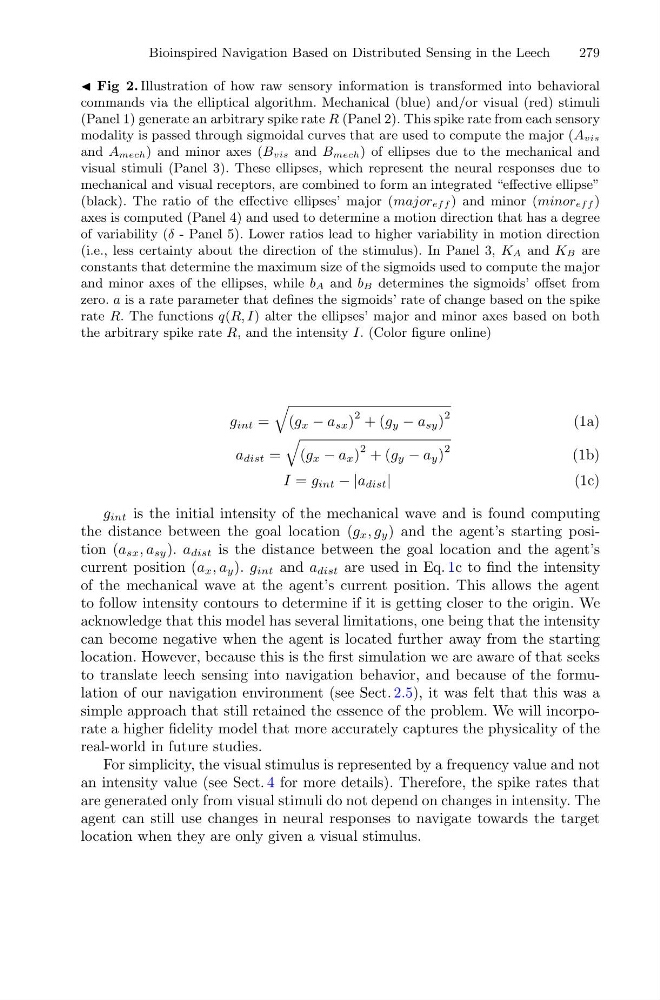
Fig 2. Illustration of how raw sensory information is transformed into behavioral
commands via the elliptical algorithm. Mechanical (blue) and/or visual (red) stimuli
(Panel 1) generate an arbitrary spike rate R (Panel 2). This spike rate from each sensory
modality is passed through sigmoidal curves that are used to compute the major (Avis
and A mech ) and minor axes (Bvis and B mech ) of ellipses due to the mechanical and
visual stimuli (Panel 3). These ellipses, which represent the neural responses due to
mechanical and visual receptors, are combined to form an integrated “effective ellipse”
(black). The ratio of the effective ellipses’ major (major ef f ) and minor (minor ef f )
axes is computed (Panel 4) and used to determine a motion direction that has a degree
of variability (δ - Panel 5). Lower ratios lead to higher variability in motion direction
(i.e., less certainty about the direction of the stimulus). In Panel 3, KA and KB are
constants that determine the maximum size of the sigmoids used to compute the major
and minor axes of the ellipses, while bA and bB determines the sigmoids’ offset from
zero. a is a rate parameter that defines the sigmoids’ rate of change based on the spike
rate R. The functions q(R, I) alter the ellipses’ major and minor axes based on both
the arbitrary spike rate R, and the intensity I. (Color figure online)
g int =
(g x − a sx )
2 + (g y − a sy )
2
(1a)
a dist =
(g x − a x )
2 + (g y − a y )
2
(1b)
I = g int − |a dist |
(1c)
g int is the initial intensity of the mechanical wave and is found computing
the distance between the goal location (g x , g y ) and the agent’s starting position (a sx , a sy ). a dist is the distance between the goal location and the agent’s
current position (a x , a y ). g int and a dist are used in Eq. 1c to find the intensity
of the mechanical wave at the agent’s current position. This allows the agent
to follow intensity contours to determine if it is getting closer to the origin. We
acknowledge that this model has several limitations, one being that the intensity
can become negative when the agent is located further away from the starting
location. However, because this is the first simulation we are aware of that seeks
to translate leech sensing into navigation behavior, and because of the formulation of our navigation environment (see Sect. 2.5), it was felt that this was a
simple approach that still retained the essence of the problem. We will incorporate a higher fidelity model that more accurately captures the physicality of the
real-world in future studies.
For simplicity, the visual stimulus is represented by a frequency value and not
an intensity value (see Sect. 4 for more details). Therefore, the spike rates that
are generated only from visual stimuli do not depend on changes in intensity. The
agent can still use changes in neural responses to navigate towards the target
location when they are only given a visual stimulus.
279
Fig 2. Illustration of how raw sensory information is transformed into behavioral
commands via the elliptical algorithm. Mechanical (blue) and/or visual (red) stimuli
(Panel 1) generate an arbitrary spike rate R (Panel 2). This spike rate from each sensory
modality is passed through sigmoidal curves that are used to compute the major (Avis
and A mech ) and minor axes (Bvis and B mech ) of ellipses due to the mechanical and
visual stimuli (Panel 3). These ellipses, which represent the neural responses due to
mechanical and visual receptors, are combined to form an integrated “effective ellipse”
(black). The ratio of the effective ellipses’ major (major ef f ) and minor (minor ef f )
axes is computed (Panel 4) and used to determine a motion direction that has a degree
of variability (δ - Panel 5). Lower ratios lead to higher variability in motion direction
(i.e., less certainty about the direction of the stimulus). In Panel 3, KA and KB are
constants that determine the maximum size of the sigmoids used to compute the major
and minor axes of the ellipses, while bA and bB determines the sigmoids’ offset from
zero. a is a rate parameter that defines the sigmoids’ rate of change based on the spike
rate R. The functions q(R, I) alter the ellipses’ major and minor axes based on both
the arbitrary spike rate R, and the intensity I. (Color figure online)
g int =
(g x − a sx )
2 + (g y − a sy )
2
(1a)
a dist =
(g x − a x )
2 + (g y − a y )
2
(1b)
I = g int − |a dist |
(1c)
g int is the initial intensity of the mechanical wave and is found computing
the distance between the goal location (g x , g y ) and the agent’s starting position (a sx , a sy ). a dist is the distance between the goal location and the agent’s
current position (a x , a y ). g int and a dist are used in Eq. 1c to find the intensity
of the mechanical wave at the agent’s current position. This allows the agent
to follow intensity contours to determine if it is getting closer to the origin. We
acknowledge that this model has several limitations, one being that the intensity
can become negative when the agent is located further away from the starting
location. However, because this is the first simulation we are aware of that seeks
to translate leech sensing into navigation behavior, and because of the formulation of our navigation environment (see Sect. 2.5), it was felt that this was a
simple approach that still retained the essence of the problem. We will incorporate a higher fidelity model that more accurately captures the physicality of the
real-world in future studies.
For simplicity, the visual stimulus is represented by a frequency value and not
an intensity value (see Sect. 4 for more details). Therefore, the spike rates that
are generated only from visual stimuli do not depend on changes in intensity. The
agent can still use changes in neural responses to navigate towards the target
location when they are only given a visual stimulus.