

Robofish as Social Partner
273
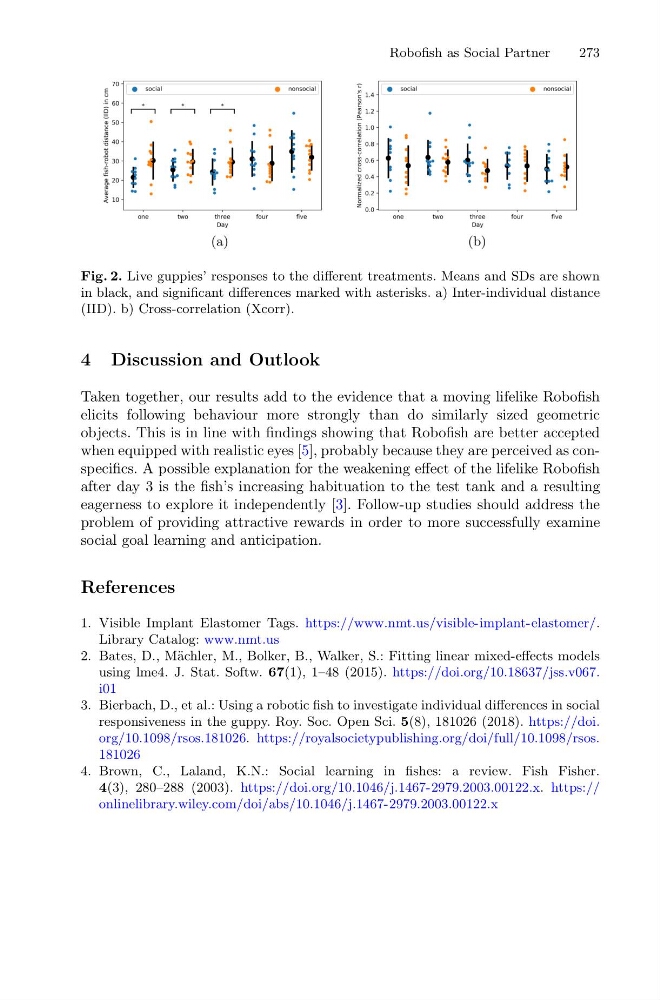
Fig. 2. Live guppies’ responses to the different treatments. Means and SDs are shown
in black, and significant differences marked with asterisks. a) Inter-individual distance
(IID). b) Cross-correlation (Xcorr).
4 Discussion and Outlook
Taken together, our results add to the evidence that a moving lifelike Robofish
elicits following behaviour more strongly than do similarly sized geometric
objects. This is in line with findings showing that Robofish are better accepted
when equipped with realistic eyes [5], probably because they are perceived as conspecifics. A possible explanation for the weakening effect of the lifelike Robofish
after day 3 is the fish’s increasing habituation to the test tank and a resulting
eagerness to explore it independently [3]. Follow-up studies should address the
problem of providing attractive rewards in order to more successfully examine
social goal learning and anticipation.
References
1. Visible Implant Elastomer Tags. https://www.nmt.us/visible-implant-elastomer/.
Library Catalog: www.nmt.us
2. Bates, D., M¨ achler, M., Bolker, B., Walker, S.: Fitting linear mixed-effects models
using lme4. J. Stat. Softw. 67(1), 1–48 (2015). https://doi.org/10.18637/jss.v067.
i01
3. Bierbach, D., et al.: Using a robotic fish to investigate individual differences in social
responsiveness in the guppy. Roy. Soc. Open Sci. 5(8), 181026 (2018). https://doi.
org/10.1098/rsos.181026. https://royalsocietypublishing.org/doi/full/10.1098/rsos.
181026
4. Brown, C., Laland, K.N.: Social learning in fishes: a review. Fish Fisher.
4(3), 280–288 (2003). https://doi.org/10.1046/j.1467-2979.2003.00122.x. https://
onlinelibrary.wiley.com/doi/abs/10.1046/j.1467-2979.2003.00122.x
273
Fig. 2. Live guppies’ responses to the different treatments. Means and SDs are shown
in black, and significant differences marked with asterisks. a) Inter-individual distance
(IID). b) Cross-correlation (Xcorr).
4 Discussion and Outlook
Taken together, our results add to the evidence that a moving lifelike Robofish
elicits following behaviour more strongly than do similarly sized geometric
objects. This is in line with findings showing that Robofish are better accepted
when equipped with realistic eyes [5], probably because they are perceived as conspecifics. A possible explanation for the weakening effect of the lifelike Robofish
after day 3 is the fish’s increasing habituation to the test tank and a resulting
eagerness to explore it independently [3]. Follow-up studies should address the
problem of providing attractive rewards in order to more successfully examine
social goal learning and anticipation.
References
1. Visible Implant Elastomer Tags. https://www.nmt.us/visible-implant-elastomer/.
Library Catalog: www.nmt.us
2. Bates, D., M¨ achler, M., Bolker, B., Walker, S.: Fitting linear mixed-effects models
using lme4. J. Stat. Softw. 67(1), 1–48 (2015). https://doi.org/10.18637/jss.v067.
i01
3. Bierbach, D., et al.: Using a robotic fish to investigate individual differences in social
responsiveness in the guppy. Roy. Soc. Open Sci. 5(8), 181026 (2018). https://doi.
org/10.1098/rsos.181026. https://royalsocietypublishing.org/doi/full/10.1098/rsos.
181026
4. Brown, C., Laland, K.N.: Social learning in fishes: a review. Fish Fisher.
4(3), 280–288 (2003). https://doi.org/10.1046/j.1467-2979.2003.00122.x. https://
onlinelibrary.wiley.com/doi/abs/10.1046/j.1467-2979.2003.00122.x