

Robofish as Social Partner
271
(open-loop behaviour). In the current study, we outline how such a tool, the
so-called Robofish [3,5], can be used to study social skills in live Trinidadian
guppies (Poecilia reticulata), a small tropical freshwater fish. We compared live
fish’s responses towards a lifelike Robofish leading to a food source with those
towards a simple cuboid object moving in a similar way. Trials were repeated on
five consecutive days in order to enable social learning of the food source location. However, the fish did not eat the food reward and did not seem attracted
to it, making this experiment unsuitable for addressing questions on goal-based
learning. Instead, we focused on examining how live fish interacted with the replicas until the replicas reached the goal location. If lifelike replicas are accepted
as social partners, we predicted that live fish should follow them more closely
and should show higher movement synchrony with them than when faced with
a cuboid replica.
2 Methods
2.1 Experimental Setup and Design
Our Robofish system essentially consists of a two-wheeled differential drive robot
moving on a platform below a shallow square glass tank and moving a 3D-printed
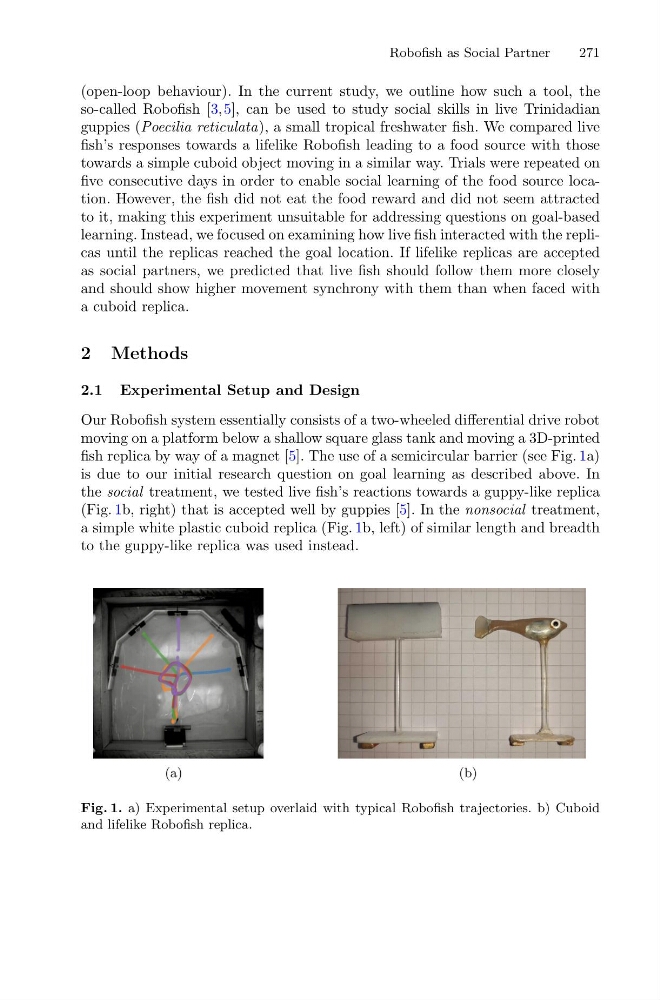
fish replica by way of a magnet [5]. The use of a semicircular barrier (see Fig. 1a)
is due to our initial research question on goal learning as described above. In
the social treatment, we tested live fish’s reactions towards a guppy-like replica
(Fig. 1b, right) that is accepted well by guppies [5]. In the nonsocial treatment,
a simple white plastic cuboid replica (Fig. 1b, left) of similar length and breadth
to the guppy-like replica was used instead.
Fig. 1. a) Experimental setup overlaid with typical Robofish trajectories. b) Cuboid
and lifelike Robofish replica.
271
(open-loop behaviour). In the current study, we outline how such a tool, the
so-called Robofish [3,5], can be used to study social skills in live Trinidadian
guppies (Poecilia reticulata), a small tropical freshwater fish. We compared live
fish’s responses towards a lifelike Robofish leading to a food source with those
towards a simple cuboid object moving in a similar way. Trials were repeated on
five consecutive days in order to enable social learning of the food source location. However, the fish did not eat the food reward and did not seem attracted
to it, making this experiment unsuitable for addressing questions on goal-based
learning. Instead, we focused on examining how live fish interacted with the replicas until the replicas reached the goal location. If lifelike replicas are accepted
as social partners, we predicted that live fish should follow them more closely
and should show higher movement synchrony with them than when faced with
a cuboid replica.
2 Methods
2.1 Experimental Setup and Design
Our Robofish system essentially consists of a two-wheeled differential drive robot
moving on a platform below a shallow square glass tank and moving a 3D-printed
fish replica by way of a magnet [5]. The use of a semicircular barrier (see Fig. 1a)
is due to our initial research question on goal learning as described above. In
the social treatment, we tested live fish’s reactions towards a guppy-like replica
(Fig. 1b, right) that is accepted well by guppies [5]. In the nonsocial treatment,
a simple white plastic cuboid replica (Fig. 1b, left) of similar length and breadth
to the guppy-like replica was used instead.
Fig. 1. a) Experimental setup overlaid with typical Robofish trajectories. b) Cuboid
and lifelike Robofish replica.