

A Framework for Resolving Motivational Conflict via Attractor Dynamics
201
The agent and its environment are shown in Fig. 6. Initially, the agent is
driven towards a region in which its body temperature is maintained in the
thermoneutral zone, which creates a conflict because the food is located in a
colder region. Two phenomena are observed. First, the agent hesitates to approach the food, and returns multiple times, illustrating a trade-off between the
cost of obtaining the food and the level of hunger; only when it is hungry enough
is the excursion for the food complete. Secondly, between 40 ms and 60 ms the
two minima of the motivational potential merge, and the agent is in an ambiguous motivational state (comparable with animal behaviour, see [1]).
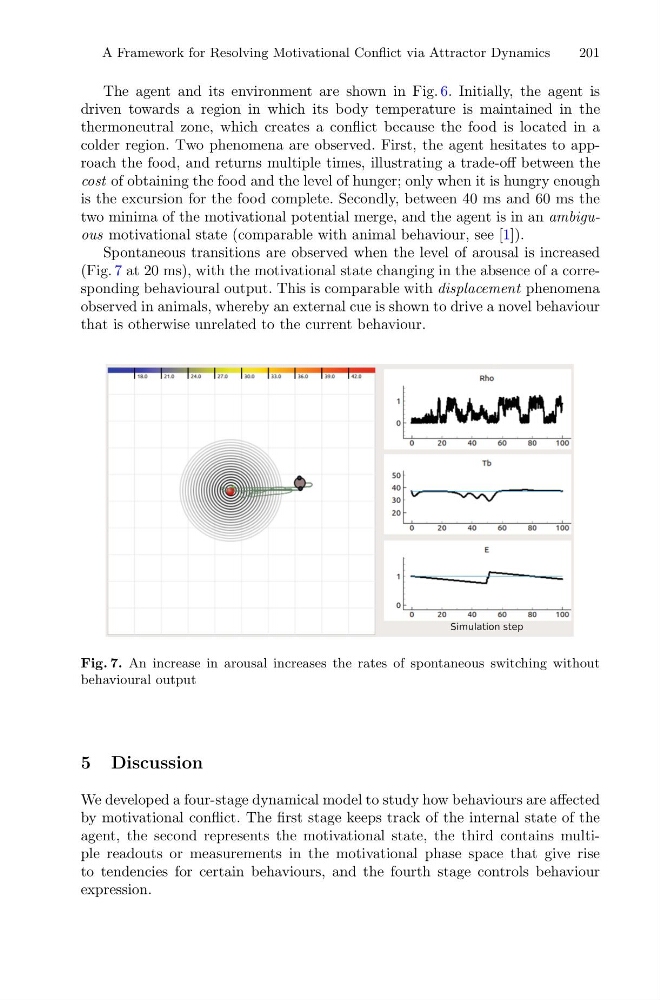
Spontaneous transitions are observed when the level of arousal is increased
(Fig. 7 at 20 ms), with the motivational state changing in the absence of a corresponding behavioural output. This is comparable with displacement phenomena
observed in animals, whereby an external cue is shown to drive a novel behaviour
that is otherwise unrelated to the current behaviour.
Fig. 7. An increase in arousal increases the rates of spontaneous switching without
behavioural output
5 Discussion
We developed a four-stage dynamical model to study how behaviours are affected
by motivational conflict. The first stage keeps track of the internal state of the
agent, the second represents the motivational state, the third contains multiple readouts or measurements in the motivational phase space that give rise
to tendencies for certain behaviours, and the fourth stage controls behaviour
expression.
201
The agent and its environment are shown in Fig. 6. Initially, the agent is
driven towards a region in which its body temperature is maintained in the
thermoneutral zone, which creates a conflict because the food is located in a
colder region. Two phenomena are observed. First, the agent hesitates to approach the food, and returns multiple times, illustrating a trade-off between the
cost of obtaining the food and the level of hunger; only when it is hungry enough
is the excursion for the food complete. Secondly, between 40 ms and 60 ms the
two minima of the motivational potential merge, and the agent is in an ambiguous motivational state (comparable with animal behaviour, see [1]).
Spontaneous transitions are observed when the level of arousal is increased
(Fig. 7 at 20 ms), with the motivational state changing in the absence of a corresponding behavioural output. This is comparable with displacement phenomena
observed in animals, whereby an external cue is shown to drive a novel behaviour
that is otherwise unrelated to the current behaviour.
Fig. 7. An increase in arousal increases the rates of spontaneous switching without
behavioural output
5 Discussion
We developed a four-stage dynamical model to study how behaviours are affected
by motivational conflict. The first stage keeps track of the internal state of the
agent, the second represents the motivational state, the third contains multiple readouts or measurements in the motivational phase space that give rise
to tendencies for certain behaviours, and the fourth stage controls behaviour
expression.