

144
C. Goldsmith et al.
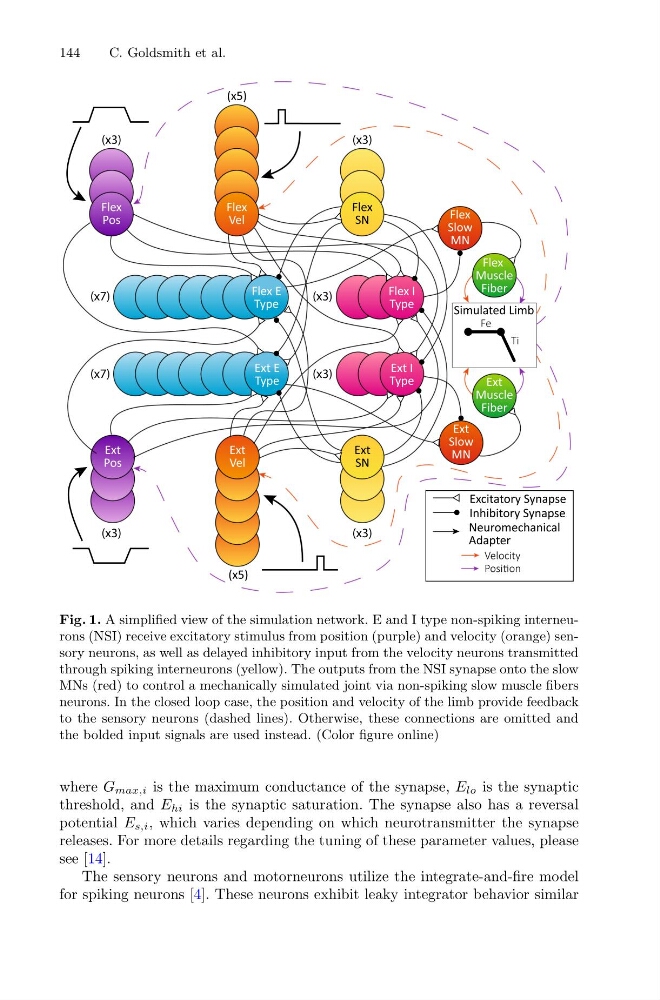
Fig. 1. A simplified view of the simulation network. E and I type non-spiking interneurons (NSI) receive excitatory stimulus from position (purple) and velocity (orange) sensory neurons, as well as delayed inhibitory input from the velocity neurons transmitted
through spiking interneurons (yellow). The outputs from the NSI synapse onto the slow
MNs (red) to control a mechanically simulated joint via non-spiking slow muscle fibers
neurons. In the closed loop case, the position and velocity of the limb provide feedback
to the sensory neurons (dashed lines). Otherwise, these connections are omitted and
the bolded input signals are used instead. (Color figure online)
where G max,i is the maximum conductance of the synapse, E lo is the synaptic
threshold, and E hi is the synaptic saturation. The synapse also has a reversal
potential E s,i , which varies depending on which neurotransmitter the synapse
releases. For more details regarding the tuning of these parameter values, please
see [14].
The sensory neurons and motorneurons utilize the integrate-and-fire model
for spiking neurons [4]. These neurons exhibit leaky integrator behavior similar
C. Goldsmith et al.
Fig. 1. A simplified view of the simulation network. E and I type non-spiking interneurons (NSI) receive excitatory stimulus from position (purple) and velocity (orange) sensory neurons, as well as delayed inhibitory input from the velocity neurons transmitted
through spiking interneurons (yellow). The outputs from the NSI synapse onto the slow
MNs (red) to control a mechanically simulated joint via non-spiking slow muscle fibers
neurons. In the closed loop case, the position and velocity of the limb provide feedback
to the sensory neurons (dashed lines). Otherwise, these connections are omitted and
the bolded input signals are used instead. (Color figure online)
where G max,i is the maximum conductance of the synapse, E lo is the synaptic
threshold, and E hi is the synaptic saturation. The synapse also has a reversal
potential E s,i , which varies depending on which neurotransmitter the synapse
releases. For more details regarding the tuning of these parameter values, please
see [14].
The sensory neurons and motorneurons utilize the integrate-and-fire model
for spiking neurons [4]. These neurons exhibit leaky integrator behavior similar