

118
I. T. Freire et al.
universal validity of a course of action can also lead to increased demands on
computational power [42].
It seems that any of the above reviewed strategies that try to implement
a normative moral system in an artificial agent will face not only the intrinsic
problems specific to that moral school, but also the intrinsic problems of the
top-down and bottom-up approaches to building artificial intelligence.
Given the current limitations of both theoretical and implementational
accounts, it seems that the old Aristotle’s ’golden mean’ is still valid, in a
sense that a successful artificial system would build upon the advantages of both
bottom-up and top-down realizations, as well as consequentialist and deontological perspectives. But if our goal is to achieve functional morality that allows
artificial agents to take moral decisions and interact with us in our daily lives,
we might also consider a more descriptive (epistemic) perspective that rather
deals with morality as a set of socio-cultural norms [2]. As we will see in the
next sections, this is consistent with data from cognitive neuroscience literature:
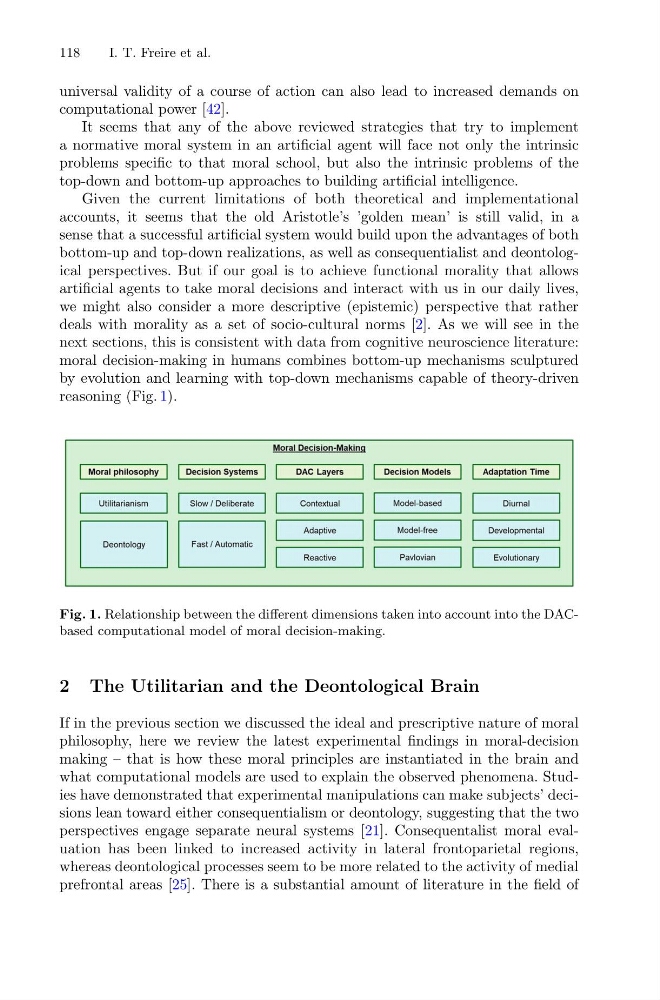
moral decision-making in humans combines bottom-up mechanisms sculptured
by evolution and learning with top-down mechanisms capable of theory-driven
reasoning (Fig. 1).
Fig. 1. Relationship between the different dimensions taken into account into the DACbased computational model of moral decision-making.
2 The Utilitarian and the Deontological Brain
If in the previous section we discussed the ideal and prescriptive nature of moral
philosophy, here we review the latest experimental findings in moral-decision
making – that is how these moral principles are instantiated in the brain and
what computational models are used to explain the observed phenomena. Studies have demonstrated that experimental manipulations can make subjects’ decisions lean toward either consequentialism or deontology, suggesting that the two
perspectives engage separate neural systems [21]. Consequentalist moral evaluation has been linked to increased activity in lateral frontoparietal regions,
whereas deontological processes seem to be more related to the activity of medial
prefrontal areas [25]. There is a substantial amount of literature in the field of
I. T. Freire et al.
universal validity of a course of action can also lead to increased demands on
computational power [42].
It seems that any of the above reviewed strategies that try to implement
a normative moral system in an artificial agent will face not only the intrinsic
problems specific to that moral school, but also the intrinsic problems of the
top-down and bottom-up approaches to building artificial intelligence.
Given the current limitations of both theoretical and implementational
accounts, it seems that the old Aristotle’s ’golden mean’ is still valid, in a
sense that a successful artificial system would build upon the advantages of both
bottom-up and top-down realizations, as well as consequentialist and deontological perspectives. But if our goal is to achieve functional morality that allows
artificial agents to take moral decisions and interact with us in our daily lives,
we might also consider a more descriptive (epistemic) perspective that rather
deals with morality as a set of socio-cultural norms [2]. As we will see in the
next sections, this is consistent with data from cognitive neuroscience literature:
moral decision-making in humans combines bottom-up mechanisms sculptured
by evolution and learning with top-down mechanisms capable of theory-driven
reasoning (Fig. 1).
Fig. 1. Relationship between the different dimensions taken into account into the DACbased computational model of moral decision-making.
2 The Utilitarian and the Deontological Brain
If in the previous section we discussed the ideal and prescriptive nature of moral
philosophy, here we review the latest experimental findings in moral-decision
making – that is how these moral principles are instantiated in the brain and
what computational models are used to explain the observed phenomena. Studies have demonstrated that experimental manipulations can make subjects’ decisions lean toward either consequentialism or deontology, suggesting that the two
perspectives engage separate neural systems [21]. Consequentalist moral evaluation has been linked to increased activity in lateral frontoparietal regions,
whereas deontological processes seem to be more related to the activity of medial
prefrontal areas [25]. There is a substantial amount of literature in the field of