

b
c
5’
3’
a
h
g
e
3’
f
3’
5’
d
Labeled RNA of interest
Light-up RNA
aptamer
5’
3’
RNA of interest
5’
3’
Fluorescent
complex
Labeled RNA of interest
5’
3’
5’
3’
Fluorogen
Destabilized
light-up RNA
aptamer
Light-up RNA
aptamer
5’
3’
Fluorogen
Destabilized
light-up RNA
aptamer
3’
5’
Sensing
aptamer
Target small
molecule
Fluorescent
complex
5’ 3’
Fluorogen
Fluorescent
complex
5’ 3’
Target protein
Destabilized
light-up RNA
aptamer
Sensing
aptamer
5’ 3’
RNA of interest
5’
3’
Fluorogen
Split light-up
RNA aptamer
5’
3’
5’
3’
Fluorescent
complex
Labeled RNA of interest
5’
5’
3’
5’
3’
Fluorescent
complex
5’
3’
H1
H2
5’
3’
H1
3’
5’
RNA of interest
5’
3’
3’
5’
RNA of interest
H1
5’ 3’
H2
Catalytic Hairpin Assembly
amplification
Fluorescent
complex
5’ 3’
5’
3’
RNA of interest
5’
3’
Fluorogen
5’
3’
Destabilized
light-up RNA
aptamer
RNA of interest
Target
binding
site
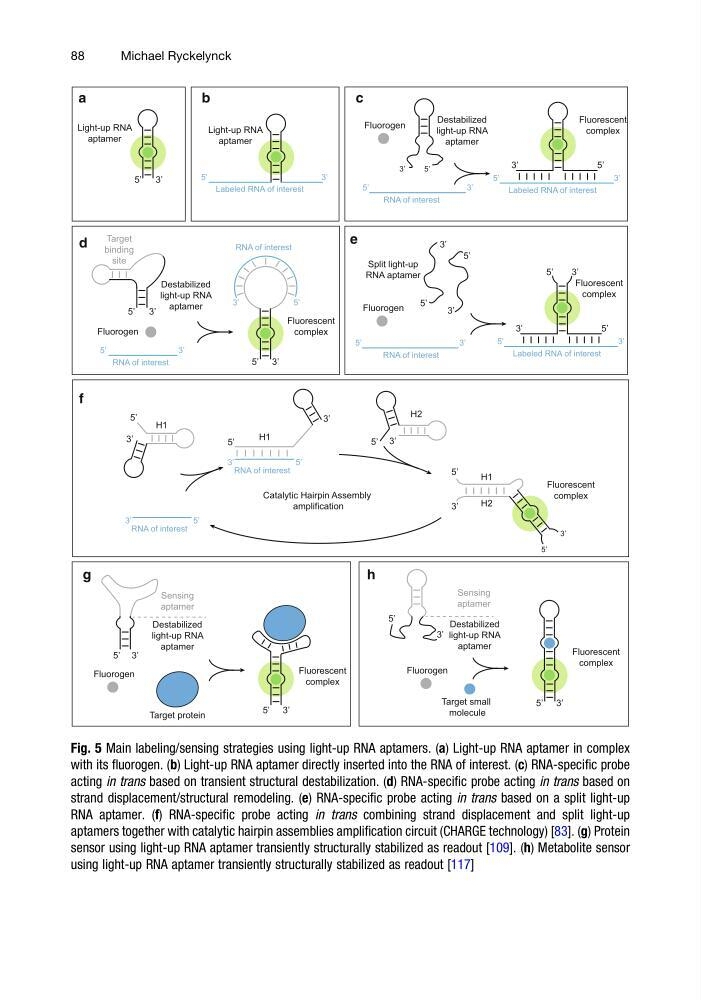
Fig. 5 Main labeling/sensing strategies using light-up RNA aptamers. (a) Light-up RNA aptamer in complex
with its fluorogen. (b) Light-up RNA aptamer directly inserted into the RNA of interest. (c) RNA-specific probe
acting in trans based on transient structural destabilization. (d) RNA-specific probe acting in trans based on
strand displacement/structural remodeling. (e) RNA-specific probe acting in trans based on a split light-up
RNA aptamer. (f) RNA-specific probe acting in trans combining strand displacement and split light-up
aptamers together with catalytic hairpin assemblies amplification circuit (CHARGE technology) [83]. (g) Protein
sensor using light-up RNA aptamer transiently structurally stabilized as readout [109]. (h) Metabolite sensor
using light-up RNA aptamer transiently structurally stabilized as readout [117]
88
Michael Ryckelynck
c
5’
3’
a
h
g
e
3’
f
3’
5’
d
Labeled RNA of interest
Light-up RNA
aptamer
5’
3’
RNA of interest
5’
3’
Fluorescent
complex
Labeled RNA of interest
5’
3’
5’
3’
Fluorogen
Destabilized
light-up RNA
aptamer
Light-up RNA
aptamer
5’
3’
Fluorogen
Destabilized
light-up RNA
aptamer
3’
5’
Sensing
aptamer
Target small
molecule
Fluorescent
complex
5’ 3’
Fluorogen
Fluorescent
complex
5’ 3’
Target protein
Destabilized
light-up RNA
aptamer
Sensing
aptamer
5’ 3’
RNA of interest
5’
3’
Fluorogen
Split light-up
RNA aptamer
5’
3’
5’
3’
Fluorescent
complex
Labeled RNA of interest
5’
5’
3’
5’
3’
Fluorescent
complex
5’
3’
H1
H2
5’
3’
H1
3’
5’
RNA of interest
5’
3’
3’
5’
RNA of interest
H1
5’ 3’
H2
Catalytic Hairpin Assembly
amplification
Fluorescent
complex
5’ 3’
5’
3’
RNA of interest
5’
3’
Fluorogen
5’
3’
Destabilized
light-up RNA
aptamer
RNA of interest
Target
binding
site
Fig. 5 Main labeling/sensing strategies using light-up RNA aptamers. (a) Light-up RNA aptamer in complex
with its fluorogen. (b) Light-up RNA aptamer directly inserted into the RNA of interest. (c) RNA-specific probe
acting in trans based on transient structural destabilization. (d) RNA-specific probe acting in trans based on
strand displacement/structural remodeling. (e) RNA-specific probe acting in trans based on a split light-up
RNA aptamer. (f) RNA-specific probe acting in trans combining strand displacement and split light-up
aptamers together with catalytic hairpin assemblies amplification circuit (CHARGE technology) [83]. (g) Protein
sensor using light-up RNA aptamer transiently structurally stabilized as readout [109]. (h) Metabolite sensor
using light-up RNA aptamer transiently structurally stabilized as readout [117]
88
Michael Ryckelynck