

2. Make aliquots of 20 μL of 1 M DTT solution and store at À20
or À40
C. Do not use DTT that is freeze-thawed more than
two times.
3. Acrylamide is highly toxic. Always wear protective gloves while
handling acrylamide. The acrylamide solution can be stored at
4
C for a month; however, it hydrolyzes to acrylic acid and
ammonia if kept for longer period of time.
4. Use freshly prepared APS for efficient polymerization. If APS
solution is old, the efficiency of polymerization will dramatically reduce. Store APS solution at 4
C.
5. Boronic acid substrate 4 can be purchased from a supplier, and
substrates 7, 9, and 10 can be prepared as has been reported
[29]. Avoid prolonged exposure to light, in particular fluorescent NBD boronic ester 9. Store the stock solutions in
aluminum-wrapped centrifuge tube or in amber-colored plastic/glass vials.
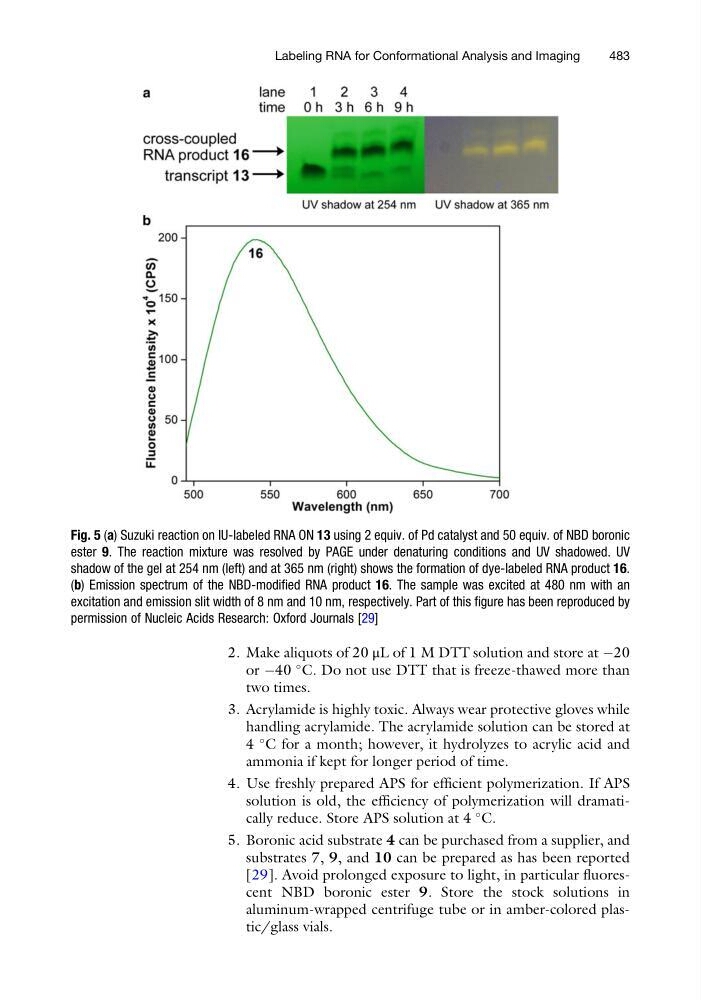
Fig. 5 (a) Suzuki reaction on IU-labeled RNA ON 13 using 2 equiv. of Pd catalyst and 50 equiv. of NBD boronic
ester 9. The reaction mixture was resolved by PAGE under denaturing conditions and UV shadowed. UV
shadow of the gel at 254 nm (left) and at 365 nm (right) shows the formation of dye-labeled RNA product 16.
(b) Emission spectrum of the NBD-modified RNA product 16. The sample was excited at 480 nm with an
excitation and emission slit width of 8 nm and 10 nm, respectively. Part of this figure has been reproduced by
permission of Nucleic Acids Research: Oxford Journals [29]
Labeling RNA for Conformational Analysis and Imaging
483
or À40
C. Do not use DTT that is freeze-thawed more than
two times.
3. Acrylamide is highly toxic. Always wear protective gloves while
handling acrylamide. The acrylamide solution can be stored at
4
C for a month; however, it hydrolyzes to acrylic acid and
ammonia if kept for longer period of time.
4. Use freshly prepared APS for efficient polymerization. If APS
solution is old, the efficiency of polymerization will dramatically reduce. Store APS solution at 4
C.
5. Boronic acid substrate 4 can be purchased from a supplier, and
substrates 7, 9, and 10 can be prepared as has been reported
[29]. Avoid prolonged exposure to light, in particular fluorescent NBD boronic ester 9. Store the stock solutions in
aluminum-wrapped centrifuge tube or in amber-colored plastic/glass vials.
Fig. 5 (a) Suzuki reaction on IU-labeled RNA ON 13 using 2 equiv. of Pd catalyst and 50 equiv. of NBD boronic
ester 9. The reaction mixture was resolved by PAGE under denaturing conditions and UV shadowed. UV
shadow of the gel at 254 nm (left) and at 365 nm (right) shows the formation of dye-labeled RNA product 16.
(b) Emission spectrum of the NBD-modified RNA product 16. The sample was excited at 480 nm with an
excitation and emission slit width of 8 nm and 10 nm, respectively. Part of this figure has been reproduced by
permission of Nucleic Acids Research: Oxford Journals [29]
Labeling RNA for Conformational Analysis and Imaging
483