

of nascent RNA with IU/IUTP followed by Pd-mediated coupling
chemistry could be potentially used to image as well as profile
cellular RNA. This notion is supported by the recent development
of a Pd nanoparticle-based catalytic system, which enables the
Suzuki reaction in the cellular environment [30].
Here, we describe a detailed stepwise protocol to incorporate
5-iodouridine-5
0 -triphosphate into RNA transcripts during in vitro
transcription using T7 RNA polymerase. Following this section,
the preparation of water-soluble Pd-ligand catalysts, the setting up
of posttranscriptional Suzuki reactions and the purification of coupled RNA products are illustrated in detail. Although we have
performed coupling reactions with several substrates, emphasis is
laid on preparing RNA labeled with fluorogenic environmentsensitive nucleoside probes (4 and 7), a fluorescent probe (9)
suitable for imaging, and an affinity tag (10) suitable for pulldown and immunoassays (Fig. 2).
2 Materials
Prepare all reagents, substrates, and buffer stocks in autoclaved
water unless indicated otherwise. Store enzymes, DNA ONs,
NTPs, and reagents in a deep freezer (À20 or À40
C).
2.1 In Vitro
Transcription
1. 5Â Transcription buffer: 200 mM Tris–HCl (pH 7.9), 30 mM
MgCl 2 , 50 mM DTT, 50 mM NaCl, and 10 mM spermidine.
This buffer is usually supplied along with T7 RNA polymerase.
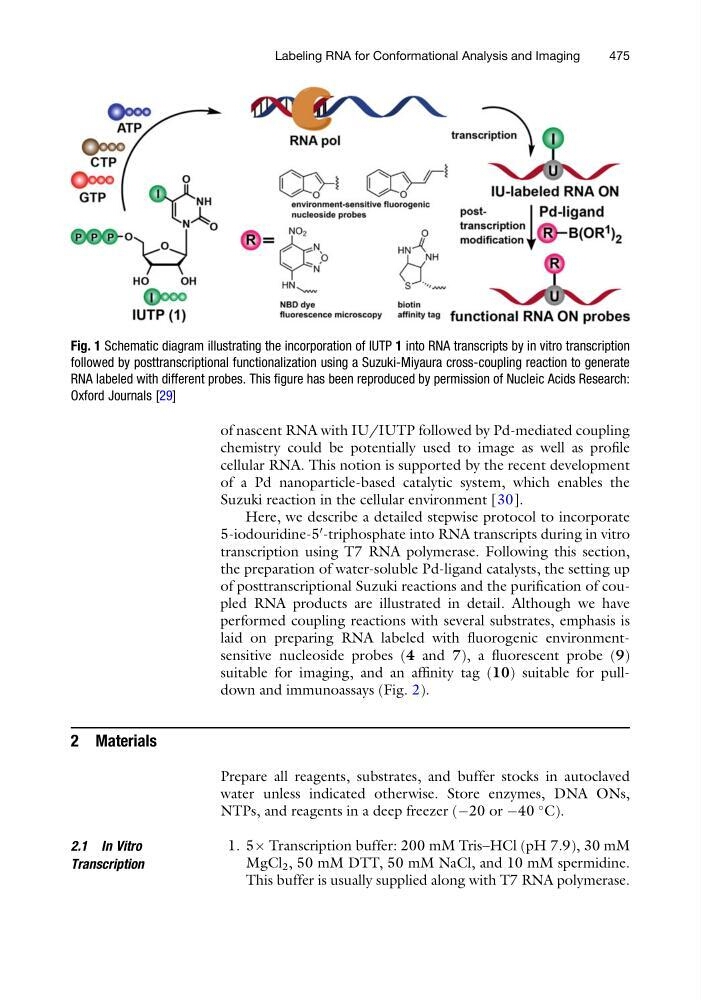
Fig. 1 Schematic diagram illustrating the incorporation of IUTP 1 into RNA transcripts by in vitro transcription
followed by posttranscriptional functionalization using a Suzuki-Miyaura cross-coupling reaction to generate
RNA labeled with different probes. This figure has been reproduced by permission of Nucleic Acids Research:
Oxford Journals [29]
Labeling RNA for Conformational Analysis and Imaging
475
chemistry could be potentially used to image as well as profile
cellular RNA. This notion is supported by the recent development
of a Pd nanoparticle-based catalytic system, which enables the
Suzuki reaction in the cellular environment [30].
Here, we describe a detailed stepwise protocol to incorporate
5-iodouridine-5
0 -triphosphate into RNA transcripts during in vitro
transcription using T7 RNA polymerase. Following this section,
the preparation of water-soluble Pd-ligand catalysts, the setting up
of posttranscriptional Suzuki reactions and the purification of coupled RNA products are illustrated in detail. Although we have
performed coupling reactions with several substrates, emphasis is
laid on preparing RNA labeled with fluorogenic environmentsensitive nucleoside probes (4 and 7), a fluorescent probe (9)
suitable for imaging, and an affinity tag (10) suitable for pulldown and immunoassays (Fig. 2).
2 Materials
Prepare all reagents, substrates, and buffer stocks in autoclaved
water unless indicated otherwise. Store enzymes, DNA ONs,
NTPs, and reagents in a deep freezer (À20 or À40
C).
2.1 In Vitro
Transcription
1. 5Â Transcription buffer: 200 mM Tris–HCl (pH 7.9), 30 mM
MgCl 2 , 50 mM DTT, 50 mM NaCl, and 10 mM spermidine.
This buffer is usually supplied along with T7 RNA polymerase.
Fig. 1 Schematic diagram illustrating the incorporation of IUTP 1 into RNA transcripts by in vitro transcription
followed by posttranscriptional functionalization using a Suzuki-Miyaura cross-coupling reaction to generate
RNA labeled with different probes. This figure has been reproduced by permission of Nucleic Acids Research:
Oxford Journals [29]
Labeling RNA for Conformational Analysis and Imaging
475