

4. Assess the quality of the libraries using Agilent 2100 Bioanalyzer with DNA 1000 Assay reagent kits (see Note 14). This step
takes about 1 h.
5. Quantify the libraries according to the Kapa Library Quantification Kit (Complete kit, Kapa Biosystems). Normalize each
library to 10 nM and pool libraries using equal volumes of each
library. Alternatively, quantify by qPCR using DNA standards
and primers for IlluminaP5 “AATGATACGGCGACCACCGA” and IlluminaP7 “CAAGCAGAAGACGGCATACGA”. This step takes approximately 3 h.
6. Sequence the libraries on an Illumina NextSeq500 or a
HiSeq3000/4000 sequencing platform (see a comparison of
different Illumina sequencing systems at https://www.
illumina.com/systems/sequencing-platforms.html). The run
time ranges from 12 h to 3.5 days and depends on the sequencing system, the read length, and the choice of single versus
paired-end sequencing (see Note 15).
3.6 Data Analysis
In this section, we present a pipeline for computational analysis of
RNA-seq data consisting of a quality check followed by read alignment, transcript assembling, and quantification and evaluation of
coding potential for new transcripts. In this analysis we use the
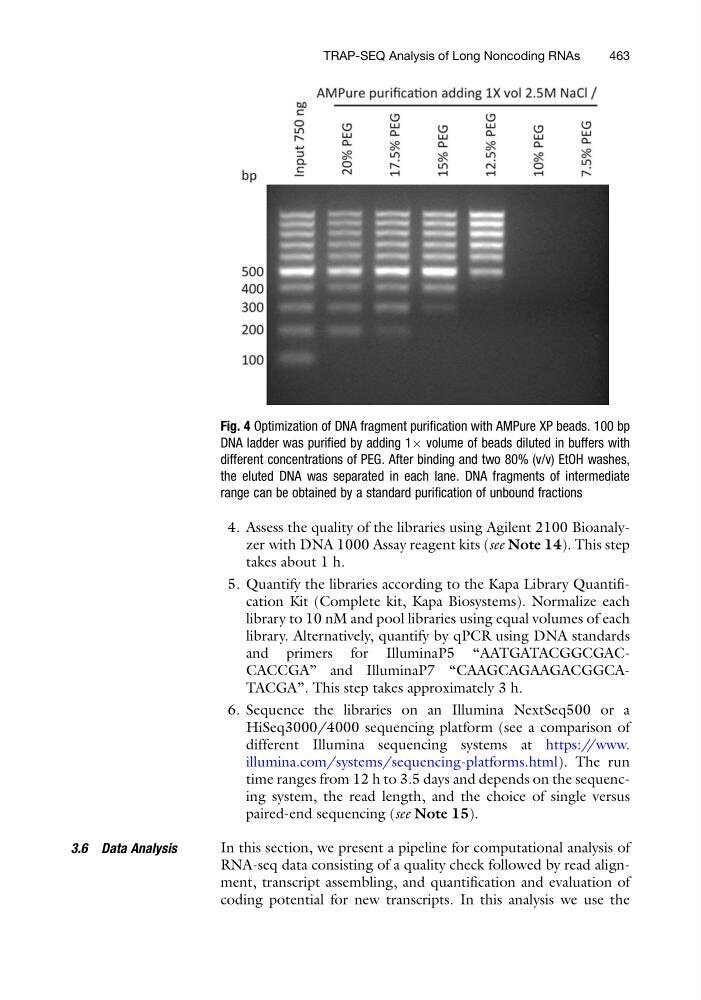
Fig. 4 Optimization of DNA fragment purification with AMPure XP beads. 100 bp
DNA ladder was purified by adding 1Â volume of beads diluted in buffers with
different concentrations of PEG. After binding and two 80% (v/v) EtOH washes,
the eluted DNA was separated in each lane. DNA fragments of intermediate
range can be obtained by a standard purification of unbound fractions
TRAP-SEQ Analysis of Long Noncoding RNAs
463
takes about 1 h.
5. Quantify the libraries according to the Kapa Library Quantification Kit (Complete kit, Kapa Biosystems). Normalize each
library to 10 nM and pool libraries using equal volumes of each
library. Alternatively, quantify by qPCR using DNA standards
and primers for IlluminaP5 “AATGATACGGCGACCACCGA” and IlluminaP7 “CAAGCAGAAGACGGCATACGA”. This step takes approximately 3 h.
6. Sequence the libraries on an Illumina NextSeq500 or a
HiSeq3000/4000 sequencing platform (see a comparison of
different Illumina sequencing systems at https://www.
illumina.com/systems/sequencing-platforms.html). The run
time ranges from 12 h to 3.5 days and depends on the sequencing system, the read length, and the choice of single versus
paired-end sequencing (see Note 15).
3.6 Data Analysis
In this section, we present a pipeline for computational analysis of
RNA-seq data consisting of a quality check followed by read alignment, transcript assembling, and quantification and evaluation of
coding potential for new transcripts. In this analysis we use the
Fig. 4 Optimization of DNA fragment purification with AMPure XP beads. 100 bp
DNA ladder was purified by adding 1Â volume of beads diluted in buffers with
different concentrations of PEG. After binding and two 80% (v/v) EtOH washes,
the eluted DNA was separated in each lane. DNA fragments of intermediate
range can be obtained by a standard purification of unbound fractions
TRAP-SEQ Analysis of Long Noncoding RNAs
463