

analyzed by any method used to study RNA expression, including
quantitative PCR (qPCR), microarray, or RNA sequencing. The
TRAP methodology has been successfully applied to study the
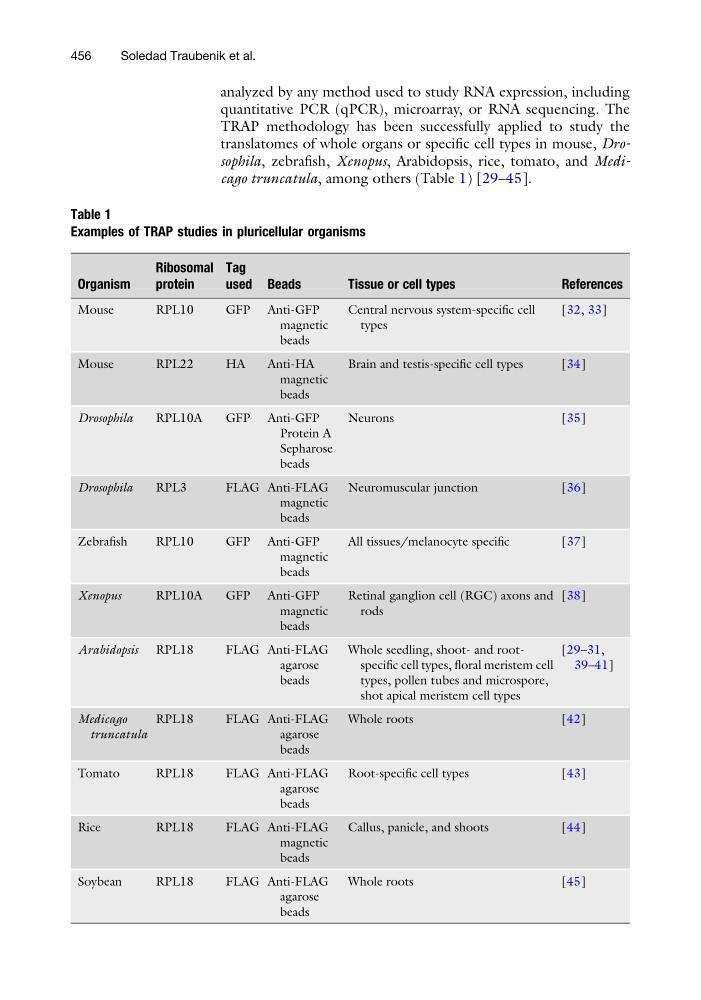
translatomes of whole organs or specific cell types in mouse, Drosophila, zebrafish, Xenopus, Arabidopsis, rice, tomato, and Medicago truncatula, among others (Table 1) [29–45].
Table 1
Examples of TRAP studies in pluricellular organisms
Organism
Ribosomal
protein
Tag
used Beads
Tissue or cell types
References
Mouse
RPL10
GFP Anti-GFP
magnetic
beads
Central nervous system-specific cell
types
[32, 33]
Mouse
RPL22
HA
Anti-HA
magnetic
beads
Brain and testis-specific cell types
[34]
Drosophila
RPL10A
GFP Anti-GFP
Protein A
Sepharose
beads
Neurons
[35]
Drosophila
RPL3
FLAG Anti-FLAG
magnetic
beads
Neuromuscular junction
[36]
Zebrafish
RPL10
GFP Anti-GFP
magnetic
beads
All tissues/melanocyte specific
[37]
Xenopus
RPL10A
GFP Anti-GFP
magnetic
beads
Retinal ganglion cell (RGC) axons and
rods
[38]
Arabidopsis RPL18
FLAG Anti-FLAG
agarose
beads
Whole seedling, shoot- and rootspecific cell types, floral meristem cell
types, pollen tubes and microspore,
shot apical meristem cell types
[29–31,
39–41]
Medicago
truncatula
RPL18
FLAG Anti-FLAG
agarose
beads
Whole roots
[42]
Tomato
RPL18
FLAG Anti-FLAG
agarose
beads
Root-specific cell types
[43]
Rice
RPL18
FLAG Anti-FLAG
magnetic
beads
Callus, panicle, and shoots
[44]
Soybean
RPL18
FLAG Anti-FLAG
agarose
beads
Whole roots
[45]
456
Soledad Traubenik et al.
quantitative PCR (qPCR), microarray, or RNA sequencing. The
TRAP methodology has been successfully applied to study the
translatomes of whole organs or specific cell types in mouse, Drosophila, zebrafish, Xenopus, Arabidopsis, rice, tomato, and Medicago truncatula, among others (Table 1) [29–45].
Table 1
Examples of TRAP studies in pluricellular organisms
Organism
Ribosomal
protein
Tag
used Beads
Tissue or cell types
References
Mouse
RPL10
GFP Anti-GFP
magnetic
beads
Central nervous system-specific cell
types
[32, 33]
Mouse
RPL22
HA
Anti-HA
magnetic
beads
Brain and testis-specific cell types
[34]
Drosophila
RPL10A
GFP Anti-GFP
Protein A
Sepharose
beads
Neurons
[35]
Drosophila
RPL3
FLAG Anti-FLAG
magnetic
beads
Neuromuscular junction
[36]
Zebrafish
RPL10
GFP Anti-GFP
magnetic
beads
All tissues/melanocyte specific
[37]
Xenopus
RPL10A
GFP Anti-GFP
magnetic
beads
Retinal ganglion cell (RGC) axons and
rods
[38]
Arabidopsis RPL18
FLAG Anti-FLAG
agarose
beads
Whole seedling, shoot- and rootspecific cell types, floral meristem cell
types, pollen tubes and microspore,
shot apical meristem cell types
[29–31,
39–41]
Medicago
truncatula
RPL18
FLAG Anti-FLAG
agarose
beads
Whole roots
[42]
Tomato
RPL18
FLAG Anti-FLAG
agarose
beads
Root-specific cell types
[43]
Rice
RPL18
FLAG Anti-FLAG
magnetic
beads
Callus, panicle, and shoots
[44]
Soybean
RPL18
FLAG Anti-FLAG
agarose
beads
Whole roots
[45]
456
Soledad Traubenik et al.