

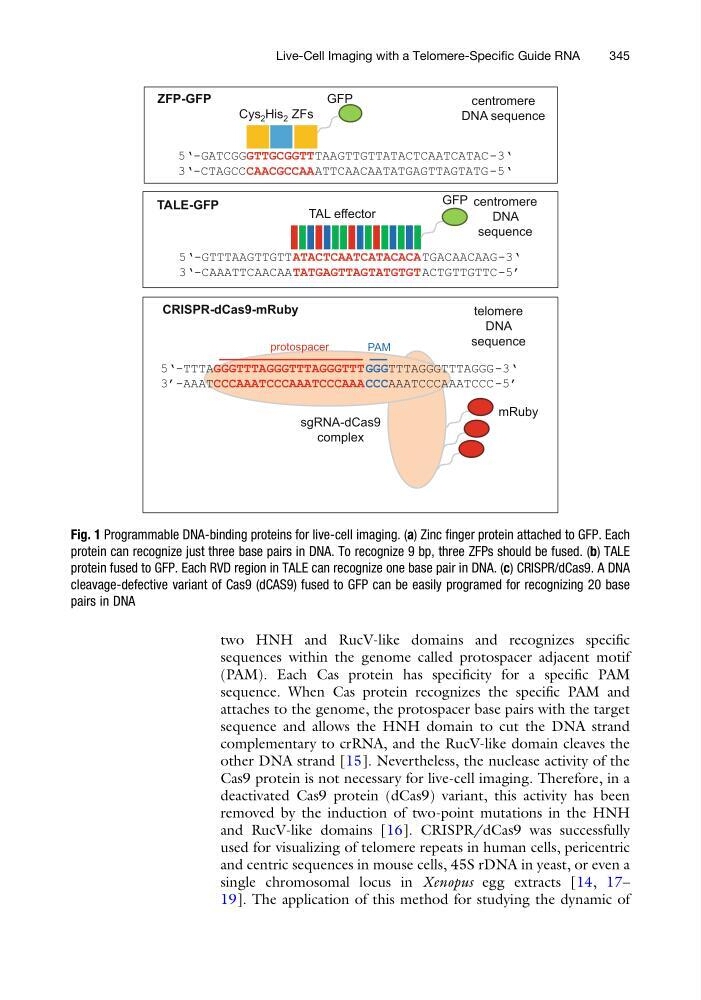
two HNH and RucV-like domains and recognizes specific
sequences within the genome called protospacer adjacent motif
(PAM). Each Cas protein has specificity for a specific PAM
sequence. When Cas protein recognizes the specific PAM and
attaches to the genome, the protospacer base pairs with the target
sequence and allows the HNH domain to cut the DNA strand
complementary to crRNA, and the RucV-like domain cleaves the
other DNA strand [15]. Nevertheless, the nuclease activity of the
Cas9 protein is not necessary for live-cell imaging. Therefore, in a
deactivated Cas9 protein (dCas9) variant, this activity has been
removed by the induction of two-point mutations in the HNH
and RucV-like domains [16]. CRISPR/dCas9 was successfully
used for visualizing of telomere repeats in human cells, pericentric
and centric sequences in mouse cells, 45S rDNA in yeast, or even a
single chromosomal locus in Xenopus egg extracts [14, 17–
19]. The application of this method for studying the dynamic of
ZFP-GFP
Cys 2 His 2 ZFs
GFP
5‘-GATCGGGTTGCGGTTTAAGTTGTTATACTCAATCATAC-3‘
3‘-CTAGCCCAACGCCAAATTCAACAATATGAGTTAGTATG-5‘
centromere
DNA sequence
centromere
DNA
sequence
telomere
DNA
sequence
5‘-GTTTAAGTTGTTATACTCAATCATACACATGACAACAAG-3‘
3‘-CAAATTCAACAATATGAGTTAGTATGTGTACTGTTGTTC-5’
TALE-GFP
TAL effector
GFP
5‘-TTTAGGGTTTAGGGTTTAGGGTTTGGGTTTAGGGTTTAGGG-3‘
3’-AAATCCCAAATCCCAAATCCCAAACCCAAATCCCAAATCCC-5’
CRISPR-dCas9-mRuby
protospacer
PAM
mRuby
sgRNA-dCas9
complex
Fig. 1 Programmable DNA-binding proteins for live-cell imaging. (a) Zinc finger protein attached to GFP. Each
protein can recognize just three base pairs in DNA. To recognize 9 bp, three ZFPs should be fused. (b) TALE
protein fused to GFP. Each RVD region in TALE can recognize one base pair in DNA. (c) CRISPR/dCas9. A DNA
cleavage-defective variant of Cas9 (dCAS9) fused to GFP can be easily programed for recognizing 20 base
pairs in DNA
Live-Cell Imaging with a Telomere-Specific Guide RNA
345
sequences within the genome called protospacer adjacent motif
(PAM). Each Cas protein has specificity for a specific PAM
sequence. When Cas protein recognizes the specific PAM and
attaches to the genome, the protospacer base pairs with the target
sequence and allows the HNH domain to cut the DNA strand
complementary to crRNA, and the RucV-like domain cleaves the
other DNA strand [15]. Nevertheless, the nuclease activity of the
Cas9 protein is not necessary for live-cell imaging. Therefore, in a
deactivated Cas9 protein (dCas9) variant, this activity has been
removed by the induction of two-point mutations in the HNH
and RucV-like domains [16]. CRISPR/dCas9 was successfully
used for visualizing of telomere repeats in human cells, pericentric
and centric sequences in mouse cells, 45S rDNA in yeast, or even a
single chromosomal locus in Xenopus egg extracts [14, 17–
19]. The application of this method for studying the dynamic of
ZFP-GFP
Cys 2 His 2 ZFs
GFP
5‘-GATCGGGTTGCGGTTTAAGTTGTTATACTCAATCATAC-3‘
3‘-CTAGCCCAACGCCAAATTCAACAATATGAGTTAGTATG-5‘
centromere
DNA sequence
centromere
DNA
sequence
telomere
DNA
sequence
5‘-GTTTAAGTTGTTATACTCAATCATACACATGACAACAAG-3‘
3‘-CAAATTCAACAATATGAGTTAGTATGTGTACTGTTGTTC-5’
TALE-GFP
TAL effector
GFP
5‘-TTTAGGGTTTAGGGTTTAGGGTTTGGGTTTAGGGTTTAGGG-3‘
3’-AAATCCCAAATCCCAAATCCCAAACCCAAATCCCAAATCCC-5’
CRISPR-dCas9-mRuby
protospacer
PAM
mRuby
sgRNA-dCas9
complex
Fig. 1 Programmable DNA-binding proteins for live-cell imaging. (a) Zinc finger protein attached to GFP. Each
protein can recognize just three base pairs in DNA. To recognize 9 bp, three ZFPs should be fused. (b) TALE
protein fused to GFP. Each RVD region in TALE can recognize one base pair in DNA. (c) CRISPR/dCas9. A DNA
cleavage-defective variant of Cas9 (dCAS9) fused to GFP can be easily programed for recognizing 20 base
pairs in DNA
Live-Cell Imaging with a Telomere-Specific Guide RNA
345