

Cas9 cleavage when located in the PAM-proximal region. In contrast, DNA bulges of 2 or more nt completely abolish Cas9 cleavage
independent of position, whereas larger RNA bulges at least outside the PAM-proximal region can be tolerated to a certain degree
[11]. Guide-internal base pairs interfere with DNA target binding,
as well. In plants, at least a certain degree of tolerance toward these
pairings can be detected [22].
1.5 Preservation
of gRNA Secondary
Structure Is Essential
for Proper Function
The structural characteristics of the gRNA are essential for interaction with the Cas protein. Structural analysis in human cell lines
regarding SpCas9 revealed that an intact repeat:anti-repeat duplex
and stem-loop 1 of the gRNA are of major relevance for Cas9
recognition, being less tolerant toward mismatches than stemloop 2 and 3 [28]. Interestingly, structure analysis of validated
gRNAs in plants revealed a minor relevance of stem-loop 1, indicating a disparity concerning the structural requirements in different
species [22]. Mismatches or substitutions maintaining the stemloop structures of the gRNA barely affect Cas9 function, rather
emphasizing the significance of the global structure of the gRNA
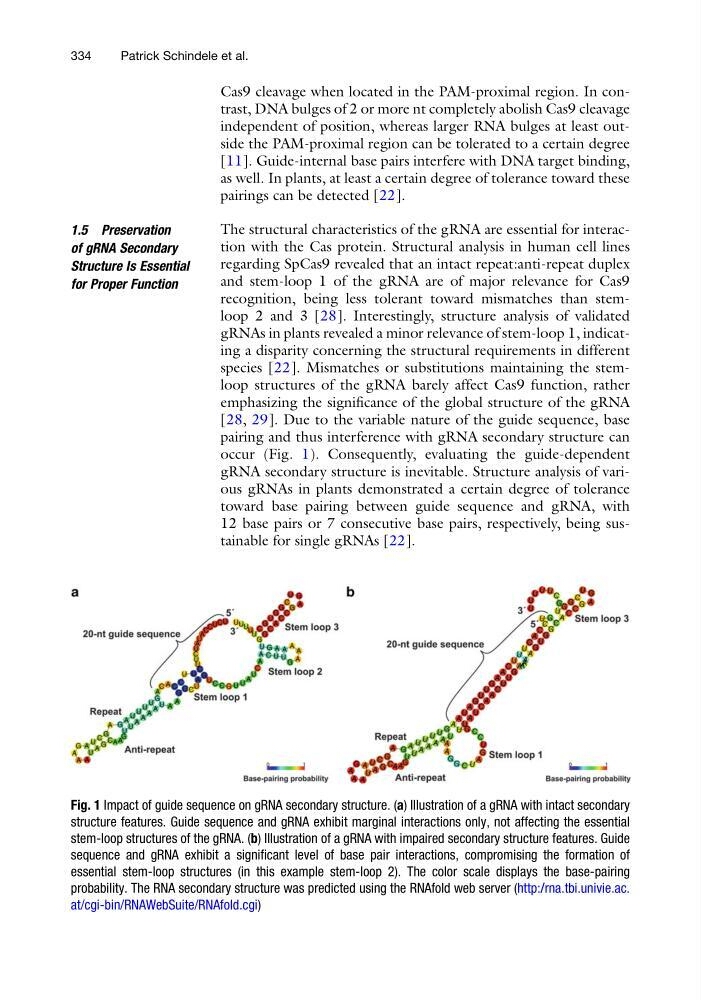
[28, 29]. Due to the variable nature of the guide sequence, base
pairing and thus interference with gRNA secondary structure can
occur (Fig. 1). Consequently, evaluating the guide-dependent
gRNA secondary structure is inevitable. Structure analysis of various gRNAs in plants demonstrated a certain degree of tolerance
toward base pairing between guide sequence and gRNA, with
12 base pairs or 7 consecutive base pairs, respectively, being sustainable for single gRNAs [22].
Fig. 1 Impact of guide sequence on gRNA secondary structure. (a) Illustration of a gRNA with intact secondary
structure features. Guide sequence and gRNA exhibit marginal interactions only, not affecting the essential
stem-loop structures of the gRNA. (b) Illustration of a gRNA with impaired secondary structure features. Guide
sequence and gRNA exhibit a significant level of base pair interactions, compromising the formation of
essential stem-loop structures (in this example stem-loop 2). The color scale displays the base-pairing
probability. The RNA secondary structure was predicted using the RNAfold web server (http:/ /rna.tbi.univie.ac.
at/cgi-bin/RNAWebSuite/RNAfold.cgi)
334
Patrick Schindele et al.
independent of position, whereas larger RNA bulges at least outside the PAM-proximal region can be tolerated to a certain degree
[11]. Guide-internal base pairs interfere with DNA target binding,
as well. In plants, at least a certain degree of tolerance toward these
pairings can be detected [22].
1.5 Preservation
of gRNA Secondary
Structure Is Essential
for Proper Function
The structural characteristics of the gRNA are essential for interaction with the Cas protein. Structural analysis in human cell lines
regarding SpCas9 revealed that an intact repeat:anti-repeat duplex
and stem-loop 1 of the gRNA are of major relevance for Cas9
recognition, being less tolerant toward mismatches than stemloop 2 and 3 [28]. Interestingly, structure analysis of validated
gRNAs in plants revealed a minor relevance of stem-loop 1, indicating a disparity concerning the structural requirements in different
species [22]. Mismatches or substitutions maintaining the stemloop structures of the gRNA barely affect Cas9 function, rather
emphasizing the significance of the global structure of the gRNA
[28, 29]. Due to the variable nature of the guide sequence, base
pairing and thus interference with gRNA secondary structure can
occur (Fig. 1). Consequently, evaluating the guide-dependent
gRNA secondary structure is inevitable. Structure analysis of various gRNAs in plants demonstrated a certain degree of tolerance
toward base pairing between guide sequence and gRNA, with
12 base pairs or 7 consecutive base pairs, respectively, being sustainable for single gRNAs [22].
Fig. 1 Impact of guide sequence on gRNA secondary structure. (a) Illustration of a gRNA with intact secondary
structure features. Guide sequence and gRNA exhibit marginal interactions only, not affecting the essential
stem-loop structures of the gRNA. (b) Illustration of a gRNA with impaired secondary structure features. Guide
sequence and gRNA exhibit a significant level of base pair interactions, compromising the formation of
essential stem-loop structures (in this example stem-loop 2). The color scale displays the base-pairing
probability. The RNA secondary structure was predicted using the RNAfold web server (http:/ /rna.tbi.univie.ac.
at/cgi-bin/RNAWebSuite/RNAfold.cgi)
334
Patrick Schindele et al.