

specific viral proteins or virus species. We have recently shown that
the dsRNA-binding domain of Flock House virus B2 protein can
be used to efficiently detect virus-derived dsRNA in extracts from
plant tissues infected with a variety of RNA viruses [7]. Furthermore, we showed that the same protein, when genetically fused
with GFP (B2:GFP) and ectopically expressed in N. benthamiana
plants, re-localizes to viral replication complexes upon infection by
a variety of RNA viruses [7]. Based on these findings, we developed
a protocol for the isolation of (i) viral replicating dsRNA and (ii) the
proteins associated to it, through the immunoprecipitation of B2:
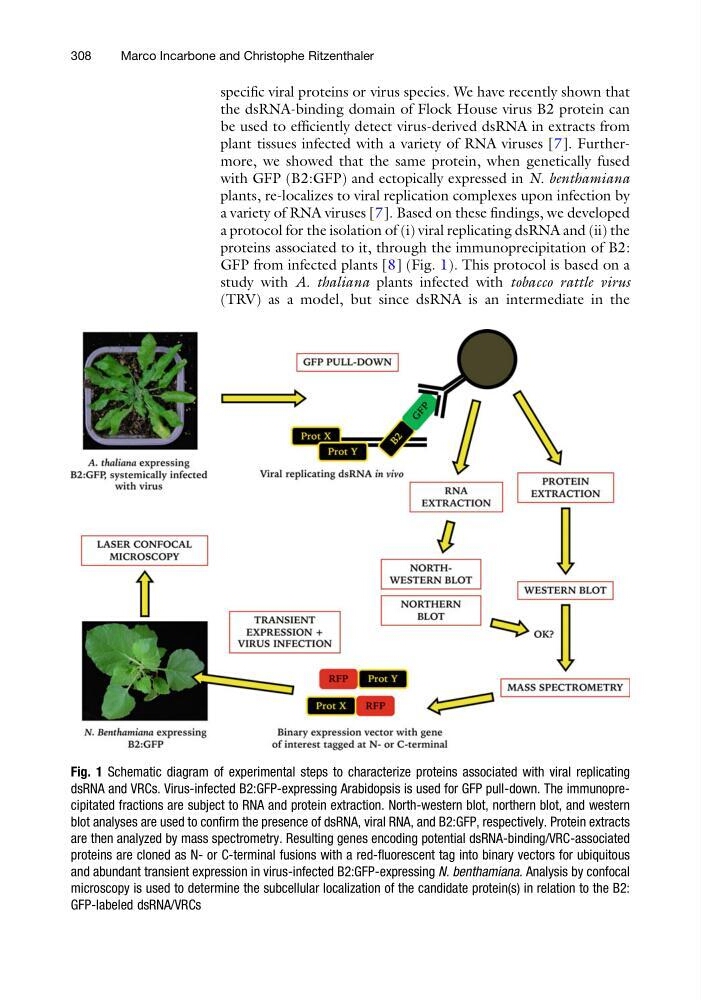
GFP from infected plants [8] (Fig. 1). This protocol is based on a
study with A. thaliana plants infected with tobacco rattle virus
(TRV) as a model, but since dsRNA is an intermediate in the
Fig. 1 Schematic diagram of experimental steps to characterize proteins associated with viral replicating
dsRNA and VRCs. Virus-infected B2:GFP-expressing Arabidopsis is used for GFP pull-down. The immunoprecipitated fractions are subject to RNA and protein extraction. North-western blot, northern blot, and western
blot analyses are used to confirm the presence of dsRNA, viral RNA, and B2:GFP, respectively. Protein extracts
are then analyzed by mass spectrometry. Resulting genes encoding potential dsRNA-binding/VRC-associated
proteins are cloned as N- or C-terminal fusions with a red-fluorescent tag into binary vectors for ubiquitous
and abundant transient expression in virus-infected B2:GFP-expressing N. benthamiana. Analysis by confocal
microscopy is used to determine the subcellular localization of the candidate protein(s) in relation to the B2:
GFP-labeled dsRNA/VRCs
308
Marco Incarbone and Christophe Ritzenthaler
the dsRNA-binding domain of Flock House virus B2 protein can
be used to efficiently detect virus-derived dsRNA in extracts from
plant tissues infected with a variety of RNA viruses [7]. Furthermore, we showed that the same protein, when genetically fused
with GFP (B2:GFP) and ectopically expressed in N. benthamiana
plants, re-localizes to viral replication complexes upon infection by
a variety of RNA viruses [7]. Based on these findings, we developed
a protocol for the isolation of (i) viral replicating dsRNA and (ii) the
proteins associated to it, through the immunoprecipitation of B2:
GFP from infected plants [8] (Fig. 1). This protocol is based on a
study with A. thaliana plants infected with tobacco rattle virus
(TRV) as a model, but since dsRNA is an intermediate in the
Fig. 1 Schematic diagram of experimental steps to characterize proteins associated with viral replicating
dsRNA and VRCs. Virus-infected B2:GFP-expressing Arabidopsis is used for GFP pull-down. The immunoprecipitated fractions are subject to RNA and protein extraction. North-western blot, northern blot, and western
blot analyses are used to confirm the presence of dsRNA, viral RNA, and B2:GFP, respectively. Protein extracts
are then analyzed by mass spectrometry. Resulting genes encoding potential dsRNA-binding/VRC-associated
proteins are cloned as N- or C-terminal fusions with a red-fluorescent tag into binary vectors for ubiquitous
and abundant transient expression in virus-infected B2:GFP-expressing N. benthamiana. Analysis by confocal
microscopy is used to determine the subcellular localization of the candidate protein(s) in relation to the B2:
GFP-labeled dsRNA/VRCs
308
Marco Incarbone and Christophe Ritzenthaler