

protocols. Recently, proximity-based approaches to study RNA
localization have emerged that however do not fully overcome
these or additional hurdles [5, 10–12].
We developed Proximity-CLIP [13, 14] that overcomes these
barriers and pinpoints RNA elements occupied by proteins at a
subcellular level. Our proof-of-concept experiments in HEK293
cells recapitulated many RNA biological phenomena that previously could only be detected using specialized approaches, and
allowed us to generate hypotheses about RNA biology at the cellcell interface [13, 15].
Proximity-CLIP relies on the well-supported assumption that
most cellular RNAs are protein bound throughout their life cycle,
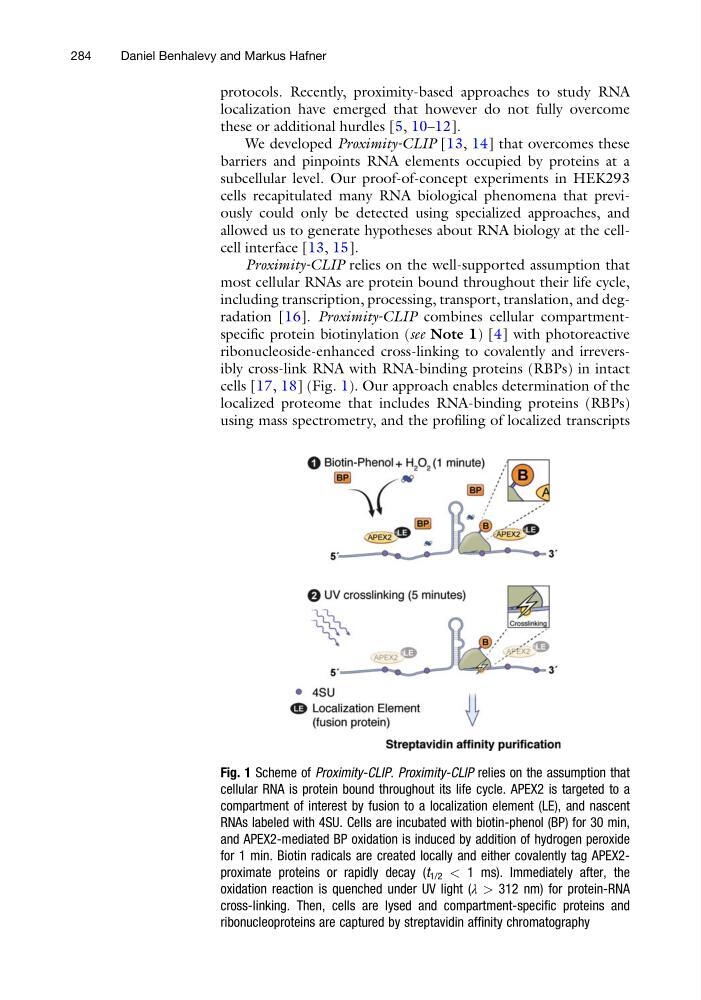
including transcription, processing, transport, translation, and degradation [16]. Proximity-CLIP combines cellular compartmentspecific protein biotinylation (see Note 1) [4] with photoreactive
ribonucleoside-enhanced cross-linking to covalently and irreversibly cross-link RNA with RNA-binding proteins (RBPs) in intact
cells [17, 18] (Fig. 1). Our approach enables determination of the
localized proteome that includes RNA-binding proteins (RBPs)
using mass spectrometry, and the profiling of localized transcripts
Fig. 1 Scheme of Proximity-CLIP. Proximity-CLIP relies on the assumption that
cellular RNA is protein bound throughout its life cycle. APEX2 is targeted to a
compartment of interest by fusion to a localization element (LE), and nascent
RNAs labeled with 4SU. Cells are incubated with biotin-phenol (BP) for 30 min,
and APEX2-mediated BP oxidation is induced by addition of hydrogen peroxide
for 1 min. Biotin radicals are created locally and either covalently tag APEX2proximate proteins or rapidly decay (t 1/2 < 1 ms). Immediately after, the
oxidation reaction is quenched under UV light (λ > 312 nm) for protein-RNA
cross-linking. Then, cells are lysed and compartment-specific proteins and
ribonucleoproteins are captured by streptavidin affinity chromatography
284
Daniel Benhalevy and Markus Hafner
localization have emerged that however do not fully overcome
these or additional hurdles [5, 10–12].
We developed Proximity-CLIP [13, 14] that overcomes these
barriers and pinpoints RNA elements occupied by proteins at a
subcellular level. Our proof-of-concept experiments in HEK293
cells recapitulated many RNA biological phenomena that previously could only be detected using specialized approaches, and
allowed us to generate hypotheses about RNA biology at the cellcell interface [13, 15].
Proximity-CLIP relies on the well-supported assumption that
most cellular RNAs are protein bound throughout their life cycle,
including transcription, processing, transport, translation, and degradation [16]. Proximity-CLIP combines cellular compartmentspecific protein biotinylation (see Note 1) [4] with photoreactive
ribonucleoside-enhanced cross-linking to covalently and irreversibly cross-link RNA with RNA-binding proteins (RBPs) in intact
cells [17, 18] (Fig. 1). Our approach enables determination of the
localized proteome that includes RNA-binding proteins (RBPs)
using mass spectrometry, and the profiling of localized transcripts
Fig. 1 Scheme of Proximity-CLIP. Proximity-CLIP relies on the assumption that
cellular RNA is protein bound throughout its life cycle. APEX2 is targeted to a
compartment of interest by fusion to a localization element (LE), and nascent
RNAs labeled with 4SU. Cells are incubated with biotin-phenol (BP) for 30 min,
and APEX2-mediated BP oxidation is induced by addition of hydrogen peroxide
for 1 min. Biotin radicals are created locally and either covalently tag APEX2proximate proteins or rapidly decay (t 1/2 < 1 ms). Immediately after, the
oxidation reaction is quenched under UV light (λ > 312 nm) for protein-RNA
cross-linking. Then, cells are lysed and compartment-specific proteins and
ribonucleoproteins are captured by streptavidin affinity chromatography
284
Daniel Benhalevy and Markus Hafner