

cross-linking through formaldehyde fixation has been mostly used
[8–11]. Of note, formaldehyde also cross-links proteins so that
transcripts may also coprecipitate due to binding to an interacting
protein. In contrast, UV cross-linking immunoprecipitation and
cross-linking (CLIP) use 254 nm UV light which only cross-links
nucleic acids and proteins.
UV light cross-linking has only recently been used in plants for
genome-wide determination of RBP targets [12, 13]. It was also
used in recent mRNA interactome capture experiments [14–
17]. For a detailed discussion of the use of UV light to cross-link
RNA and protein in Arabidopsis thaliana we refer to [18].
In CLIP techniques, during construction of libraries from
coprecipitated RNAs, RNA adapters are ligated at both the 5
0 and
3
0 ends before reverse transcription. Reverse transcriptase stalls at
the cross-linked nucleotide in >90% of the cases [18] and CLIP can
identify sequences only when reverse transcriptase is able to pass
through the cross-link site. This property has been explicitly used to
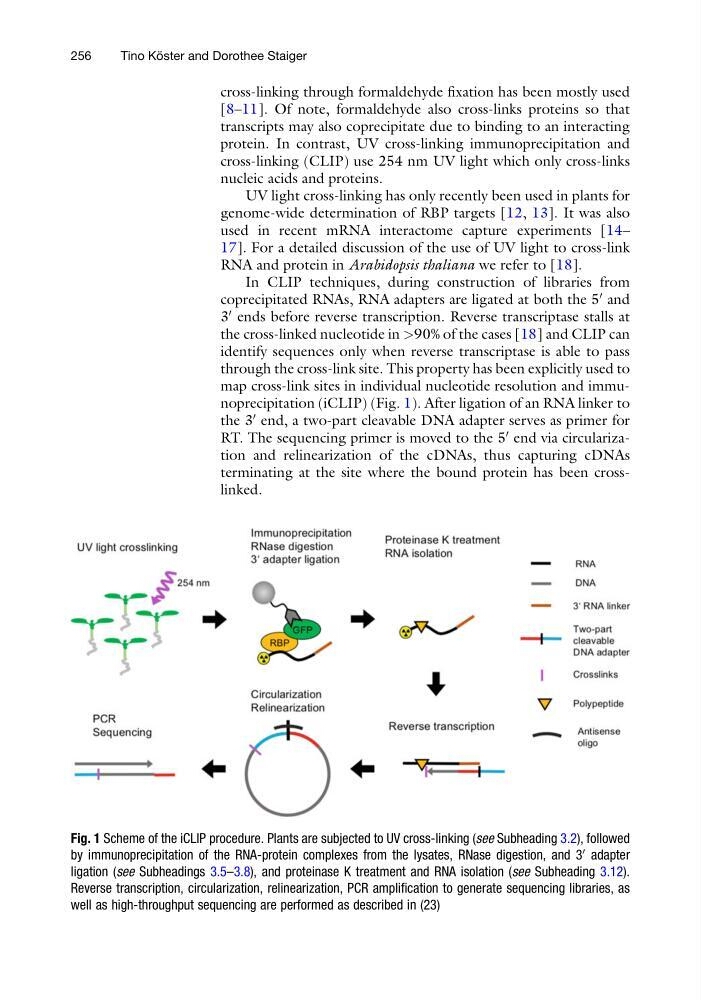
map cross-link sites in individual nucleotide resolution and immunoprecipitation (iCLIP) (Fig. 1). After ligation of an RNA linker to
the 3
0 end, a two-part cleavable DNA adapter serves as primer for
RT. The sequencing primer is moved to the 5
0 end via circularization and relinearization of the cDNAs, thus capturing cDNAs
terminating at the site where the bound protein has been crosslinked.
Fig. 1 Scheme of the iCLIP procedure. Plants are subjected to UV cross-linking (see Subheading 3.2), followed
by immunoprecipitation of the RNA-protein complexes from the lysates, RNase digestion, and 3
0 adapter
ligation (see Subheadings 3.5–3.8), and proteinase K treatment and RNA isolation (see Subheading 3.12).
Reverse transcription, circularization, relinearization, PCR amplification to generate sequencing libraries, as
well as high-throughput sequencing are performed as described in (23)
256
Tino Ko ¨ ster and Dorothee Staiger
[8–11]. Of note, formaldehyde also cross-links proteins so that
transcripts may also coprecipitate due to binding to an interacting
protein. In contrast, UV cross-linking immunoprecipitation and
cross-linking (CLIP) use 254 nm UV light which only cross-links
nucleic acids and proteins.
UV light cross-linking has only recently been used in plants for
genome-wide determination of RBP targets [12, 13]. It was also
used in recent mRNA interactome capture experiments [14–
17]. For a detailed discussion of the use of UV light to cross-link
RNA and protein in Arabidopsis thaliana we refer to [18].
In CLIP techniques, during construction of libraries from
coprecipitated RNAs, RNA adapters are ligated at both the 5
0 and
3
0 ends before reverse transcription. Reverse transcriptase stalls at
the cross-linked nucleotide in >90% of the cases [18] and CLIP can
identify sequences only when reverse transcriptase is able to pass
through the cross-link site. This property has been explicitly used to
map cross-link sites in individual nucleotide resolution and immunoprecipitation (iCLIP) (Fig. 1). After ligation of an RNA linker to
the 3
0 end, a two-part cleavable DNA adapter serves as primer for
RT. The sequencing primer is moved to the 5
0 end via circularization and relinearization of the cDNAs, thus capturing cDNAs
terminating at the site where the bound protein has been crosslinked.
Fig. 1 Scheme of the iCLIP procedure. Plants are subjected to UV cross-linking (see Subheading 3.2), followed
by immunoprecipitation of the RNA-protein complexes from the lysates, RNase digestion, and 3
0 adapter
ligation (see Subheadings 3.5–3.8), and proteinase K treatment and RNA isolation (see Subheading 3.12).
Reverse transcription, circularization, relinearization, PCR amplification to generate sequencing libraries, as
well as high-throughput sequencing are performed as described in (23)
256
Tino Ko ¨ ster and Dorothee Staiger