

3. Select target sequence: Choose a cDNA sequence (circa 400 nt
in length), which derives from a potential fungal target gene
sequence and is likely to generate a good number of silencingefficient siRNAs. To determine this last parameter, perform in
silico analysis using si-Fi v21 software (program designed for
RNAi off-target analysis and silencing efficiency predictions).
Paste the target sequence into the software and analyze it
against the DNA database of the pathogen tested. Use as
database the complete genome of the fungus or the DNA
sequence of the gene used to produce the approximately
400 nt long fragment sequence. The program will calculate
the possible number of efficient siRNAs hits (as a number)
based upon the contextual similarity between the two
sequences and the predicted thermodynamic stability analysis,
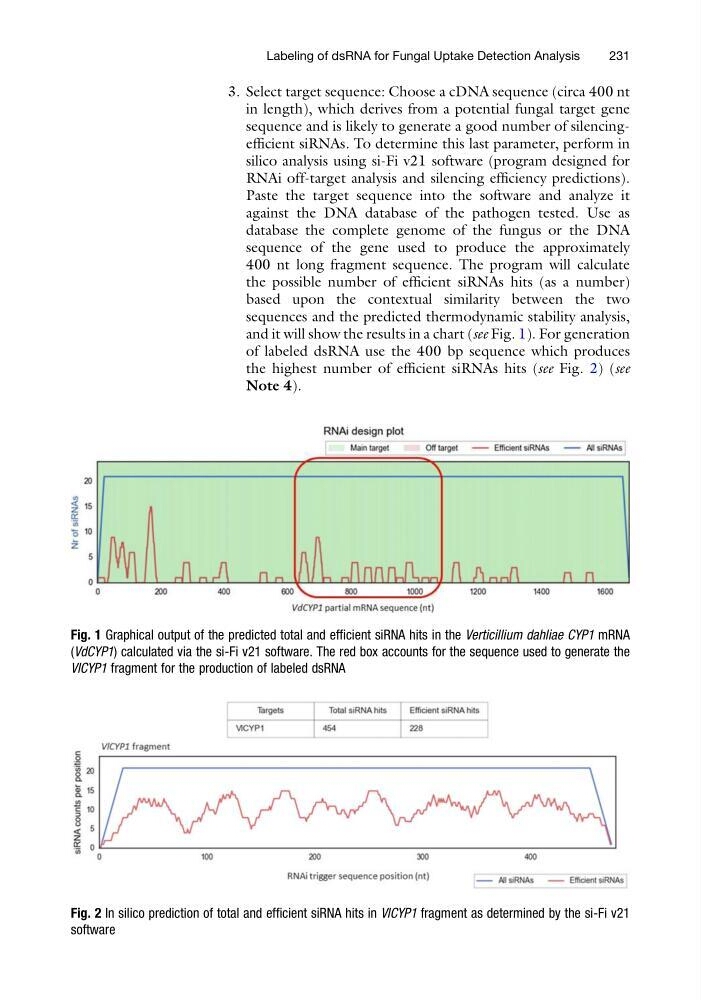
and it will show the results in a chart (see Fig. 1). For generation
of labeled dsRNA use the 400 bp sequence which produces
the highest number of efficient siRNAs hits (see Fig. 2) (see
Note 4).
Fig. 1 Graphical output of the predicted total and efficient siRNA hits in the Verticillium dahliae CYP1 mRNA
(VdCYP1) calculated via the si-Fi v21 software. The red box accounts for the sequence used to generate the
VlCYP1 fragment for the production of labeled dsRNA
Fig. 2 In silico prediction of total and efficient siRNA hits in VlCYP1 fragment as determined by the si-Fi v21
software
Labeling of dsRNA for Fungal Uptake Detection Analysis
231
in length), which derives from a potential fungal target gene
sequence and is likely to generate a good number of silencingefficient siRNAs. To determine this last parameter, perform in
silico analysis using si-Fi v21 software (program designed for
RNAi off-target analysis and silencing efficiency predictions).
Paste the target sequence into the software and analyze it
against the DNA database of the pathogen tested. Use as
database the complete genome of the fungus or the DNA
sequence of the gene used to produce the approximately
400 nt long fragment sequence. The program will calculate
the possible number of efficient siRNAs hits (as a number)
based upon the contextual similarity between the two
sequences and the predicted thermodynamic stability analysis,
and it will show the results in a chart (see Fig. 1). For generation
of labeled dsRNA use the 400 bp sequence which produces
the highest number of efficient siRNAs hits (see Fig. 2) (see
Note 4).
Fig. 1 Graphical output of the predicted total and efficient siRNA hits in the Verticillium dahliae CYP1 mRNA
(VdCYP1) calculated via the si-Fi v21 software. The red box accounts for the sequence used to generate the
VlCYP1 fragment for the production of labeled dsRNA
Fig. 2 In silico prediction of total and efficient siRNA hits in VlCYP1 fragment as determined by the si-Fi v21
software
Labeling of dsRNA for Fungal Uptake Detection Analysis
231