

3. Confirm that the PCR product is unique and of the expected
size of the target DNA + two T7 promoter sequences by
agarose gel electrophoresis (see Note 2). Prepare a 1% agarose
gel by adding 1 g agarose per 100 mL TAE buffer in a 500 mL
Erlenmeyer flask. Specific amounts vary based on the size of gel
mold. Microwave for sufficient time to completely dissolve
agarose. Add ethidium bromide to a final concentration of
0.3 μg/mL. Briefly swirl to mix and pour into gel mold. Add
comb and let set for about 30 min.
4. When gel is solidified, place it into the horizontal electrophoresis chamber. Fill the chamber with 1Â TAE until the gel is
covered. Add 2 μL 6Â loading dye to a 10 μL aliquot of PCR
product and load into gel. Add 8 μL of 1 kb DNA ladder as
molecular marker. Run the gel at 180 V/cm for 15–30 min.
5. Place the gel on a UV light source after electrophoresis. There
should be a single band of a size consistent with that of target
DNA + two T7 promoter sequences.
6. Pool all PCR products into a single 1.5 mL tube and add 2.5
volumes of 100% ethanol and 0.1 volumes of 3 M sodium
acetate (pH 5.5).
7. Precipitate the DNA at À20
C overnight.
8. Centrifuge the tube at 4
C for 15 min at 13,000 Â g.
9. Discard the supernatant and add 700 μL of cold 75% ethanol
to wash.
10. Centrifuge again for 5 min at 13,000 Â g.
11. Discard the supernatant, air-dry the pellet, and resuspend the
DNA in 30 μL of nuclease-free water.
12. Run a small aliquot on an agarose gel, as described above, to
check the quality of the product and use Nanodrop spectrophotometry to estimate the concentration.
13. Thaw frozen reagents of the fluorescein RNA labeling mix kit
needed for in vitro labeling reaction at room temperature
before placing on ice.
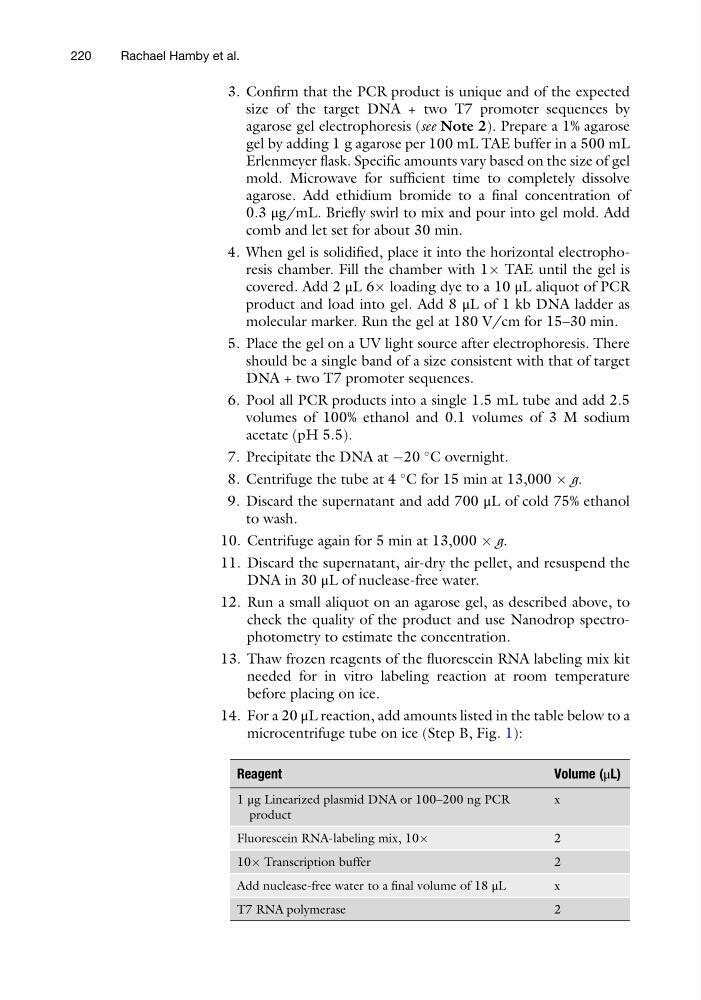
14. For a 20 μL reaction, add amounts listed in the table below to a
microcentrifuge tube on ice (Step B, Fig. 1):
Reagent
Volume (μL)
1 μg Linearized plasmid DNA or 100–200 ng PCR
product
x
Fluorescein RNA-labeling mix, 10Â
2
10Â Transcription buffer
2
Add nuclease-free water to a final volume of 18 μL
x
T7 RNA polymerase
2
220
Rachael Hamby et al.
size of the target DNA + two T7 promoter sequences by
agarose gel electrophoresis (see Note 2). Prepare a 1% agarose
gel by adding 1 g agarose per 100 mL TAE buffer in a 500 mL
Erlenmeyer flask. Specific amounts vary based on the size of gel
mold. Microwave for sufficient time to completely dissolve
agarose. Add ethidium bromide to a final concentration of
0.3 μg/mL. Briefly swirl to mix and pour into gel mold. Add
comb and let set for about 30 min.
4. When gel is solidified, place it into the horizontal electrophoresis chamber. Fill the chamber with 1Â TAE until the gel is
covered. Add 2 μL 6Â loading dye to a 10 μL aliquot of PCR
product and load into gel. Add 8 μL of 1 kb DNA ladder as
molecular marker. Run the gel at 180 V/cm for 15–30 min.
5. Place the gel on a UV light source after electrophoresis. There
should be a single band of a size consistent with that of target
DNA + two T7 promoter sequences.
6. Pool all PCR products into a single 1.5 mL tube and add 2.5
volumes of 100% ethanol and 0.1 volumes of 3 M sodium
acetate (pH 5.5).
7. Precipitate the DNA at À20
C overnight.
8. Centrifuge the tube at 4
C for 15 min at 13,000 Â g.
9. Discard the supernatant and add 700 μL of cold 75% ethanol
to wash.
10. Centrifuge again for 5 min at 13,000 Â g.
11. Discard the supernatant, air-dry the pellet, and resuspend the
DNA in 30 μL of nuclease-free water.
12. Run a small aliquot on an agarose gel, as described above, to
check the quality of the product and use Nanodrop spectrophotometry to estimate the concentration.
13. Thaw frozen reagents of the fluorescein RNA labeling mix kit
needed for in vitro labeling reaction at room temperature
before placing on ice.
14. For a 20 μL reaction, add amounts listed in the table below to a
microcentrifuge tube on ice (Step B, Fig. 1):
Reagent
Volume (μL)
1 μg Linearized plasmid DNA or 100–200 ng PCR
product
x
Fluorescein RNA-labeling mix, 10Â
2
10Â Transcription buffer
2
Add nuclease-free water to a final volume of 18 μL
x
T7 RNA polymerase
2
220
Rachael Hamby et al.