

3. We recommend having multiple biological replicates (at least
two) to ensure reproducibility.
4. It is important that all the reagents, media, tubes, etc. that are
used after harvesting are chilled to 4
C and free of RNases to
prevent the degradation of RNA.
5. We have found in certain cases, such as transfer of mRNA
through nanotubes, that the efficiency of mRNA transfer is
higher when the acceptor cells are allowed to adhere first to
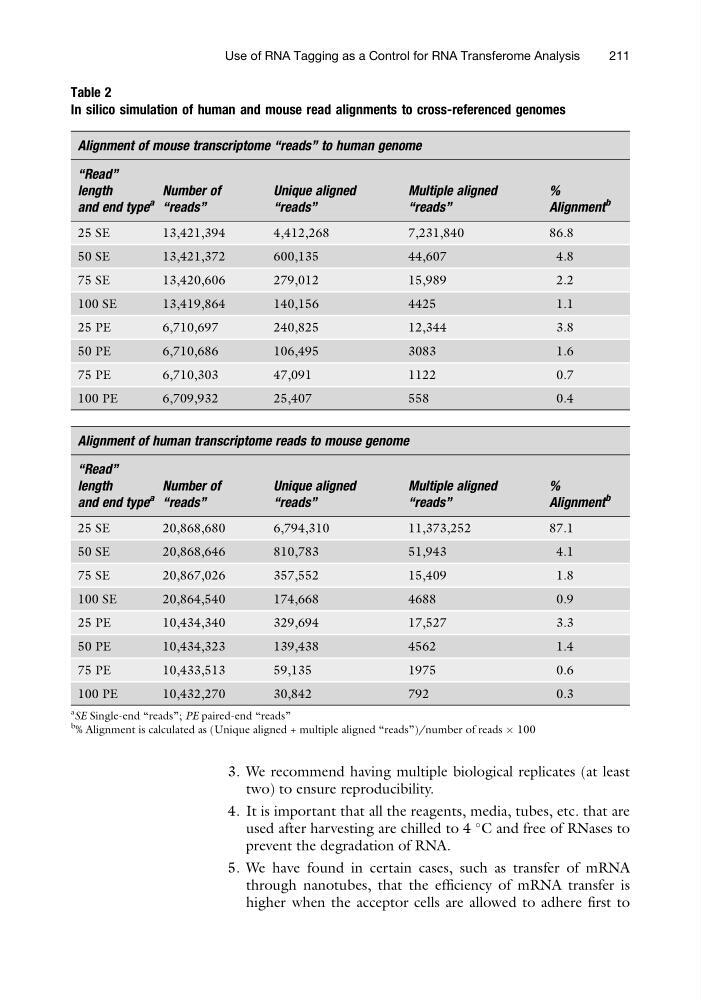
Table 2
In silico simulation of human and mouse read alignments to cross-referenced genomes
Alignment of mouse transcriptome “reads” to human genome
“Read”
length
and end type
a
Number of
“reads”
Unique aligned
“reads”
Multiple aligned
“reads”
%
Alignment
b
25 SE
13,421,394
4,412,268
7,231,840
86.8
50 SE
13,421,372
600,135
44,607
4.8
75 SE
13,420,606
279,012
15,989
2.2
100 SE
13,419,864
140,156
4425
1.1
25 PE
6,710,697
240,825
12,344
3.8
50 PE
6,710,686
106,495
3083
1.6
75 PE
6,710,303
47,091
1122
0.7
100 PE
6,709,932
25,407
558
0.4
Alignment of human transcriptome reads to mouse genome
“Read”
length
and end type
a
Number of
“reads”
Unique aligned
“reads”
Multiple aligned
“reads”
%
Alignment
b
25 SE
20,868,680
6,794,310
11,373,252
87.1
50 SE
20,868,646
810,783
51,943
4.1
75 SE
20,867,026
357,552
15,409
1.8
100 SE
20,864,540
174,668
4688
0.9
25 PE
10,434,340
329,694
17,527
3.3
50 PE
10,434,323
139,438
4562
1.4
75 PE
10,433,513
59,135
1975
0.6
100 PE
10,432,270
30,842
792
0.3
a
SE Single-end “reads”; PE paired-end “reads”
b
% Alignment is calculated as (Unique aligned + multiple aligned “reads”)/number of reads  100
Use of RNA Tagging as a Control for RNA Transferome Analysis
211
two) to ensure reproducibility.
4. It is important that all the reagents, media, tubes, etc. that are
used after harvesting are chilled to 4
C and free of RNases to
prevent the degradation of RNA.
5. We have found in certain cases, such as transfer of mRNA
through nanotubes, that the efficiency of mRNA transfer is
higher when the acceptor cells are allowed to adhere first to
Table 2
In silico simulation of human and mouse read alignments to cross-referenced genomes
Alignment of mouse transcriptome “reads” to human genome
“Read”
length
and end type
a
Number of
“reads”
Unique aligned
“reads”
Multiple aligned
“reads”
%
Alignment
b
25 SE
13,421,394
4,412,268
7,231,840
86.8
50 SE
13,421,372
600,135
44,607
4.8
75 SE
13,420,606
279,012
15,989
2.2
100 SE
13,419,864
140,156
4425
1.1
25 PE
6,710,697
240,825
12,344
3.8
50 PE
6,710,686
106,495
3083
1.6
75 PE
6,710,303
47,091
1122
0.7
100 PE
6,709,932
25,407
558
0.4
Alignment of human transcriptome reads to mouse genome
“Read”
length
and end type
a
Number of
“reads”
Unique aligned
“reads”
Multiple aligned
“reads”
%
Alignment
b
25 SE
20,868,680
6,794,310
11,373,252
87.1
50 SE
20,868,646
810,783
51,943
4.1
75 SE
20,867,026
357,552
15,409
1.8
100 SE
20,864,540
174,668
4688
0.9
25 PE
10,434,340
329,694
17,527
3.3
50 PE
10,434,323
139,438
4562
1.4
75 PE
10,433,513
59,135
1975
0.6
100 PE
10,432,270
30,842
792
0.3
a
SE Single-end “reads”; PE paired-end “reads”
b
% Alignment is calculated as (Unique aligned + multiple aligned “reads”)/number of reads  100
Use of RNA Tagging as a Control for RNA Transferome Analysis
211