

3 Methods
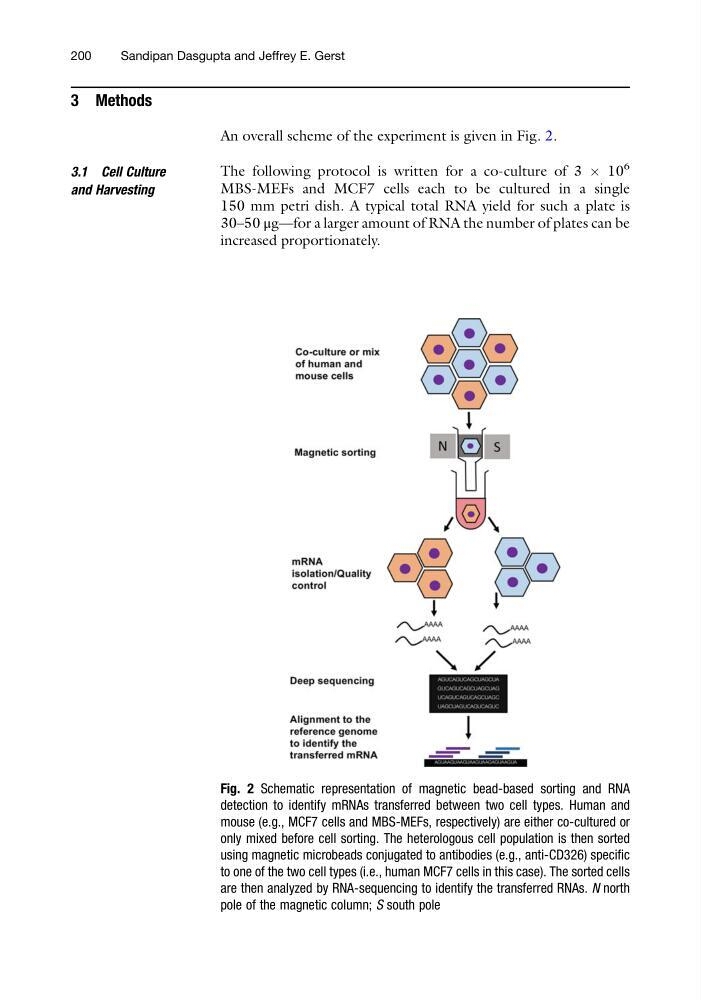
An overall scheme of the experiment is given in Fig. 2.
3.1 Cell Culture
and Harvesting
The following protocol is written for a co-culture of 3 Â 10
6
MBS-MEFs and MCF7 cells each to be cultured in a single
150 mm petri dish. A typical total RNA yield for such a plate is
30–50 μg—for a larger amount of RNA the number of plates can be
increased proportionately.
Fig. 2 Schematic representation of magnetic bead-based sorting and RNA
detection to identify mRNAs transferred between two cell types. Human and
mouse (e.g., MCF7 cells and MBS-MEFs, respectively) are either co-cultured or
only mixed before cell sorting. The heterologous cell population is then sorted
using magnetic microbeads conjugated to antibodies (e.g., anti-CD326) specific
to one of the two cell types (i.e., human MCF7 cells in this case). The sorted cells
are then analyzed by RNA-sequencing to identify the transferred RNAs. N north
pole of the magnetic column; S south pole
200
Sandipan Dasgupta and Jeffrey E. Gerst
An overall scheme of the experiment is given in Fig. 2.
3.1 Cell Culture
and Harvesting
The following protocol is written for a co-culture of 3 Â 10
6
MBS-MEFs and MCF7 cells each to be cultured in a single
150 mm petri dish. A typical total RNA yield for such a plate is
30–50 μg—for a larger amount of RNA the number of plates can be
increased proportionately.
Fig. 2 Schematic representation of magnetic bead-based sorting and RNA
detection to identify mRNAs transferred between two cell types. Human and
mouse (e.g., MCF7 cells and MBS-MEFs, respectively) are either co-cultured or
only mixed before cell sorting. The heterologous cell population is then sorted
using magnetic microbeads conjugated to antibodies (e.g., anti-CD326) specific
to one of the two cell types (i.e., human MCF7 cells in this case). The sorted cells
are then analyzed by RNA-sequencing to identify the transferred RNAs. N north
pole of the magnetic column; S south pole
200
Sandipan Dasgupta and Jeffrey E. Gerst