

the MCS of the PVX vector. In most cases, the GOI is not a fulllength gene (Fig. 1). This cloning strategy was used for the BEL
RNAs of potato (Fig. 2), StBEL5 (mobile) and StBEL14 (nonmobile). These were cloned after RT-PCR amplification into the MluI
and EcoRV sites of the PVX/ΔCP vector to create PVX/BEL5
RNA ΔCP and PVX/BEL14 RNA ΔCP fusions [26]. Figure 1
shows PVX/ΔCP constructs in which FT RNA was fused to the
RNA for GFP (designated PVX/GFP-FTΔCP), thus allowing the
monitoring of the mobilized viral RNA via fluorescence emitted
from the encoded GFP protein. Inclusion of the GFP fusion is not
critical for the movement assay and will not be discussed in this
protocol. Only cloning of the cDNA of the ROI into the MluI and
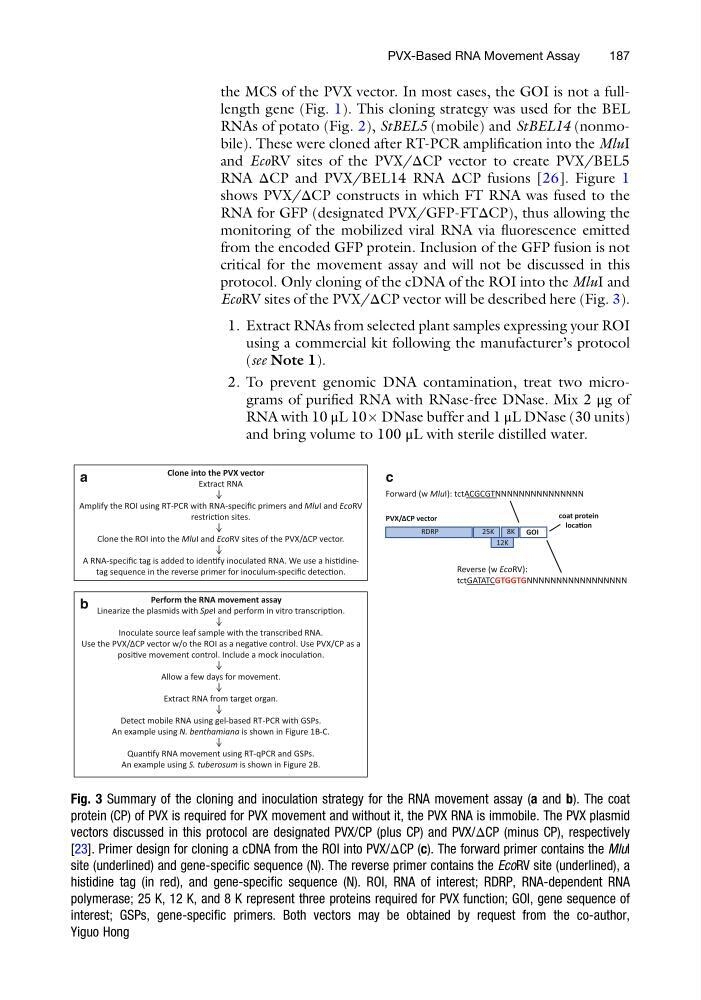
EcoRV sites of the PVX/ΔCP vector will be described here (Fig. 3).
1. Extract RNAs from selected plant samples expressing your ROI
using a commercial kit following the manufacturer’s protocol
(see Note 1).
2. To prevent genomic DNA contamination, treat two micrograms of purified RNA with RNase-free DNase. Mix 2 μg of
RNA with 10 μL 10Â DNase buffer and 1 μL DNase (30 units)
and bring volume to 100 μL with sterile distilled water.
Clone into the PVX vector
Extract RNA
a
c
b
Amplify the ROI using RT-PCR with RNA-specific primers and MluI and EcoRV
restricƟon sites.
Clone the ROI into the MluI and EcoRV sites of the PVX/ΔCP vector.
A RNA-specific tag is added to idenƟfy inoculated RNA. We use a hisƟdinetag sequence in the reverse primer for inoculum-specific detecƟon.
Perform the RNA movement assay
Linearize the plasmids with SpeI and perform in vitro transcripƟon.
Inoculate source leaf sample with the transcribed RNA.
Use the PVX/ΔCP vector w/o the ROI as a negaƟve control. Use PVX/CP as a
posiƟve movement control. Include a mock inoculaƟon.
Allow a few days for movement.
Extract RNA from target organ.
Detect mobile RNA using gel-based RT-PCR with GSPs.
An example using N. benthamiana is shown in Figure 1B-C.
QuanƟfy RNA movement using RT-qPCR and GSPs.
An example using S. tuberosum is shown in Figure 2B.
Forward (w MluI): tctACGCGTNNNNNNNNNNNNNNN
GOI
RDRP
25K
8K
12K
Reverse (w EcoRV):
tctGATATCGTGGTGNNNNNNNNNNNNNNNNN
coat protein
locaƟon
PVX/ΔCP vector
Fig. 3 Summary of the cloning and inoculation strategy for the RNA movement assay (a and b). The coat
protein (CP) of PVX is required for PVX movement and without it, the PVX RNA is immobile. The PVX plasmid
vectors discussed in this protocol are designated PVX/CP (plus CP) and PVX/ΔCP (minus CP), respectively
[23]. Primer design for cloning a cDNA from the ROI into PVX/ΔCP (c). The forward primer contains the MluI
site (underlined) and gene-specific sequence (N). The reverse primer contains the EcoRV site (underlined), a
histidine tag (in red), and gene-specific sequence (N). ROI, RNA of interest; RDRP, RNA-dependent RNA
polymerase; 25 K, 12 K, and 8 K represent three proteins required for PVX function; GOI, gene sequence of
interest; GSPs, gene-specific primers. Both vectors may be obtained by request from the co-author,
Yiguo Hong
PVX-Based RNA Movement Assay
187
RNAs of potato (Fig. 2), StBEL5 (mobile) and StBEL14 (nonmobile). These were cloned after RT-PCR amplification into the MluI
and EcoRV sites of the PVX/ΔCP vector to create PVX/BEL5
RNA ΔCP and PVX/BEL14 RNA ΔCP fusions [26]. Figure 1
shows PVX/ΔCP constructs in which FT RNA was fused to the
RNA for GFP (designated PVX/GFP-FTΔCP), thus allowing the
monitoring of the mobilized viral RNA via fluorescence emitted
from the encoded GFP protein. Inclusion of the GFP fusion is not
critical for the movement assay and will not be discussed in this
protocol. Only cloning of the cDNA of the ROI into the MluI and
EcoRV sites of the PVX/ΔCP vector will be described here (Fig. 3).
1. Extract RNAs from selected plant samples expressing your ROI
using a commercial kit following the manufacturer’s protocol
(see Note 1).
2. To prevent genomic DNA contamination, treat two micrograms of purified RNA with RNase-free DNase. Mix 2 μg of
RNA with 10 μL 10Â DNase buffer and 1 μL DNase (30 units)
and bring volume to 100 μL with sterile distilled water.
Clone into the PVX vector
Extract RNA
a
c
b
Amplify the ROI using RT-PCR with RNA-specific primers and MluI and EcoRV
restricƟon sites.
Clone the ROI into the MluI and EcoRV sites of the PVX/ΔCP vector.
A RNA-specific tag is added to idenƟfy inoculated RNA. We use a hisƟdinetag sequence in the reverse primer for inoculum-specific detecƟon.
Perform the RNA movement assay
Linearize the plasmids with SpeI and perform in vitro transcripƟon.
Inoculate source leaf sample with the transcribed RNA.
Use the PVX/ΔCP vector w/o the ROI as a negaƟve control. Use PVX/CP as a
posiƟve movement control. Include a mock inoculaƟon.
Allow a few days for movement.
Extract RNA from target organ.
Detect mobile RNA using gel-based RT-PCR with GSPs.
An example using N. benthamiana is shown in Figure 1B-C.
QuanƟfy RNA movement using RT-qPCR and GSPs.
An example using S. tuberosum is shown in Figure 2B.
Forward (w MluI): tctACGCGTNNNNNNNNNNNNNNN
GOI
RDRP
25K
8K
12K
Reverse (w EcoRV):
tctGATATCGTGGTGNNNNNNNNNNNNNNNNN
coat protein
locaƟon
PVX/ΔCP vector
Fig. 3 Summary of the cloning and inoculation strategy for the RNA movement assay (a and b). The coat
protein (CP) of PVX is required for PVX movement and without it, the PVX RNA is immobile. The PVX plasmid
vectors discussed in this protocol are designated PVX/CP (plus CP) and PVX/ΔCP (minus CP), respectively
[23]. Primer design for cloning a cDNA from the ROI into PVX/ΔCP (c). The forward primer contains the MluI
site (underlined) and gene-specific sequence (N). The reverse primer contains the EcoRV site (underlined), a
histidine tag (in red), and gene-specific sequence (N). ROI, RNA of interest; RDRP, RNA-dependent RNA
polymerase; 25 K, 12 K, and 8 K represent three proteins required for PVX function; GOI, gene sequence of
interest; GSPs, gene-specific primers. Both vectors may be obtained by request from the co-author,
Yiguo Hong
PVX-Based RNA Movement Assay
187