

444
S. Perrin et al.
birth of the Dutch optician being in reality in 1585 [1]. The precise origin of optical
microscopy may thus be difficult nowadays to determine. We can, however, assign
the observation of biological elements (e.g. bacteria and structures of plants) through
an optical lens arrangement, for the first time, to A. van Leeuwenhoek [2]. His work
was attested and simultaneously improved by R. Hooke who published the first book
on microscopy in 1665 [3]. At that time and right up until the nineteenth century, the
performance of the optical microscope was abstract and the notion of resolution was
still unknown.
17.1.1 From Diffraction-Limited Optical Microscopy
It was only in the mid-1860s that the scientific community took a particular interest
in the understanding of the concept of resolution and its limits. For the first time, in
1869, the diffraction of light was explicitly mentioned as a probable reason for the
resolution limit [4]. This assumption was further promoted in 1873 by E. Abbe who
considered the object to be visualized as a sum of periodic diffraction elements [5].
E. Abbe described in words that at least two orders of a periodic object (e.g. the +1
and −1 orders of a diffraction grating) should be collected by the objective lens in
order to resolve its features. In 1876, H. von Helmholtz confirmed the Abbe theory
through a mathematical demonstration of the resolution limit [6], leading to the first
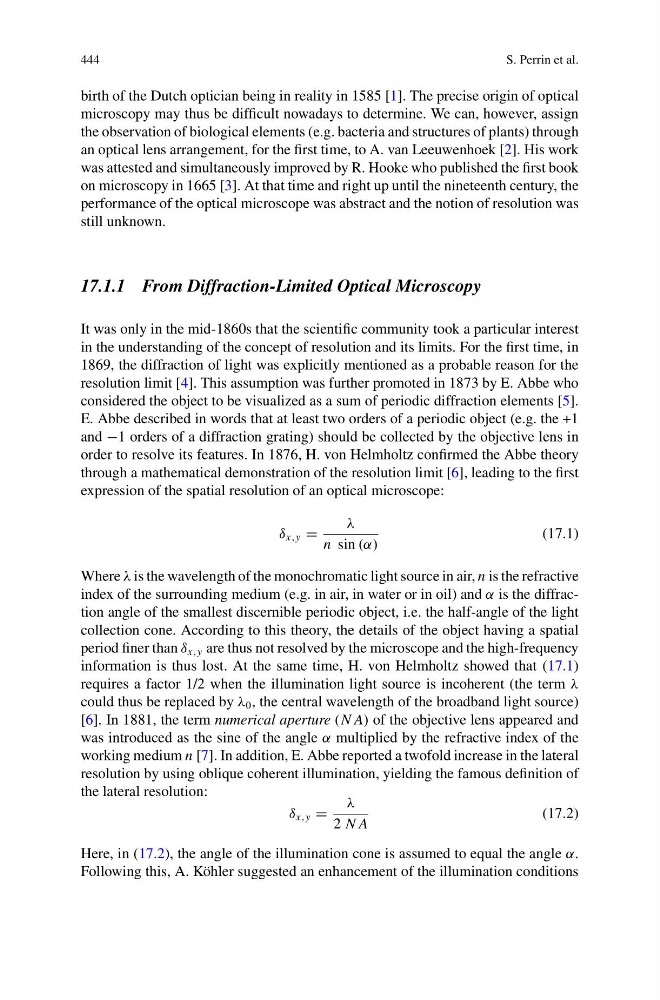
expression of the spatial resolution of an optical microscope:
δ x,y =
λ
n sin (α)
(17.1)
Where λ is the wavelength of the monochromatic light source in air, n is the refractive
index of the surrounding medium (e.g. in air, in water or in oil) and α is the diffraction angle of the smallest discernible periodic object, i.e. the half-angle of the light
collection cone. According to this theory, the details of the object having a spatial
period finer than δ x,y are thus not resolved by the microscope and the high-frequency
information is thus lost. At the same time, H. von Helmholtz showed that (17.1)
requires a factor 1/2 when the illumination light source is incoherent (the term λ
could thus be replaced by λ 0 , the central wavelength of the broadband light source)
[6]. In 1881, the term numerical aperture (N A) of the objective lens appeared and
was introduced as the sine of the angle α multiplied by the refractive index of the
working medium n [7]. In addition, E. Abbe reported a twofold increase in the lateral
resolution by using oblique coherent illumination, yielding the famous definition of
the lateral resolution:
δ x,y =
λ
2 N A
(17.2)
Here, in (17.2), the angle of the illumination cone is assumed to equal the angle α.
Following this, A. Köhler suggested an enhancement of the illumination conditions
S. Perrin et al.
birth of the Dutch optician being in reality in 1585 [1]. The precise origin of optical
microscopy may thus be difficult nowadays to determine. We can, however, assign
the observation of biological elements (e.g. bacteria and structures of plants) through
an optical lens arrangement, for the first time, to A. van Leeuwenhoek [2]. His work
was attested and simultaneously improved by R. Hooke who published the first book
on microscopy in 1665 [3]. At that time and right up until the nineteenth century, the
performance of the optical microscope was abstract and the notion of resolution was
still unknown.
17.1.1 From Diffraction-Limited Optical Microscopy
It was only in the mid-1860s that the scientific community took a particular interest
in the understanding of the concept of resolution and its limits. For the first time, in
1869, the diffraction of light was explicitly mentioned as a probable reason for the
resolution limit [4]. This assumption was further promoted in 1873 by E. Abbe who
considered the object to be visualized as a sum of periodic diffraction elements [5].
E. Abbe described in words that at least two orders of a periodic object (e.g. the +1
and −1 orders of a diffraction grating) should be collected by the objective lens in
order to resolve its features. In 1876, H. von Helmholtz confirmed the Abbe theory
through a mathematical demonstration of the resolution limit [6], leading to the first
expression of the spatial resolution of an optical microscope:
δ x,y =
λ
n sin (α)
(17.1)
Where λ is the wavelength of the monochromatic light source in air, n is the refractive
index of the surrounding medium (e.g. in air, in water or in oil) and α is the diffraction angle of the smallest discernible periodic object, i.e. the half-angle of the light
collection cone. According to this theory, the details of the object having a spatial
period finer than δ x,y are thus not resolved by the microscope and the high-frequency
information is thus lost. At the same time, H. von Helmholtz showed that (17.1)
requires a factor 1/2 when the illumination light source is incoherent (the term λ
could thus be replaced by λ 0 , the central wavelength of the broadband light source)
[6]. In 1881, the term numerical aperture (N A) of the objective lens appeared and
was introduced as the sine of the angle α multiplied by the refractive index of the
working medium n [7]. In addition, E. Abbe reported a twofold increase in the lateral
resolution by using oblique coherent illumination, yielding the famous definition of
the lateral resolution:
δ x,y =
λ
2 N A
(17.2)
Here, in (17.2), the angle of the illumination cone is assumed to equal the angle α.
Following this, A. Köhler suggested an enhancement of the illumination conditions