

15 Super-Resolution Imaging and Microscopy by Dielectric …
381
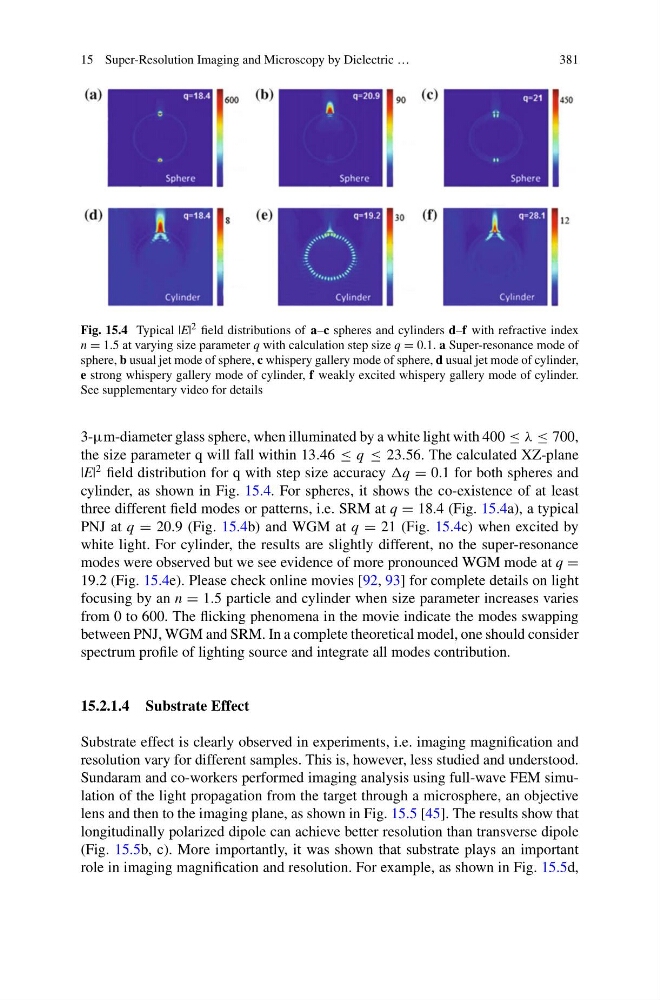
Fig. 15.4 Typical |E| 2 field distributions of a–c spheres and cylinders d–f with refractive index
n = 1.5 at varying size parameter q with calculation step size q = 0.1. a Super-resonance mode of
sphere, b usual jet mode of sphere, c whispery gallery mode of sphere, d usual jet mode of cylinder,
e strong whispery gallery mode of cylinder, f weakly excited whispery gallery mode of cylinder.
See supplementary video for details
3-μm-diameter glass sphere, when illuminated by a white light with 400 ≤ λ ≤ 700,
the size parameter q will fall within 13.46 ≤ q ≤ 23.56. The calculated XZ-plane
|E|
2 field distribution for q with step size accuracy q = 0.1 for both spheres and
cylinder, as shown in Fig. 15.4. For spheres, it shows the co-existence of at least
three different field modes or patterns, i.e. SRM at q = 18.4 (Fig. 15.4a), a typical
PNJ at q = 20.9 (Fig. 15.4b) and WGM at q = 21 (Fig. 15.4c) when excited by
white light. For cylinder, the results are slightly different, no the super-resonance
modes were observed but we see evidence of more pronounced WGM mode at q =
19.2 (Fig. 15.4e). Please check online movies [92, 93] for complete details on light
focusing by an n = 1.5 particle and cylinder when size parameter increases varies
from 0 to 600. The flicking phenomena in the movie indicate the modes swapping
between PNJ, WGM and SRM. In a complete theoretical model, one should consider
spectrum profile of lighting source and integrate all modes contribution.
15.2.1.4 Substrate Effect
Substrate effect is clearly observed in experiments, i.e. imaging magnification and
resolution vary for different samples. This is, however, less studied and understood.
Sundaram and co-workers performed imaging analysis using full-wave FEM simulation of the light propagation from the target through a microsphere, an objective
lens and then to the imaging plane, as shown in Fig. 15.5 [45]. The results show that
longitudinally polarized dipole can achieve better resolution than transverse dipole
(Fig. 15.5b, c). More importantly, it was shown that substrate plays an important
role in imaging magnification and resolution. For example, as shown in Fig. 15.5d,
381
Fig. 15.4 Typical |E| 2 field distributions of a–c spheres and cylinders d–f with refractive index
n = 1.5 at varying size parameter q with calculation step size q = 0.1. a Super-resonance mode of
sphere, b usual jet mode of sphere, c whispery gallery mode of sphere, d usual jet mode of cylinder,
e strong whispery gallery mode of cylinder, f weakly excited whispery gallery mode of cylinder.
See supplementary video for details
3-μm-diameter glass sphere, when illuminated by a white light with 400 ≤ λ ≤ 700,
the size parameter q will fall within 13.46 ≤ q ≤ 23.56. The calculated XZ-plane
|E|
2 field distribution for q with step size accuracy q = 0.1 for both spheres and
cylinder, as shown in Fig. 15.4. For spheres, it shows the co-existence of at least
three different field modes or patterns, i.e. SRM at q = 18.4 (Fig. 15.4a), a typical
PNJ at q = 20.9 (Fig. 15.4b) and WGM at q = 21 (Fig. 15.4c) when excited by
white light. For cylinder, the results are slightly different, no the super-resonance
modes were observed but we see evidence of more pronounced WGM mode at q =
19.2 (Fig. 15.4e). Please check online movies [92, 93] for complete details on light
focusing by an n = 1.5 particle and cylinder when size parameter increases varies
from 0 to 600. The flicking phenomena in the movie indicate the modes swapping
between PNJ, WGM and SRM. In a complete theoretical model, one should consider
spectrum profile of lighting source and integrate all modes contribution.
15.2.1.4 Substrate Effect
Substrate effect is clearly observed in experiments, i.e. imaging magnification and
resolution vary for different samples. This is, however, less studied and understood.
Sundaram and co-workers performed imaging analysis using full-wave FEM simulation of the light propagation from the target through a microsphere, an objective
lens and then to the imaging plane, as shown in Fig. 15.5 [45]. The results show that
longitudinally polarized dipole can achieve better resolution than transverse dipole
(Fig. 15.5b, c). More importantly, it was shown that substrate plays an important
role in imaging magnification and resolution. For example, as shown in Fig. 15.5d,