

378
Z. Wang and B. Luk’yanchuk
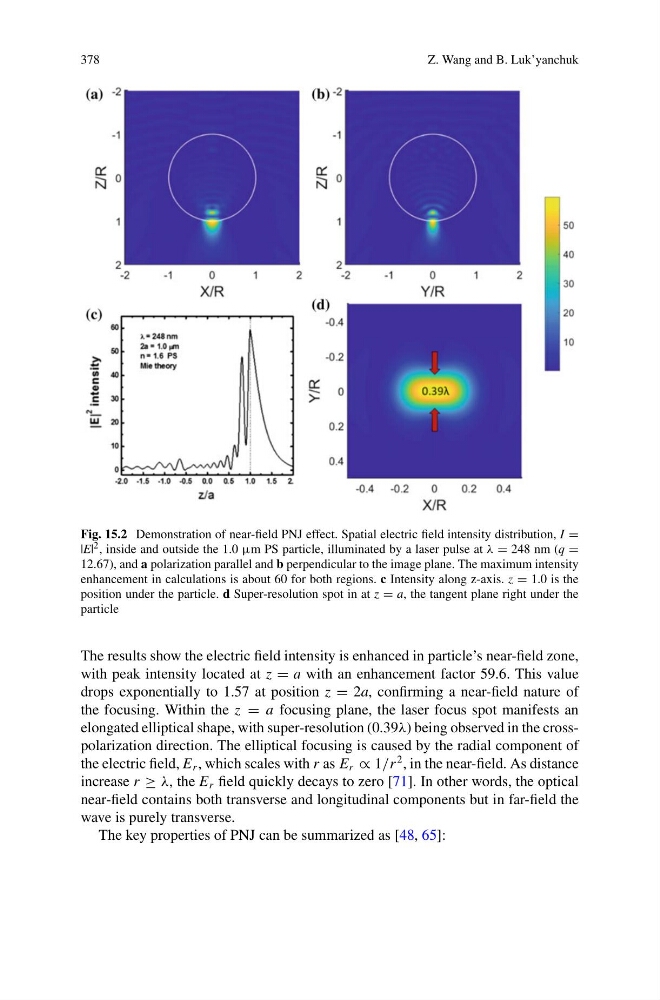
Fig. 15.2 Demonstration of near-field PNJ effect. Spatial electric field intensity distribution, I =
|E| 2 , inside and outside the 1.0 μm PS particle, illuminated by a laser pulse at λ = 248 nm (q =
12.67), and a polarization parallel and b perpendicular to the image plane. The maximum intensity
enhancement in calculations is about 60 for both regions. c Intensity along z-axis. z = 1.0 is the
position under the particle. d Super-resolution spot in at z = a, the tangent plane right under the
particle
The results show the electric field intensity is enhanced in particle’s near-field zone,
with peak intensity located at z = a with an enhancement factor 59.6. This value
drops exponentially to 1.57 at position z = 2a, confirming a near-field nature of
the focusing. Within the z = a focusing plane, the laser focus spot manifests an
elongated elliptical shape, with super-resolution (0.39λ) being observed in the crosspolarization direction. The elliptical focusing is caused by the radial component of
the electric field, E r , which scales with r as E r ∝ 1/r
2 , in the near-field. As distance
increase r ≥ λ, the E r field quickly decays to zero [71]. In other words, the optical
near-field contains both transverse and longitudinal components but in far-field the
wave is purely transverse.
The key properties of PNJ can be summarized as [48, 65]:
Z. Wang and B. Luk’yanchuk
Fig. 15.2 Demonstration of near-field PNJ effect. Spatial electric field intensity distribution, I =
|E| 2 , inside and outside the 1.0 μm PS particle, illuminated by a laser pulse at λ = 248 nm (q =
12.67), and a polarization parallel and b perpendicular to the image plane. The maximum intensity
enhancement in calculations is about 60 for both regions. c Intensity along z-axis. z = 1.0 is the
position under the particle. d Super-resolution spot in at z = a, the tangent plane right under the
particle
The results show the electric field intensity is enhanced in particle’s near-field zone,
with peak intensity located at z = a with an enhancement factor 59.6. This value
drops exponentially to 1.57 at position z = 2a, confirming a near-field nature of
the focusing. Within the z = a focusing plane, the laser focus spot manifests an
elongated elliptical shape, with super-resolution (0.39λ) being observed in the crosspolarization direction. The elliptical focusing is caused by the radial component of
the electric field, E r , which scales with r as E r ∝ 1/r
2 , in the near-field. As distance
increase r ≥ λ, the E r field quickly decays to zero [71]. In other words, the optical
near-field contains both transverse and longitudinal components but in far-field the
wave is purely transverse.
The key properties of PNJ can be summarized as [48, 65]: