

350
E. Khan and E. Narimanov
x /
/
(a)
(b)
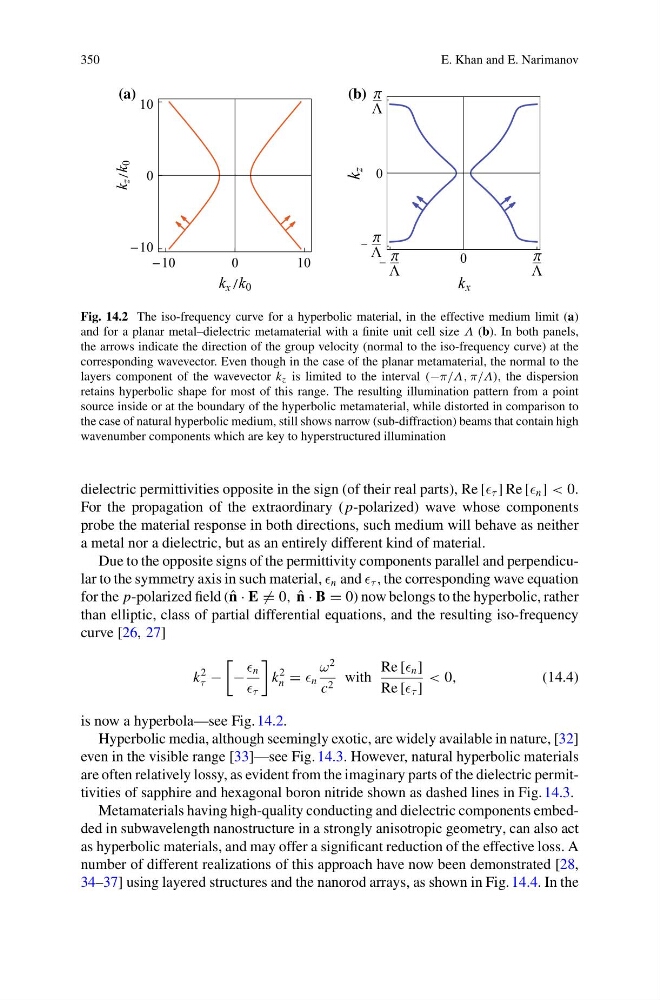
Fig. 14.2 The iso-frequency curve for a hyperbolic material, in the effective medium limit (a)
and for a planar metal–dielectric metamaterial with a finite unit cell size Λ (b). In both panels,
the arrows indicate the direction of the group velocity (normal to the iso-frequency curve) at the
corresponding wavevector. Even though in the case of the planar metamaterial, the normal to the
layers component of the wavevector k z is limited to the interval (−π/Λ, π/Λ), the dispersion
retains hyperbolic shape for most of this range. The resulting illumination pattern from a point
source inside or at the boundary of the hyperbolic metamaterial, while distorted in comparison to
the case of natural hyperbolic medium, still shows narrow (sub-diffraction) beams that contain high
wavenumber components which are key to hyperstructured illumination
dielectric permittivities opposite in the sign (of their real parts), Re [ τ ] Re [ n ] < 0.
For the propagation of the extraordinary ( p-polarized) wave whose components
probe the material response in both directions, such medium will behave as neither
a metal nor a dielectric, but as an entirely different kind of material.
Due to the opposite signs of the permittivity components parallel and perpendicular to the symmetry axis in such material, n and τ , the corresponding wave equation
for the p-polarized field ( ˆ
n · E = 0, ˆ
n · B = 0) now belongs to the hyperbolic, rather
than elliptic, class of partial differential equations, and the resulting iso-frequency
curve [26, 27]
k
2
τ −
−
n
τ
k
2
n = n
ω
2
c 2 with
Re [ n ]
Re [ τ ]
< 0,
(14.4)
is now a hyperbola—see Fig. 14.2.
Hyperbolic media, although seemingly exotic, are widely available in nature, [32]
even in the visible range [33]—see Fig. 14.3. However, natural hyperbolic materials
are often relatively lossy, as evident from the imaginary parts of the dielectric permittivities of sapphire and hexagonal boron nitride shown as dashed lines in Fig. 14.3.
Metamaterials having high-quality conducting and dielectric components embedded in subwavelength nanostructure in a strongly anisotropic geometry, can also act
as hyperbolic materials, and may offer a significant reduction of the effective loss. A
number of different realizations of this approach have now been demonstrated [28,
34–37] using layered structures and the nanorod arrays, as shown in Fig. 14.4. In the
E. Khan and E. Narimanov
x /
/
(a)
(b)
Fig. 14.2 The iso-frequency curve for a hyperbolic material, in the effective medium limit (a)
and for a planar metal–dielectric metamaterial with a finite unit cell size Λ (b). In both panels,
the arrows indicate the direction of the group velocity (normal to the iso-frequency curve) at the
corresponding wavevector. Even though in the case of the planar metamaterial, the normal to the
layers component of the wavevector k z is limited to the interval (−π/Λ, π/Λ), the dispersion
retains hyperbolic shape for most of this range. The resulting illumination pattern from a point
source inside or at the boundary of the hyperbolic metamaterial, while distorted in comparison to
the case of natural hyperbolic medium, still shows narrow (sub-diffraction) beams that contain high
wavenumber components which are key to hyperstructured illumination
dielectric permittivities opposite in the sign (of their real parts), Re [ τ ] Re [ n ] < 0.
For the propagation of the extraordinary ( p-polarized) wave whose components
probe the material response in both directions, such medium will behave as neither
a metal nor a dielectric, but as an entirely different kind of material.
Due to the opposite signs of the permittivity components parallel and perpendicular to the symmetry axis in such material, n and τ , the corresponding wave equation
for the p-polarized field ( ˆ
n · E = 0, ˆ
n · B = 0) now belongs to the hyperbolic, rather
than elliptic, class of partial differential equations, and the resulting iso-frequency
curve [26, 27]
k
2
τ −
−
n
τ
k
2
n = n
ω
2
c 2 with
Re [ n ]
Re [ τ ]
< 0,
(14.4)
is now a hyperbola—see Fig. 14.2.
Hyperbolic media, although seemingly exotic, are widely available in nature, [32]
even in the visible range [33]—see Fig. 14.3. However, natural hyperbolic materials
are often relatively lossy, as evident from the imaginary parts of the dielectric permittivities of sapphire and hexagonal boron nitride shown as dashed lines in Fig. 14.3.
Metamaterials having high-quality conducting and dielectric components embedded in subwavelength nanostructure in a strongly anisotropic geometry, can also act
as hyperbolic materials, and may offer a significant reduction of the effective loss. A
number of different realizations of this approach have now been demonstrated [28,
34–37] using layered structures and the nanorod arrays, as shown in Fig. 14.4. In the