

348
E. Khan and E. Narimanov
Superlens
Image
air
object
air
Hyperlens
far-field
air
object
air
Distance
Field
Amplitiude
(a)
(b)
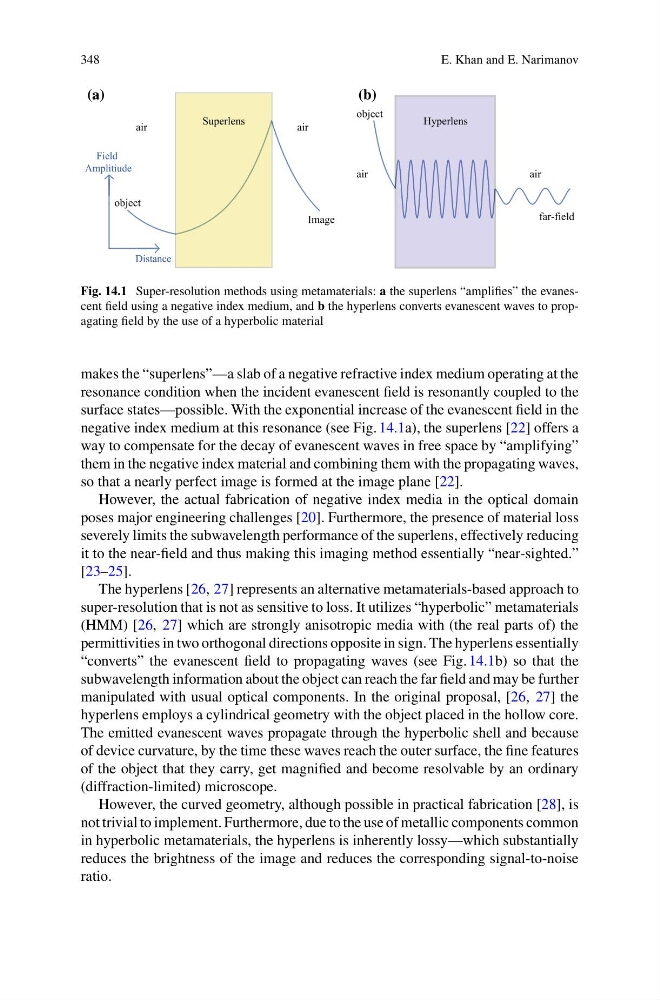
Fig. 14.1 Super-resolution methods using metamaterials: a the superlens “amplifies” the evanescent field using a negative index medium, and b the hyperlens converts evanescent waves to propagating field by the use of a hyperbolic material
makes the “superlens”—a slab of a negative refractive index medium operating at the
resonance condition when the incident evanescent field is resonantly coupled to the
surface states—possible. With the exponential increase of the evanescent field in the
negative index medium at this resonance (see Fig. 14.1a), the superlens [22] offers a
way to compensate for the decay of evanescent waves in free space by “amplifying”
them in the negative index material and combining them with the propagating waves,
so that a nearly perfect image is formed at the image plane [22].
However, the actual fabrication of negative index media in the optical domain
poses major engineering challenges [20]. Furthermore, the presence of material loss
severely limits the subwavelength performance of the superlens, effectively reducing
it to the near-field and thus making this imaging method essentially “near-sighted.”
[23–25].
The hyperlens [26, 27] represents an alternative metamaterials-based approach to
super-resolution that is not as sensitive to loss. It utilizes “hyperbolic” metamaterials
(HMM) [26, 27] which are strongly anisotropic media with (the real parts of) the
permittivities in two orthogonal directions opposite in sign. The hyperlens essentially
“converts” the evanescent field to propagating waves (see Fig. 14.1b) so that the
subwavelength information about the object can reach the far field and may be further
manipulated with usual optical components. In the original proposal, [26, 27] the
hyperlens employs a cylindrical geometry with the object placed in the hollow core.
The emitted evanescent waves propagate through the hyperbolic shell and because
of device curvature, by the time these waves reach the outer surface, the fine features
of the object that they carry, get magnified and become resolvable by an ordinary
(diffraction-limited) microscope.
However, the curved geometry, although possible in practical fabrication [28], is
not trivial to implement. Furthermore, due to the use of metallic components common
in hyperbolic metamaterials, the hyperlens is inherently lossy—which substantially
reduces the brightness of the image and reduces the corresponding signal-to-noise
ratio.
E. Khan and E. Narimanov
Superlens
Image
air
object
air
Hyperlens
far-field
air
object
air
Distance
Field
Amplitiude
(a)
(b)
Fig. 14.1 Super-resolution methods using metamaterials: a the superlens “amplifies” the evanescent field using a negative index medium, and b the hyperlens converts evanescent waves to propagating field by the use of a hyperbolic material
makes the “superlens”—a slab of a negative refractive index medium operating at the
resonance condition when the incident evanescent field is resonantly coupled to the
surface states—possible. With the exponential increase of the evanescent field in the
negative index medium at this resonance (see Fig. 14.1a), the superlens [22] offers a
way to compensate for the decay of evanescent waves in free space by “amplifying”
them in the negative index material and combining them with the propagating waves,
so that a nearly perfect image is formed at the image plane [22].
However, the actual fabrication of negative index media in the optical domain
poses major engineering challenges [20]. Furthermore, the presence of material loss
severely limits the subwavelength performance of the superlens, effectively reducing
it to the near-field and thus making this imaging method essentially “near-sighted.”
[23–25].
The hyperlens [26, 27] represents an alternative metamaterials-based approach to
super-resolution that is not as sensitive to loss. It utilizes “hyperbolic” metamaterials
(HMM) [26, 27] which are strongly anisotropic media with (the real parts of) the
permittivities in two orthogonal directions opposite in sign. The hyperlens essentially
“converts” the evanescent field to propagating waves (see Fig. 14.1b) so that the
subwavelength information about the object can reach the far field and may be further
manipulated with usual optical components. In the original proposal, [26, 27] the
hyperlens employs a cylindrical geometry with the object placed in the hollow core.
The emitted evanescent waves propagate through the hyperbolic shell and because
of device curvature, by the time these waves reach the outer surface, the fine features
of the object that they carry, get magnified and become resolvable by an ordinary
(diffraction-limited) microscope.
However, the curved geometry, although possible in practical fabrication [28], is
not trivial to implement. Furthermore, due to the use of metallic components common
in hyperbolic metamaterials, the hyperlens is inherently lossy—which substantially
reduces the brightness of the image and reduces the corresponding signal-to-noise
ratio.