

276
O. Tzang et al.
11.5.3 Resolution Improvement via Beam Apodization
So far, our discussion was limited to the case of a Gaussian diffraction-limited spot.
However, by using a phase and/or amplitude filter in the beam path, a smaller spot
at the focal plane is achievable. The disturbing existence of annular tails in the PSF,
often associated with such filters, is less pronounced in higher orders of the PSF pump ,
and are practically nulled in the overlap with the probe beam.
The use of spatial filters to achieve SR was investigated and used to improve
the resolution in a confocal setup [38–40]. We followed the prediction of Lerman
and Levi [41] on annular amplitude mask to test the improvement in resolution. We
fabricated a circular gold mask (16 mm diameter) on glass. The mask was mounted
in the beam path, to minimize far-field diffraction fringes. The mask position was
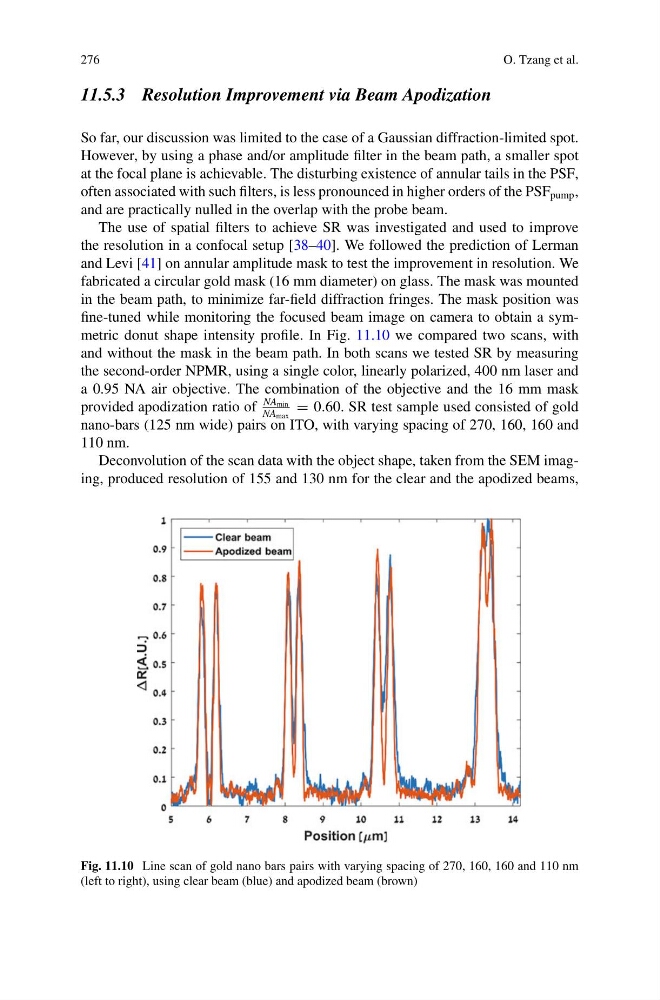
fine-tuned while monitoring the focused beam image on camera to obtain a symmetric donut shape intensity profile. In Fig. 11.10 we compared two scans, with
and without the mask in the beam path. In both scans we tested SR by measuring
the second-order NPMR, using a single color, linearly polarized, 400 nm laser and
a 0.95 NA air objective. The combination of the objective and the 16 mm mask
provided apodization ratio of
NA min
NA max
= 0.60. SR test sample used consisted of gold
nano-bars (125 nm wide) pairs on ITO, with varying spacing of 270, 160, 160 and
110 nm.
Deconvolution of the scan data with the object shape, taken from the SEM imaging, produced resolution of 155 and 130 nm for the clear and the apodized beams,
Fig. 11.10 Line scan of gold nano bars pairs with varying spacing of 270, 160, 160 and 110 nm
(left to right), using clear beam (blue) and apodized beam (brown)
O. Tzang et al.
11.5.3 Resolution Improvement via Beam Apodization
So far, our discussion was limited to the case of a Gaussian diffraction-limited spot.
However, by using a phase and/or amplitude filter in the beam path, a smaller spot
at the focal plane is achievable. The disturbing existence of annular tails in the PSF,
often associated with such filters, is less pronounced in higher orders of the PSF pump ,
and are practically nulled in the overlap with the probe beam.
The use of spatial filters to achieve SR was investigated and used to improve
the resolution in a confocal setup [38–40]. We followed the prediction of Lerman
and Levi [41] on annular amplitude mask to test the improvement in resolution. We
fabricated a circular gold mask (16 mm diameter) on glass. The mask was mounted
in the beam path, to minimize far-field diffraction fringes. The mask position was
fine-tuned while monitoring the focused beam image on camera to obtain a symmetric donut shape intensity profile. In Fig. 11.10 we compared two scans, with
and without the mask in the beam path. In both scans we tested SR by measuring
the second-order NPMR, using a single color, linearly polarized, 400 nm laser and
a 0.95 NA air objective. The combination of the objective and the 16 mm mask
provided apodization ratio of
NA min
NA max
= 0.60. SR test sample used consisted of gold
nano-bars (125 nm wide) pairs on ITO, with varying spacing of 270, 160, 160 and
110 nm.
Deconvolution of the scan data with the object shape, taken from the SEM imaging, produced resolution of 155 and 130 nm for the clear and the apodized beams,
Fig. 11.10 Line scan of gold nano bars pairs with varying spacing of 270, 160, 160 and 110 nm
(left to right), using clear beam (blue) and apodized beam (brown)