

274
O. Tzang et al.
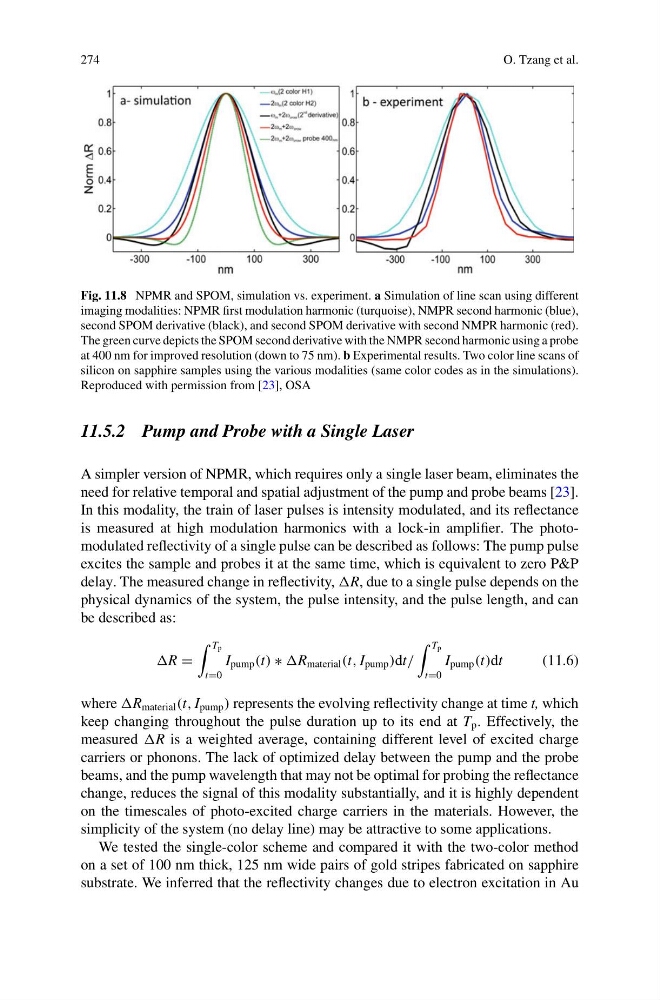
Fig. 11.8 NPMR and SPOM, simulation vs. experiment. a Simulation of line scan using different
imaging modalities: NPMR first modulation harmonic (turquoise), NMPR second harmonic (blue),
second SPOM derivative (black), and second SPOM derivative with second NMPR harmonic (red).
The green curve depicts the SPOM second derivative with the NMPR second harmonic using a probe
at 400 nm for improved resolution (down to 75 nm). b Experimental results. Two color line scans of
silicon on sapphire samples using the various modalities (same color codes as in the simulations).
Reproduced with permission from [23], OSA
11.5.2 Pump and Probe with a Single Laser
A simpler version of NPMR, which requires only a single laser beam, eliminates the
need for relative temporal and spatial adjustment of the pump and probe beams [23].
In this modality, the train of laser pulses is intensity modulated, and its reflectance
is measured at high modulation harmonics with a lock-in amplifier. The photomodulated reflectivity of a single pulse can be described as follows: The pump pulse
excites the sample and probes it at the same time, which is equivalent to zero P&P
delay. The measured change in reflectivity, R, due to a single pulse depends on the
physical dynamics of the system, the pulse intensity, and the pulse length, and can
be described as:
R =
T p
t=0
I pump (t) ∗ R material (t, I pump )dt/
T p
t=0
I pump (t)dt
(11.6)
where R material (t, I pump ) represents the evolving reflectivity change at time t, which
keep changing throughout the pulse duration up to its end at T p . Effectively, the
measured R is a weighted average, containing different level of excited charge
carriers or phonons. The lack of optimized delay between the pump and the probe
beams, and the pump wavelength that may not be optimal for probing the reflectance
change, reduces the signal of this modality substantially, and it is highly dependent
on the timescales of photo-excited charge carriers in the materials. However, the
simplicity of the system (no delay line) may be attractive to some applications.
We tested the single-color scheme and compared it with the two-color method
on a set of 100 nm thick, 125 nm wide pairs of gold stripes fabricated on sapphire
substrate. We inferred that the reflectivity changes due to electron excitation in Au
O. Tzang et al.
Fig. 11.8 NPMR and SPOM, simulation vs. experiment. a Simulation of line scan using different
imaging modalities: NPMR first modulation harmonic (turquoise), NMPR second harmonic (blue),
second SPOM derivative (black), and second SPOM derivative with second NMPR harmonic (red).
The green curve depicts the SPOM second derivative with the NMPR second harmonic using a probe
at 400 nm for improved resolution (down to 75 nm). b Experimental results. Two color line scans of
silicon on sapphire samples using the various modalities (same color codes as in the simulations).
Reproduced with permission from [23], OSA
11.5.2 Pump and Probe with a Single Laser
A simpler version of NPMR, which requires only a single laser beam, eliminates the
need for relative temporal and spatial adjustment of the pump and probe beams [23].
In this modality, the train of laser pulses is intensity modulated, and its reflectance
is measured at high modulation harmonics with a lock-in amplifier. The photomodulated reflectivity of a single pulse can be described as follows: The pump pulse
excites the sample and probes it at the same time, which is equivalent to zero P&P
delay. The measured change in reflectivity, R, due to a single pulse depends on the
physical dynamics of the system, the pulse intensity, and the pulse length, and can
be described as:
R =
T p
t=0
I pump (t) ∗ R material (t, I pump )dt/
T p
t=0
I pump (t)dt
(11.6)
where R material (t, I pump ) represents the evolving reflectivity change at time t, which
keep changing throughout the pulse duration up to its end at T p . Effectively, the
measured R is a weighted average, containing different level of excited charge
carriers or phonons. The lack of optimized delay between the pump and the probe
beams, and the pump wavelength that may not be optimal for probing the reflectance
change, reduces the signal of this modality substantially, and it is highly dependent
on the timescales of photo-excited charge carriers in the materials. However, the
simplicity of the system (no delay line) may be attractive to some applications.
We tested the single-color scheme and compared it with the two-color method
on a set of 100 nm thick, 125 nm wide pairs of gold stripes fabricated on sapphire
substrate. We inferred that the reflectivity changes due to electron excitation in Au