

252
T. C. Jagadale and S.-W. Chu
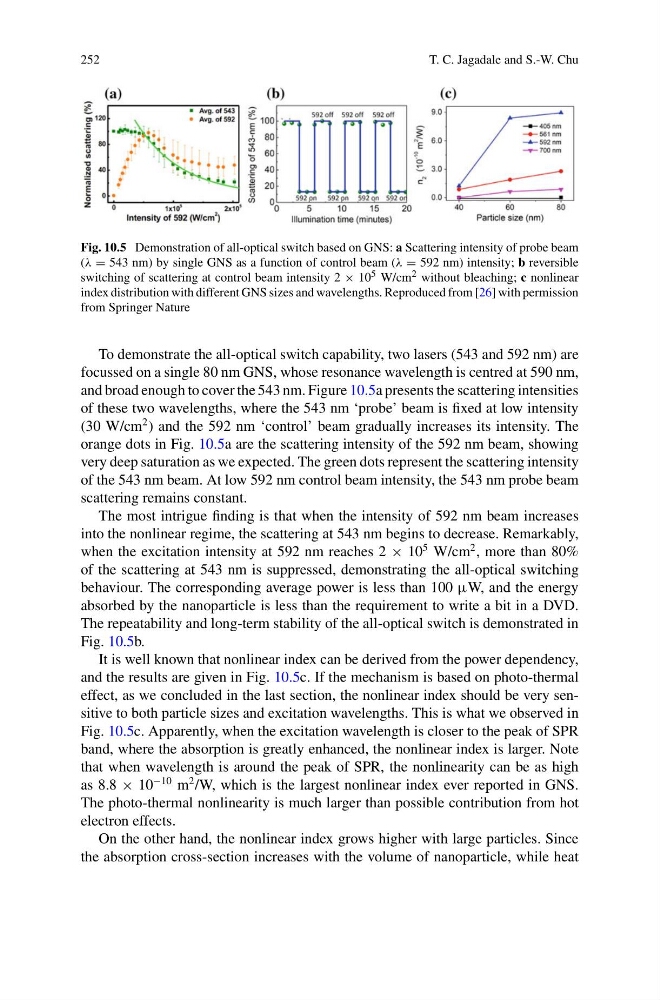
Fig. 10.5 Demonstration of all-optical switch based on GNS: a Scattering intensity of probe beam
(λ = 543 nm) by single GNS as a function of control beam (λ = 592 nm) intensity; b reversible
switching of scattering at control beam intensity 2 × 10 5 W/cm 2 without bleaching; c nonlinear
index distribution with different GNS sizes and wavelengths. Reproduced from [26] with permission
from Springer Nature
To demonstrate the all-optical switch capability, two lasers (543 and 592 nm) are
focussed on a single 80 nm GNS, whose resonance wavelength is centred at 590 nm,
and broad enough to cover the 543 nm. Figure 10.5a presents the scattering intensities
of these two wavelengths, where the 543 nm ‘probe’ beam is fixed at low intensity
(30 W/cm
2 ) and the 592 nm ‘control’ beam gradually increases its intensity. The
orange dots in Fig. 10.5a are the scattering intensity of the 592 nm beam, showing
very deep saturation as we expected. The green dots represent the scattering intensity
of the 543 nm beam. At low 592 nm control beam intensity, the 543 nm probe beam
scattering remains constant.
The most intrigue finding is that when the intensity of 592 nm beam increases
into the nonlinear regime, the scattering at 543 nm begins to decrease. Remarkably,
when the excitation intensity at 592 nm reaches 2 × 10
5 W/cm
2 , more than 80%
of the scattering at 543 nm is suppressed, demonstrating the all-optical switching
behaviour. The corresponding average power is less than 100 µW, and the energy
absorbed by the nanoparticle is less than the requirement to write a bit in a DVD.
The repeatability and long-term stability of the all-optical switch is demonstrated in
Fig. 10.5b.
It is well known that nonlinear index can be derived from the power dependency,
and the results are given in Fig. 10.5c. If the mechanism is based on photo-thermal
effect, as we concluded in the last section, the nonlinear index should be very sensitive to both particle sizes and excitation wavelengths. This is what we observed in
Fig. 10.5c. Apparently, when the excitation wavelength is closer to the peak of SPR
band, where the absorption is greatly enhanced, the nonlinear index is larger. Note
that when wavelength is around the peak of SPR, the nonlinearity can be as high
as 8.8 × 10
−10 m
2 /W, which is the largest nonlinear index ever reported in GNS.
The photo-thermal nonlinearity is much larger than possible contribution from hot
electron effects.
On the other hand, the nonlinear index grows higher with large particles. Since
the absorption cross-section increases with the volume of nanoparticle, while heat
T. C. Jagadale and S.-W. Chu
Fig. 10.5 Demonstration of all-optical switch based on GNS: a Scattering intensity of probe beam
(λ = 543 nm) by single GNS as a function of control beam (λ = 592 nm) intensity; b reversible
switching of scattering at control beam intensity 2 × 10 5 W/cm 2 without bleaching; c nonlinear
index distribution with different GNS sizes and wavelengths. Reproduced from [26] with permission
from Springer Nature
To demonstrate the all-optical switch capability, two lasers (543 and 592 nm) are
focussed on a single 80 nm GNS, whose resonance wavelength is centred at 590 nm,
and broad enough to cover the 543 nm. Figure 10.5a presents the scattering intensities
of these two wavelengths, where the 543 nm ‘probe’ beam is fixed at low intensity
(30 W/cm
2 ) and the 592 nm ‘control’ beam gradually increases its intensity. The
orange dots in Fig. 10.5a are the scattering intensity of the 592 nm beam, showing
very deep saturation as we expected. The green dots represent the scattering intensity
of the 543 nm beam. At low 592 nm control beam intensity, the 543 nm probe beam
scattering remains constant.
The most intrigue finding is that when the intensity of 592 nm beam increases
into the nonlinear regime, the scattering at 543 nm begins to decrease. Remarkably,
when the excitation intensity at 592 nm reaches 2 × 10
5 W/cm
2 , more than 80%
of the scattering at 543 nm is suppressed, demonstrating the all-optical switching
behaviour. The corresponding average power is less than 100 µW, and the energy
absorbed by the nanoparticle is less than the requirement to write a bit in a DVD.
The repeatability and long-term stability of the all-optical switch is demonstrated in
Fig. 10.5b.
It is well known that nonlinear index can be derived from the power dependency,
and the results are given in Fig. 10.5c. If the mechanism is based on photo-thermal
effect, as we concluded in the last section, the nonlinear index should be very sensitive to both particle sizes and excitation wavelengths. This is what we observed in
Fig. 10.5c. Apparently, when the excitation wavelength is closer to the peak of SPR
band, where the absorption is greatly enhanced, the nonlinear index is larger. Note
that when wavelength is around the peak of SPR, the nonlinearity can be as high
as 8.8 × 10
−10 m
2 /W, which is the largest nonlinear index ever reported in GNS.
The photo-thermal nonlinearity is much larger than possible contribution from hot
electron effects.
On the other hand, the nonlinear index grows higher with large particles. Since
the absorption cross-section increases with the volume of nanoparticle, while heat