

6 Absorption-Based Far-Field Label-Free Super-Resolution …
151
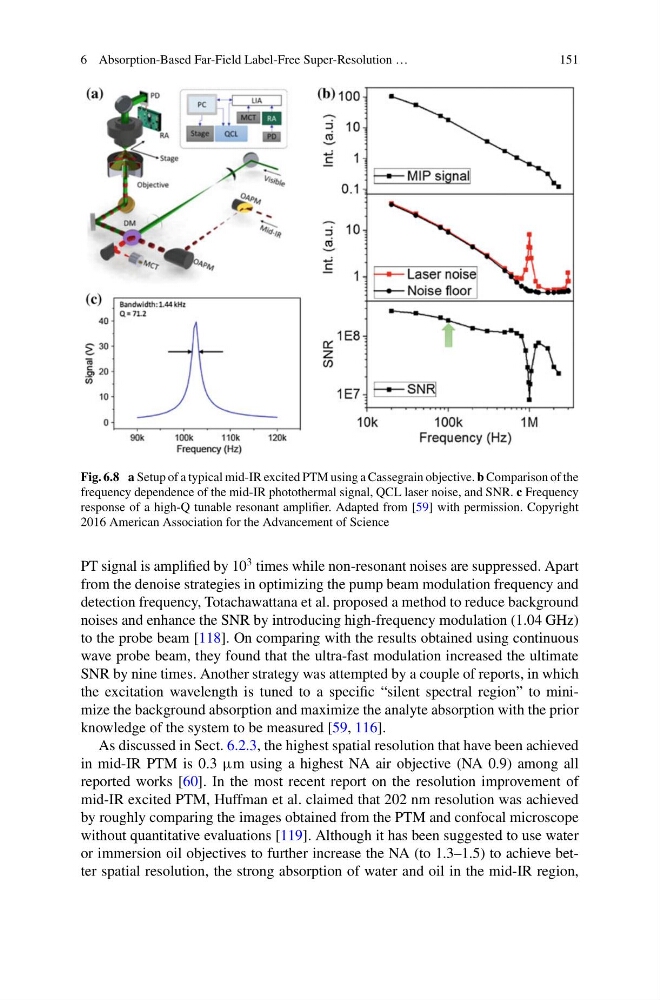
Fig. 6.8 a Setup of a typical mid-IR excited PTM using a Cassegrain objective. b Comparison of the
frequency dependence of the mid-IR photothermal signal, QCL laser noise, and SNR. c Frequency
response of a high-Q tunable resonant amplifier. Adapted from [59] with permission. Copyright
2016 American Association for the Advancement of Science
PT signal is amplified by 10
3 times while non-resonant noises are suppressed. Apart
from the denoise strategies in optimizing the pump beam modulation frequency and
detection frequency, Totachawattana et al. proposed a method to reduce background
noises and enhance the SNR by introducing high-frequency modulation (1.04 GHz)
to the probe beam [118]. On comparing with the results obtained using continuous
wave probe beam, they found that the ultra-fast modulation increased the ultimate
SNR by nine times. Another strategy was attempted by a couple of reports, in which
the excitation wavelength is tuned to a specific “silent spectral region” to minimize the background absorption and maximize the analyte absorption with the prior
knowledge of the system to be measured [59, 116].
As discussed in Sect. 6.2.3, the highest spatial resolution that have been achieved
in mid-IR PTM is 0.3 µm using a highest NA air objective (NA 0.9) among all
reported works [60]. In the most recent report on the resolution improvement of
mid-IR excited PTM, Huffman et al. claimed that 202 nm resolution was achieved
by roughly comparing the images obtained from the PTM and confocal microscope
without quantitative evaluations [119]. Although it has been suggested to use water
or immersion oil objectives to further increase the NA (to 1.3–1.5) to achieve better spatial resolution, the strong absorption of water and oil in the mid-IR region,
151
Fig. 6.8 a Setup of a typical mid-IR excited PTM using a Cassegrain objective. b Comparison of the
frequency dependence of the mid-IR photothermal signal, QCL laser noise, and SNR. c Frequency
response of a high-Q tunable resonant amplifier. Adapted from [59] with permission. Copyright
2016 American Association for the Advancement of Science
PT signal is amplified by 10
3 times while non-resonant noises are suppressed. Apart
from the denoise strategies in optimizing the pump beam modulation frequency and
detection frequency, Totachawattana et al. proposed a method to reduce background
noises and enhance the SNR by introducing high-frequency modulation (1.04 GHz)
to the probe beam [118]. On comparing with the results obtained using continuous
wave probe beam, they found that the ultra-fast modulation increased the ultimate
SNR by nine times. Another strategy was attempted by a couple of reports, in which
the excitation wavelength is tuned to a specific “silent spectral region” to minimize the background absorption and maximize the analyte absorption with the prior
knowledge of the system to be measured [59, 116].
As discussed in Sect. 6.2.3, the highest spatial resolution that have been achieved
in mid-IR PTM is 0.3 µm using a highest NA air objective (NA 0.9) among all
reported works [60]. In the most recent report on the resolution improvement of
mid-IR excited PTM, Huffman et al. claimed that 202 nm resolution was achieved
by roughly comparing the images obtained from the PTM and confocal microscope
without quantitative evaluations [119]. Although it has been suggested to use water
or immersion oil objectives to further increase the NA (to 1.3–1.5) to achieve better spatial resolution, the strong absorption of water and oil in the mid-IR region,