

250
A. Wittek et al.
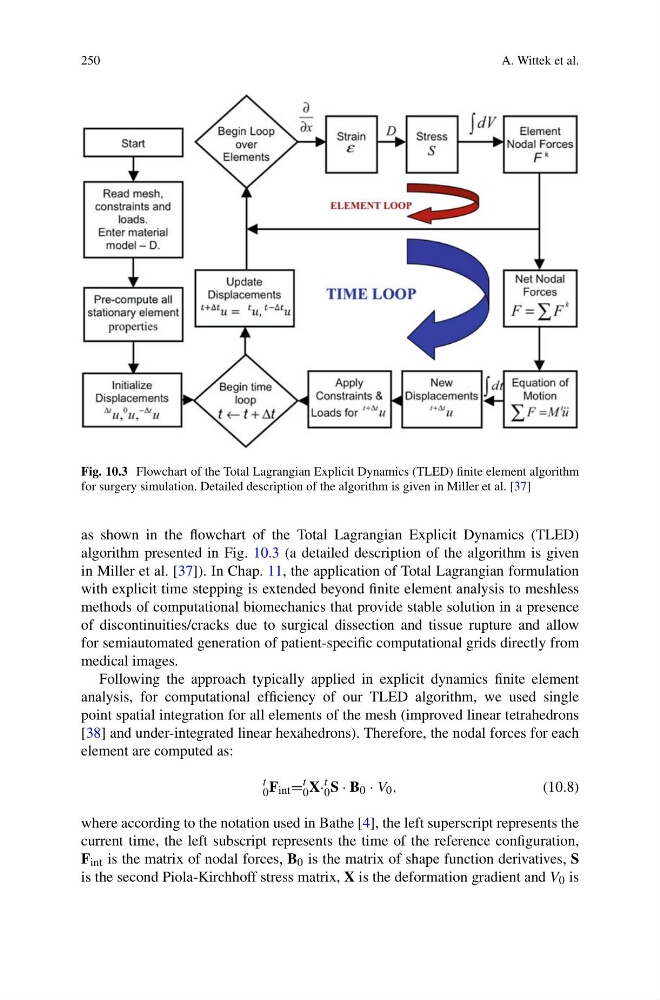
Fig. 10.3 Flowchart of the Total Lagrangian Explicit Dynamics (TLED) finite element algorithm
for surgery simulation. Detailed description of the algorithm is given in Miller et al. [37]
as shown in the flowchart of the Total Lagrangian Explicit Dynamics (TLED)
algorithm presented in Fig. 10.3 (a detailed description of the algorithm is given
in Miller et al. [37]). In Chap. 11, the application of Total Lagrangian formulation
with explicit time stepping is extended beyond finite element analysis to meshless
methods of computational biomechanics that provide stable solution in a presence
of discontinuities/cracks due to surgical dissection and tissue rupture and allow
for semiautomated generation of patient-specific computational grids directly from
medical images.
Following the approach typically applied in explicit dynamics finite element
analysis, for computational efficiency of our TLED algorithm, we used single
point spatial integration for all elements of the mesh (improved linear tetrahedrons
[38] and under-integrated linear hexahedrons). Therefore, the nodal forces for each
element are computed as:
t
0 F int =
t
0 X·
t
0 S · B 0 · V 0 ,
(10.8)
where according to the notation used in Bathe [4], the left superscript represents the
current time, the left subscript represents the time of the reference configuration,
F int is the matrix of nodal forces, B 0 is the matrix of shape function derivatives, S
is the second Piola-Kirchhoff stress matrix, X is the deformation gradient and V 0 is
A. Wittek et al.
Fig. 10.3 Flowchart of the Total Lagrangian Explicit Dynamics (TLED) finite element algorithm
for surgery simulation. Detailed description of the algorithm is given in Miller et al. [37]
as shown in the flowchart of the Total Lagrangian Explicit Dynamics (TLED)
algorithm presented in Fig. 10.3 (a detailed description of the algorithm is given
in Miller et al. [37]). In Chap. 11, the application of Total Lagrangian formulation
with explicit time stepping is extended beyond finite element analysis to meshless
methods of computational biomechanics that provide stable solution in a presence
of discontinuities/cracks due to surgical dissection and tissue rupture and allow
for semiautomated generation of patient-specific computational grids directly from
medical images.
Following the approach typically applied in explicit dynamics finite element
analysis, for computational efficiency of our TLED algorithm, we used single
point spatial integration for all elements of the mesh (improved linear tetrahedrons
[38] and under-integrated linear hexahedrons). Therefore, the nodal forces for each
element are computed as:
t
0 F int =
t
0 X·
t
0 S · B 0 · V 0 ,
(10.8)
where according to the notation used in Bathe [4], the left superscript represents the
current time, the left subscript represents the time of the reference configuration,
F int is the matrix of nodal forces, B 0 is the matrix of shape function derivatives, S
is the second Piola-Kirchhoff stress matrix, X is the deformation gradient and V 0 is