

216
V. Kurtcuoglu et al.
models can provide spatially and temporally resolved information on flow, pressure
and mass transport, making them suitable for subject-specific calculations of CSF
dynamics based on medical image data.
The laws of mass, momentum and energy conservation constitute the basis
of CFD modelling. While the continuity equation is used to describe mass conservation, the Navier-Stokes equations are employed to characterize momentum
conservation in Newtonian fluids. Energy conservation is often not imposed in CSF
modelling, unless relevant temperature gradients are expected, such as in thermal
ablation or CNS cooling applications.
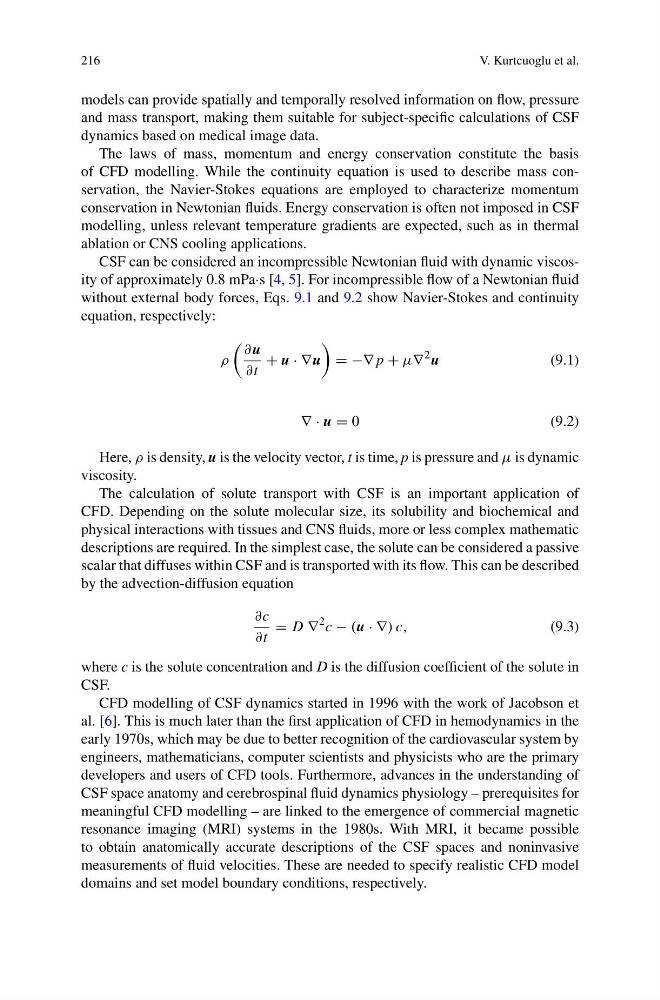
CSF can be considered an incompressible Newtonian fluid with dynamic viscosity of approximately 0.8 mPa·s [4, 5]. For incompressible flow of a Newtonian fluid
without external body forces, Eqs. 9.1 and 9.2 show Navier-Stokes and continuity
equation, respectively:
ρ
∂u
∂t
+ u · ∇u
= −∇p + μ∇
2 u
(9.1)
∇ · u = 0
(9.2)
Here, ρ is density, u is the velocity vector, t is time, p is pressure and μ is dynamic
viscosity.
The calculation of solute transport with CSF is an important application of
CFD. Depending on the solute molecular size, its solubility and biochemical and
physical interactions with tissues and CNS fluids, more or less complex mathematic
descriptions are required. In the simplest case, the solute can be considered a passive
scalar that diffuses within CSF and is transported with its flow. This can be described
by the advection-diffusion equation
∂c
∂t
= D ∇
2 c − (u · ∇) c,
(9.3)
where c is the solute concentration and D is the diffusion coefficient of the solute in
CSF.
CFD modelling of CSF dynamics started in 1996 with the work of Jacobson et
al. [6]. This is much later than the first application of CFD in hemodynamics in the
early 1970s, which may be due to better recognition of the cardiovascular system by
engineers, mathematicians, computer scientists and physicists who are the primary
developers and users of CFD tools. Furthermore, advances in the understanding of
CSF space anatomy and cerebrospinal fluid dynamics physiology – prerequisites for
meaningful CFD modelling – are linked to the emergence of commercial magnetic
resonance imaging (MRI) systems in the 1980s. With MRI, it became possible
to obtain anatomically accurate descriptions of the CSF spaces and noninvasive
measurements of fluid velocities. These are needed to specify realistic CFD model
domains and set model boundary conditions, respectively.
V. Kurtcuoglu et al.
models can provide spatially and temporally resolved information on flow, pressure
and mass transport, making them suitable for subject-specific calculations of CSF
dynamics based on medical image data.
The laws of mass, momentum and energy conservation constitute the basis
of CFD modelling. While the continuity equation is used to describe mass conservation, the Navier-Stokes equations are employed to characterize momentum
conservation in Newtonian fluids. Energy conservation is often not imposed in CSF
modelling, unless relevant temperature gradients are expected, such as in thermal
ablation or CNS cooling applications.
CSF can be considered an incompressible Newtonian fluid with dynamic viscosity of approximately 0.8 mPa·s [4, 5]. For incompressible flow of a Newtonian fluid
without external body forces, Eqs. 9.1 and 9.2 show Navier-Stokes and continuity
equation, respectively:
ρ
∂u
∂t
+ u · ∇u
= −∇p + μ∇
2 u
(9.1)
∇ · u = 0
(9.2)
Here, ρ is density, u is the velocity vector, t is time, p is pressure and μ is dynamic
viscosity.
The calculation of solute transport with CSF is an important application of
CFD. Depending on the solute molecular size, its solubility and biochemical and
physical interactions with tissues and CNS fluids, more or less complex mathematic
descriptions are required. In the simplest case, the solute can be considered a passive
scalar that diffuses within CSF and is transported with its flow. This can be described
by the advection-diffusion equation
∂c
∂t
= D ∇
2 c − (u · ∇) c,
(9.3)
where c is the solute concentration and D is the diffusion coefficient of the solute in
CSF.
CFD modelling of CSF dynamics started in 1996 with the work of Jacobson et
al. [6]. This is much later than the first application of CFD in hemodynamics in the
early 1970s, which may be due to better recognition of the cardiovascular system by
engineers, mathematicians, computer scientists and physicists who are the primary
developers and users of CFD tools. Furthermore, advances in the understanding of
CSF space anatomy and cerebrospinal fluid dynamics physiology – prerequisites for
meaningful CFD modelling – are linked to the emergence of commercial magnetic
resonance imaging (MRI) systems in the 1980s. With MRI, it became possible
to obtain anatomically accurate descriptions of the CSF spaces and noninvasive
measurements of fluid velocities. These are needed to specify realistic CFD model
domains and set model boundary conditions, respectively.