

184
L. Geregele et al.
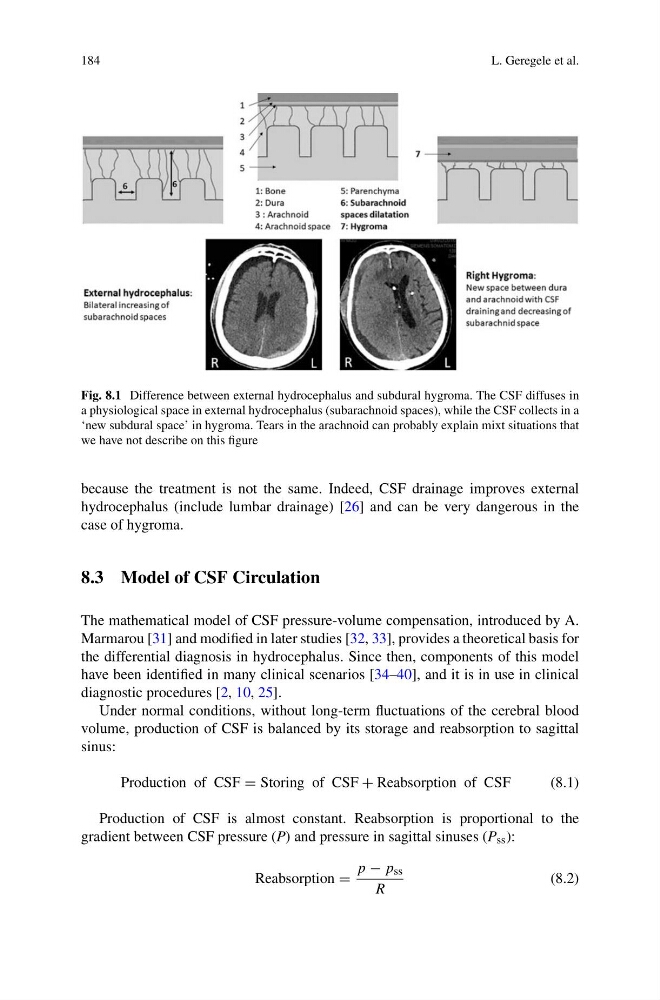
Fig. 8.1 Difference between external hydrocephalus and subdural hygroma. The CSF diffuses in
a physiological space in external hydrocephalus (subarachnoid spaces), while the CSF collects in a
‘new subdural space’ in hygroma. Tears in the arachnoid can probably explain mixt situations that
we have not describe on this figure
because the treatment is not the same. Indeed, CSF drainage improves external
hydrocephalus (include lumbar drainage) [26] and can be very dangerous in the
case of hygroma.
8.3 Model of CSF Circulation
The mathematical model of CSF pressure-volume compensation, introduced by A.
Marmarou [31] and modified in later studies [32, 33], provides a theoretical basis for
the differential diagnosis in hydrocephalus. Since then, components of this model
have been identified in many clinical scenarios [34–40], and it is in use in clinical
diagnostic procedures [2, 10, 25].
Under normal conditions, without long-term fluctuations of the cerebral blood
volume, production of CSF is balanced by its storage and reabsorption to sagittal
sinus:
Production of CSF = Storing of CSF + Reabsorption of CSF
(8.1)
Production of CSF is almost constant. Reabsorption is proportional to the
gradient between CSF pressure (P) and pressure in sagittal sinuses (P ss ):
Reabsorption =
p − p ss
R
(8.2)
L. Geregele et al.
Fig. 8.1 Difference between external hydrocephalus and subdural hygroma. The CSF diffuses in
a physiological space in external hydrocephalus (subarachnoid spaces), while the CSF collects in a
‘new subdural space’ in hygroma. Tears in the arachnoid can probably explain mixt situations that
we have not describe on this figure
because the treatment is not the same. Indeed, CSF drainage improves external
hydrocephalus (include lumbar drainage) [26] and can be very dangerous in the
case of hygroma.
8.3 Model of CSF Circulation
The mathematical model of CSF pressure-volume compensation, introduced by A.
Marmarou [31] and modified in later studies [32, 33], provides a theoretical basis for
the differential diagnosis in hydrocephalus. Since then, components of this model
have been identified in many clinical scenarios [34–40], and it is in use in clinical
diagnostic procedures [2, 10, 25].
Under normal conditions, without long-term fluctuations of the cerebral blood
volume, production of CSF is balanced by its storage and reabsorption to sagittal
sinus:
Production of CSF = Storing of CSF + Reabsorption of CSF
(8.1)
Production of CSF is almost constant. Reabsorption is proportional to the
gradient between CSF pressure (P) and pressure in sagittal sinuses (P ss ):
Reabsorption =
p − p ss
R
(8.2)