

6 Biomechanical Modelling of the Brain for Neurosurgical Simulation. . .
153
a large number of image pairs [113]. Therefore we chose Canny edges [114] as
features for comparison [9]. Edges are regarded as useful and easily recognisable
features, and they can be detected using techniques that are automated and fast.
Canny edges obtained from the intra-operative and registered pre-operative image
slices are labelled in different colours and overlaid.
6.3.6.2 Quantitative Evaluation
For a quantitative evaluation of the accuracy of the displacement calculations, we
used the edge-based Hausdorff distance. This methodology, based on pioneering
work of [115], is described in detail in [9].
While measuring the misalignments between two medical images, it is desirable
to calculate the distance between local features (in the case of brain MRI considered
here, the automatically detected Canny edges) in two images that correspond to each
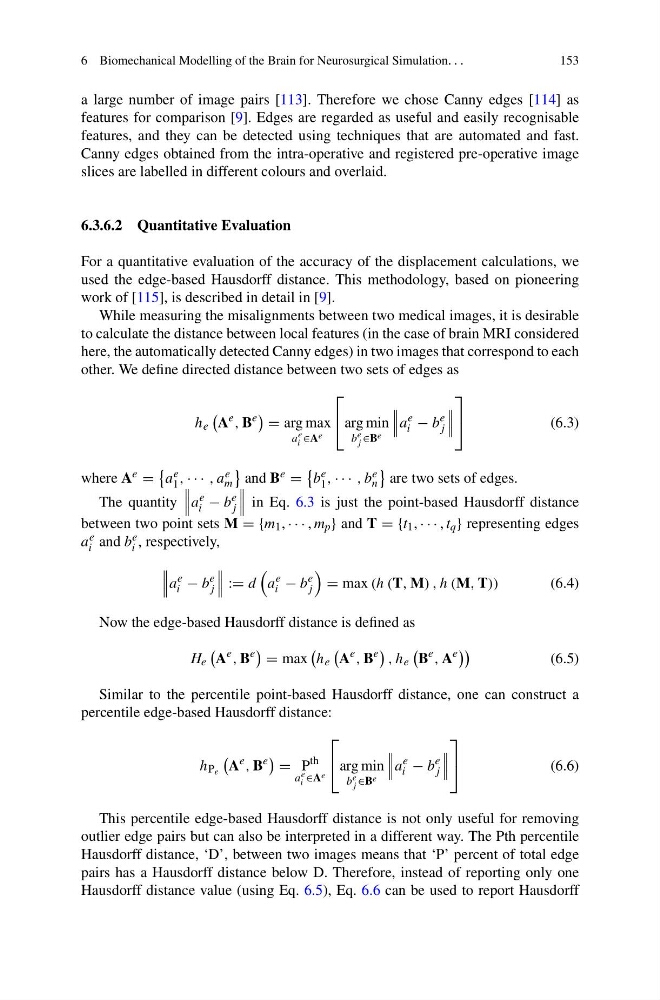
other. We define directed distance between two sets of edges as
h e
A
e , B
e
= arg max
a e
i ∈A e
⎡
⎣ arg min
b e
j ∈B e
a
e
i − b
e
j
⎤
⎦
(6.3)
where A e =
a e
1 , · · · , a e
m
and B e =
b e
1 , · · · , b e
n
are two sets of edges.
The quantity
a
e
i − b e
j
in Eq. 6.3 is just the point-based Hausdorff distance
between two point sets M = {m 1 , · · · , m p } and T = {t 1 , · · · , t q } representing edges
a e
i and b e
i , respectively,
a
e
i − b
e
j
:= d
a
e
i − b
e
j
= max (h (T, M) , h (M, T))
(6.4)
Now the edge-based Hausdorff distance is defined as
H e
A
e , B
e
= max
h e
A
e , B
e
, h e
B
e , A
e
(6.5)
Similar to the percentile point-based Hausdorff distance, one can construct a
percentile edge-based Hausdorff distance:
h P e
A
e , B
e
= P
th
a e
i ∈A e
⎡
⎣ arg min
b e
j ∈B e
a
e
i − b
e
j
⎤
⎦
(6.6)
This percentile edge-based Hausdorff distance is not only useful for removing
outlier edge pairs but can also be interpreted in a different way. The Pth percentile
Hausdorff distance, ‘D’, between two images means that ‘P’ percent of total edge
pairs has a Hausdorff distance below D. Therefore, instead of reporting only one
Hausdorff distance value (using Eq. 6.5), Eq. 6.6 can be used to report Hausdorff
153
a large number of image pairs [113]. Therefore we chose Canny edges [114] as
features for comparison [9]. Edges are regarded as useful and easily recognisable
features, and they can be detected using techniques that are automated and fast.
Canny edges obtained from the intra-operative and registered pre-operative image
slices are labelled in different colours and overlaid.
6.3.6.2 Quantitative Evaluation
For a quantitative evaluation of the accuracy of the displacement calculations, we
used the edge-based Hausdorff distance. This methodology, based on pioneering
work of [115], is described in detail in [9].
While measuring the misalignments between two medical images, it is desirable
to calculate the distance between local features (in the case of brain MRI considered
here, the automatically detected Canny edges) in two images that correspond to each
other. We define directed distance between two sets of edges as
h e
A
e , B
e
= arg max
a e
i ∈A e
⎡
⎣ arg min
b e
j ∈B e
a
e
i − b
e
j
⎤
⎦
(6.3)
where A e =
a e
1 , · · · , a e
m
and B e =
b e
1 , · · · , b e
n
are two sets of edges.
The quantity
a
e
i − b e
j
in Eq. 6.3 is just the point-based Hausdorff distance
between two point sets M = {m 1 , · · · , m p } and T = {t 1 , · · · , t q } representing edges
a e
i and b e
i , respectively,
a
e
i − b
e
j
:= d
a
e
i − b
e
j
= max (h (T, M) , h (M, T))
(6.4)
Now the edge-based Hausdorff distance is defined as
H e
A
e , B
e
= max
h e
A
e , B
e
, h e
B
e , A
e
(6.5)
Similar to the percentile point-based Hausdorff distance, one can construct a
percentile edge-based Hausdorff distance:
h P e
A
e , B
e
= P
th
a e
i ∈A e
⎡
⎣ arg min
b e
j ∈B e
a
e
i − b
e
j
⎤
⎦
(6.6)
This percentile edge-based Hausdorff distance is not only useful for removing
outlier edge pairs but can also be interpreted in a different way. The Pth percentile
Hausdorff distance, ‘D’, between two images means that ‘P’ percent of total edge
pairs has a Hausdorff distance below D. Therefore, instead of reporting only one
Hausdorff distance value (using Eq. 6.5), Eq. 6.6 can be used to report Hausdorff