

148
K. Miller et al.
Nevertheless, as shown in the previous section on modelling loading, much
can be achieved even without a patient-specific model of brain tissue mechanical
properties, if the model is loaded by the enforced motion of a boundary and the
problem is formulated as Dirichlet-type: a pure displacement or displacement-zero
traction problem. As the computed results are then almost insensitive to the assumed
mechanical properties of the tissue, we advocate using the simplest model that is
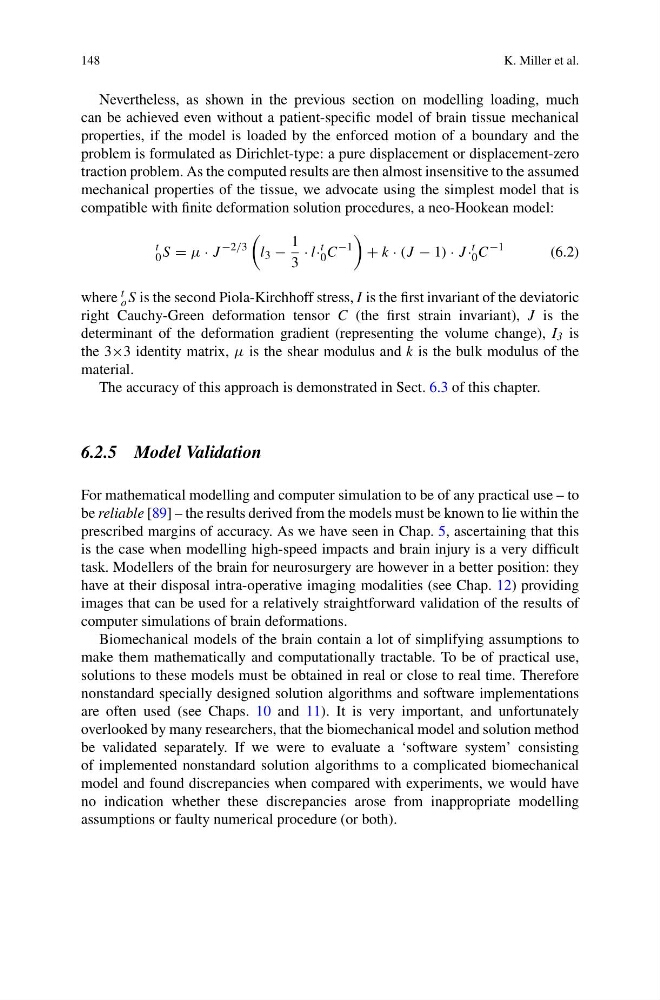
compatible with finite deformation solution procedures, a neo-Hookean model:
t
0 S = μ · J
−2/3
l 3 −
1
3
· l·
t
0 C
−1
+ k · (J − 1) · J ·
t
0 C
−1
(6.2)
where t
o S is the second Piola-Kirchhoff stress, I is the first invariant of the deviatoric
right Cauchy-Green deformation tensor C (the first strain invariant), J is the
determinant of the deformation gradient (representing the volume change), I 3 is
the 3×3 identity matrix, μ is the shear modulus and k is the bulk modulus of the
material.
The accuracy of this approach is demonstrated in Sect. 6.3 of this chapter.
6.2.5 Model Validation
For mathematical modelling and computer simulation to be of any practical use – to
be reliable [89] – the results derived from the models must be known to lie within the
prescribed margins of accuracy. As we have seen in Chap. 5, ascertaining that this
is the case when modelling high-speed impacts and brain injury is a very difficult
task. Modellers of the brain for neurosurgery are however in a better position: they
have at their disposal intra-operative imaging modalities (see Chap. 12) providing
images that can be used for a relatively straightforward validation of the results of
computer simulations of brain deformations.
Biomechanical models of the brain contain a lot of simplifying assumptions to
make them mathematically and computationally tractable. To be of practical use,
solutions to these models must be obtained in real or close to real time. Therefore
nonstandard specially designed solution algorithms and software implementations
are often used (see Chaps. 10 and 11). It is very important, and unfortunately
overlooked by many researchers, that the biomechanical model and solution method
be validated separately. If we were to evaluate a ‘software system’ consisting
of implemented nonstandard solution algorithms to a complicated biomechanical
model and found discrepancies when compared with experiments, we would have
no indication whether these discrepancies arose from inappropriate modelling
assumptions or faulty numerical procedure (or both).
K. Miller et al.
Nevertheless, as shown in the previous section on modelling loading, much
can be achieved even without a patient-specific model of brain tissue mechanical
properties, if the model is loaded by the enforced motion of a boundary and the
problem is formulated as Dirichlet-type: a pure displacement or displacement-zero
traction problem. As the computed results are then almost insensitive to the assumed
mechanical properties of the tissue, we advocate using the simplest model that is
compatible with finite deformation solution procedures, a neo-Hookean model:
t
0 S = μ · J
−2/3
l 3 −
1
3
· l·
t
0 C
−1
+ k · (J − 1) · J ·
t
0 C
−1
(6.2)
where t
o S is the second Piola-Kirchhoff stress, I is the first invariant of the deviatoric
right Cauchy-Green deformation tensor C (the first strain invariant), J is the
determinant of the deformation gradient (representing the volume change), I 3 is
the 3×3 identity matrix, μ is the shear modulus and k is the bulk modulus of the
material.
The accuracy of this approach is demonstrated in Sect. 6.3 of this chapter.
6.2.5 Model Validation
For mathematical modelling and computer simulation to be of any practical use – to
be reliable [89] – the results derived from the models must be known to lie within the
prescribed margins of accuracy. As we have seen in Chap. 5, ascertaining that this
is the case when modelling high-speed impacts and brain injury is a very difficult
task. Modellers of the brain for neurosurgery are however in a better position: they
have at their disposal intra-operative imaging modalities (see Chap. 12) providing
images that can be used for a relatively straightforward validation of the results of
computer simulations of brain deformations.
Biomechanical models of the brain contain a lot of simplifying assumptions to
make them mathematically and computationally tractable. To be of practical use,
solutions to these models must be obtained in real or close to real time. Therefore
nonstandard specially designed solution algorithms and software implementations
are often used (see Chaps. 10 and 11). It is very important, and unfortunately
overlooked by many researchers, that the biomechanical model and solution method
be validated separately. If we were to evaluate a ‘software system’ consisting
of implemented nonstandard solution algorithms to a complicated biomechanical
model and found discrepancies when compared with experiments, we would have
no indication whether these discrepancies arose from inappropriate modelling
assumptions or faulty numerical procedure (or both).