

124
K. H. Yang and H. Mao
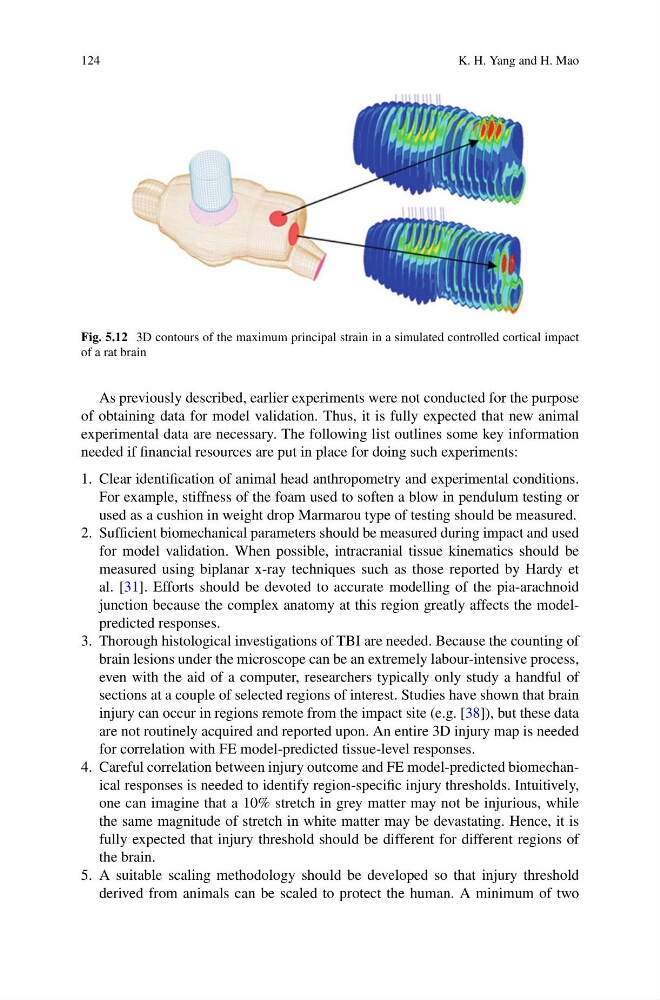
Fig. 5.12 3D contours of the maximum principal strain in a simulated controlled cortical impact
of a rat brain
As previously described, earlier experiments were not conducted for the purpose
of obtaining data for model validation. Thus, it is fully expected that new animal
experimental data are necessary. The following list outlines some key information
needed if financial resources are put in place for doing such experiments:
1. Clear identification of animal head anthropometry and experimental conditions.
For example, stiffness of the foam used to soften a blow in pendulum testing or
used as a cushion in weight drop Marmarou type of testing should be measured.
2. Sufficient biomechanical parameters should be measured during impact and used
for model validation. When possible, intracranial tissue kinematics should be
measured using biplanar x-ray techniques such as those reported by Hardy et
al. [31]. Efforts should be devoted to accurate modelling of the pia-arachnoid
junction because the complex anatomy at this region greatly affects the modelpredicted responses.
3. Thorough histological investigations of TBI are needed. Because the counting of
brain lesions under the microscope can be an extremely labour-intensive process,
even with the aid of a computer, researchers typically only study a handful of
sections at a couple of selected regions of interest. Studies have shown that brain
injury can occur in regions remote from the impact site (e.g. [38]), but these data
are not routinely acquired and reported upon. An entire 3D injury map is needed
for correlation with FE model-predicted tissue-level responses.
4. Careful correlation between injury outcome and FE model-predicted biomechanical responses is needed to identify region-specific injury thresholds. Intuitively,
one can imagine that a 10% stretch in grey matter may not be injurious, while
the same magnitude of stretch in white matter may be devastating. Hence, it is
fully expected that injury threshold should be different for different regions of
the brain.
5. A suitable scaling methodology should be developed so that injury threshold
derived from animals can be scaled to protect the human. A minimum of two
K. H. Yang and H. Mao
Fig. 5.12 3D contours of the maximum principal strain in a simulated controlled cortical impact
of a rat brain
As previously described, earlier experiments were not conducted for the purpose
of obtaining data for model validation. Thus, it is fully expected that new animal
experimental data are necessary. The following list outlines some key information
needed if financial resources are put in place for doing such experiments:
1. Clear identification of animal head anthropometry and experimental conditions.
For example, stiffness of the foam used to soften a blow in pendulum testing or
used as a cushion in weight drop Marmarou type of testing should be measured.
2. Sufficient biomechanical parameters should be measured during impact and used
for model validation. When possible, intracranial tissue kinematics should be
measured using biplanar x-ray techniques such as those reported by Hardy et
al. [31]. Efforts should be devoted to accurate modelling of the pia-arachnoid
junction because the complex anatomy at this region greatly affects the modelpredicted responses.
3. Thorough histological investigations of TBI are needed. Because the counting of
brain lesions under the microscope can be an extremely labour-intensive process,
even with the aid of a computer, researchers typically only study a handful of
sections at a couple of selected regions of interest. Studies have shown that brain
injury can occur in regions remote from the impact site (e.g. [38]), but these data
are not routinely acquired and reported upon. An entire 3D injury map is needed
for correlation with FE model-predicted tissue-level responses.
4. Careful correlation between injury outcome and FE model-predicted biomechanical responses is needed to identify region-specific injury thresholds. Intuitively,
one can imagine that a 10% stretch in grey matter may not be injurious, while
the same magnitude of stretch in white matter may be devastating. Hence, it is
fully expected that injury threshold should be different for different regions of
the brain.
5. A suitable scaling methodology should be developed so that injury threshold
derived from animals can be scaled to protect the human. A minimum of two