

77
expected to reach $50 billion by 2020. Moreover, poor design and complexity of
electronics impose difficulties during recycling and separation of different materials, which can be overcome by alternative designs and in-house industrial recycling.
Also, lack of Electronic-waste management regulations inhibits effective recycling
and allows E-waste producers to practice landfilling and incineration.
Also, Electronic-waste major categories include photovoltaic panels which have
the longest lifespan of electronic products of 20 years and consist of 90% siliconbased products. Advantages of photovoltaic (PV) panels recycling include lowcarbon emissions and low energy costs in comparison with other major electronic
products. Also, liquid crystal display (LCD) panels contain toxic substances that
require pretreatment before recycling of heavy metals especially indium which is
considered the most valuable material in liquid crystal display (LCD) screens. On
the other hand, computer E-waste focuses on copper extraction from printed wiring
boards (PWBs) which have a process efficiency of 80%. On the other hand, mobile
phones have very low recycling rate that doesn’t exceed 3% where lithium is the
most valuable material available in batteries. Since mobile phones have a short lifespan and a compact design, difficulties are faced in segregation and dismantling as
well as the acid scrapping of metals.
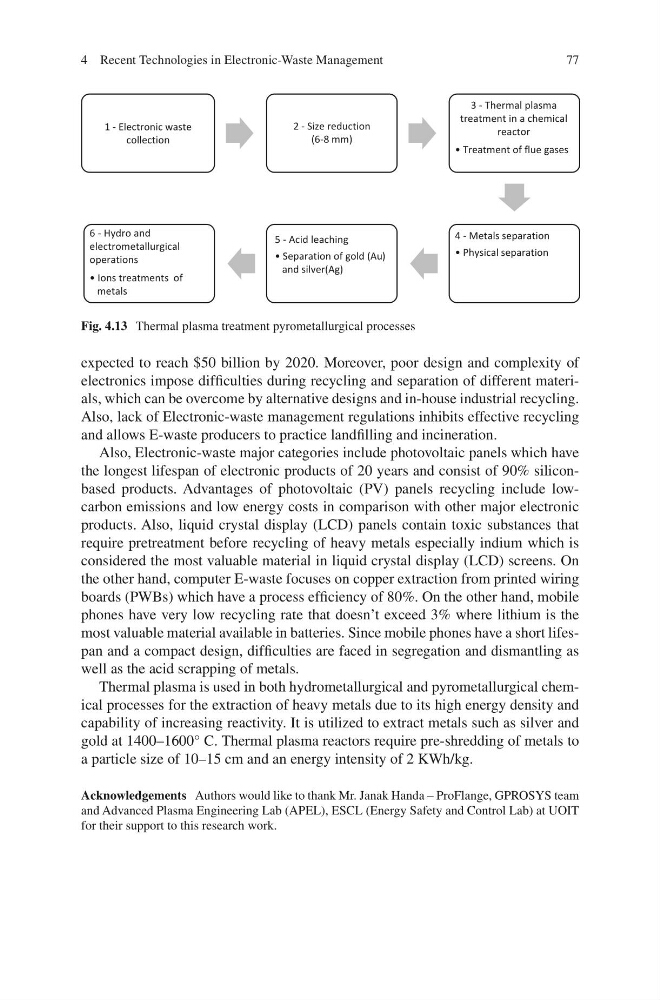
Thermal plasma is used in both hydrometallurgical and pyrometallurgical chemical processes for the extraction of heavy metals due to its high energy density and
capability of increasing reactivity. It is utilized to extract metals such as silver and
gold at 1400–1600° C. Thermal plasma reactors require pre-shredding of metals to
a particle size of 10–15 cm and an energy intensity of 2 KWh/kg.
Acknowledgements Authors would like to thank Mr. Janak Handa – ProFlange, GPROSYS team
and Advanced Plasma Engineering Lab (APEL), ESCL (Energy Safety and Control Lab) at UOIT
for their support to this research work.
1 - Electronic waste
collection
2 - Size reduction
(6-8 mm)
3 - Thermal plasma
treatment in a chemical
reactor
• Treatment of flue gases
4 - Metals separation
• Physical separation
5 - Acid leaching
• Separation of gold (Au)
and silver(Ag)
6 - Hydro and
electrometallurgical
operations
• Ions treatments of
metals
Fig. 4.13 Thermal plasma treatment pyrometallurgical processes
4 Recent Technologies in Electronic-Waste Management
expected to reach $50 billion by 2020. Moreover, poor design and complexity of
electronics impose difficulties during recycling and separation of different materials, which can be overcome by alternative designs and in-house industrial recycling.
Also, lack of Electronic-waste management regulations inhibits effective recycling
and allows E-waste producers to practice landfilling and incineration.
Also, Electronic-waste major categories include photovoltaic panels which have
the longest lifespan of electronic products of 20 years and consist of 90% siliconbased products. Advantages of photovoltaic (PV) panels recycling include lowcarbon emissions and low energy costs in comparison with other major electronic
products. Also, liquid crystal display (LCD) panels contain toxic substances that
require pretreatment before recycling of heavy metals especially indium which is
considered the most valuable material in liquid crystal display (LCD) screens. On
the other hand, computer E-waste focuses on copper extraction from printed wiring
boards (PWBs) which have a process efficiency of 80%. On the other hand, mobile
phones have very low recycling rate that doesn’t exceed 3% where lithium is the
most valuable material available in batteries. Since mobile phones have a short lifespan and a compact design, difficulties are faced in segregation and dismantling as
well as the acid scrapping of metals.
Thermal plasma is used in both hydrometallurgical and pyrometallurgical chemical processes for the extraction of heavy metals due to its high energy density and
capability of increasing reactivity. It is utilized to extract metals such as silver and
gold at 1400–1600° C. Thermal plasma reactors require pre-shredding of metals to
a particle size of 10–15 cm and an energy intensity of 2 KWh/kg.
Acknowledgements Authors would like to thank Mr. Janak Handa – ProFlange, GPROSYS team
and Advanced Plasma Engineering Lab (APEL), ESCL (Energy Safety and Control Lab) at UOIT
for their support to this research work.
1 - Electronic waste
collection
2 - Size reduction
(6-8 mm)
3 - Thermal plasma
treatment in a chemical
reactor
• Treatment of flue gases
4 - Metals separation
• Physical separation
5 - Acid leaching
• Separation of gold (Au)
and silver(Ag)
6 - Hydro and
electrometallurgical
operations
• Ions treatments of
metals
Fig. 4.13 Thermal plasma treatment pyrometallurgical processes
4 Recent Technologies in Electronic-Waste Management