

75
have a relatively short lifespan, and recyclers face problems due to compact design
and waste released to the environment during recycling (Soo and Doolan 2014).
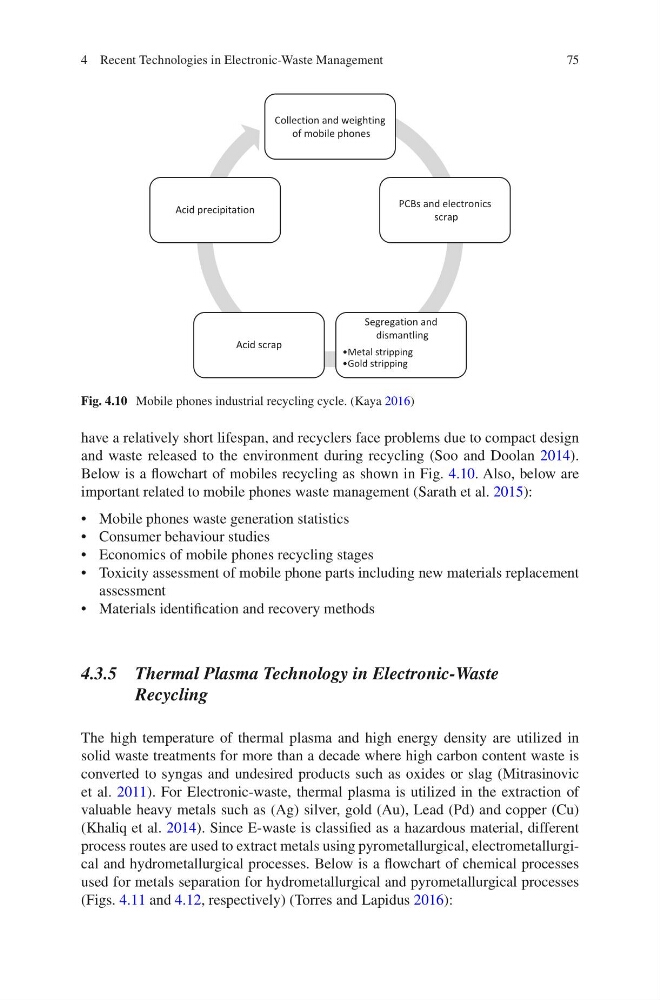
Below is a flowchart of mobiles recycling as shown in Fig. 4.10. Also, below are
important related to mobile phones waste management (Sarath et al. 2015):
• Mobile phones waste generation statistics
• Consumer behaviour studies
• Economics of mobile phones recycling stages
• Toxicity assessment of mobile phone parts including new materials replacement
assessment
• Materials identification and recovery methods
4.3.5 Thermal Plasma Technology in Electronic-Waste
Recycling
The high temperature of thermal plasma and high energy density are utilized in
solid waste treatments for more than a decade where high carbon content waste is
converted to syngas and undesired products such as oxides or slag (Mitrasinovic
et al. 2011). For Electronic-waste, thermal plasma is utilized in the extraction of
valuable heavy metals such as (Ag) silver, gold (Au), Lead (Pd) and copper (Cu)
(Khaliq et al. 2014). Since E-waste is classified as a hazardous material, different
process routes are used to extract metals using pyrometallurgical, electrometallurgical and hydrometallurgical processes. Below is a flowchart of chemical processes
used for metals separation for hydrometallurgical and pyrometallurgical processes
(Figs. 4.11 and 4.12, respectively) (Torres and Lapidus 2016):
Collection and weighting
of mobile phones
PCBs and electronics
scrap
Segregation and
dismantling
•Metal stripping
•Gold stripping
Acid scrap
Acid precipitation
Fig. 4.10 Mobile phones industrial recycling cycle. (Kaya 2016)
4 Recent Technologies in Electronic-Waste Management
have a relatively short lifespan, and recyclers face problems due to compact design
and waste released to the environment during recycling (Soo and Doolan 2014).
Below is a flowchart of mobiles recycling as shown in Fig. 4.10. Also, below are
important related to mobile phones waste management (Sarath et al. 2015):
• Mobile phones waste generation statistics
• Consumer behaviour studies
• Economics of mobile phones recycling stages
• Toxicity assessment of mobile phone parts including new materials replacement
assessment
• Materials identification and recovery methods
4.3.5 Thermal Plasma Technology in Electronic-Waste
Recycling
The high temperature of thermal plasma and high energy density are utilized in
solid waste treatments for more than a decade where high carbon content waste is
converted to syngas and undesired products such as oxides or slag (Mitrasinovic
et al. 2011). For Electronic-waste, thermal plasma is utilized in the extraction of
valuable heavy metals such as (Ag) silver, gold (Au), Lead (Pd) and copper (Cu)
(Khaliq et al. 2014). Since E-waste is classified as a hazardous material, different
process routes are used to extract metals using pyrometallurgical, electrometallurgical and hydrometallurgical processes. Below is a flowchart of chemical processes
used for metals separation for hydrometallurgical and pyrometallurgical processes
(Figs. 4.11 and 4.12, respectively) (Torres and Lapidus 2016):
Collection and weighting
of mobile phones
PCBs and electronics
scrap
Segregation and
dismantling
•Metal stripping
•Gold stripping
Acid scrap
Acid precipitation
Fig. 4.10 Mobile phones industrial recycling cycle. (Kaya 2016)
4 Recent Technologies in Electronic-Waste Management