

40
We also point out that the rates of collecting and recycling waste electrical and
electronic equipment are relatively low in Japan as well as in the European Union
countries. This chapter puts forward some recommendations that need to be taken into
account in the public policy debate in order that the current low rates are to be improved.
3.1 Introduction
Much attention has been paid to the generation of Electronic-waste (typically
termed as “E-waste”) in many countries in recent years. Electronic-waste, for example, represents waste electrical and electronic equipment (typically termed as
“WEEE”), among other product categories, and is measured in various ways.
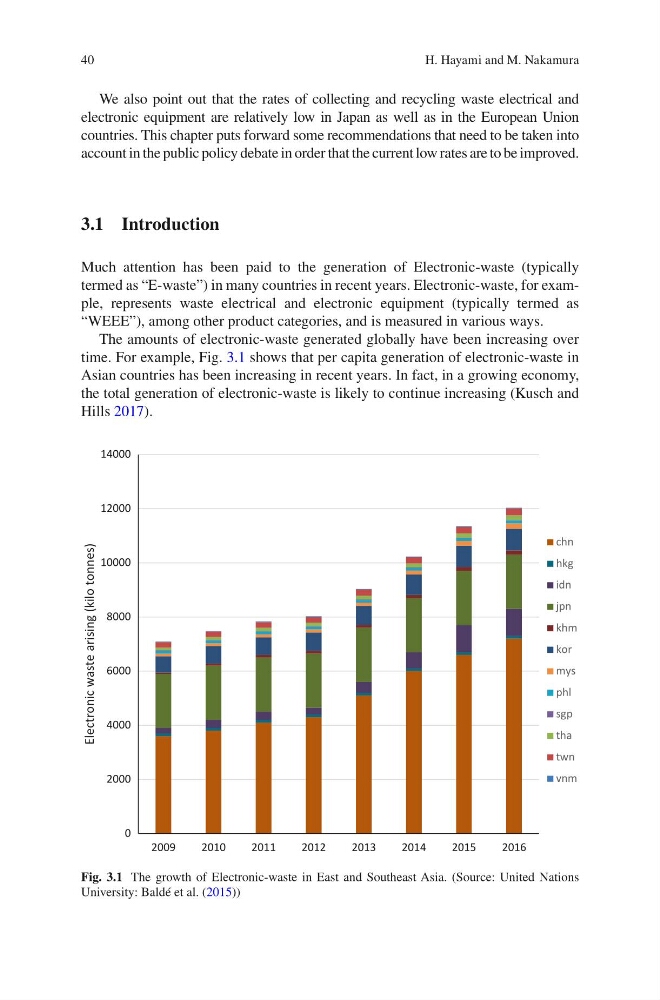
The amounts of electronic-waste generated globally have been increasing over
time. For example, Fig. 3.1 shows that per capita generation of electronic-waste in
Asian countries has been increasing in recent years. In fact, in a growing economy,
the total generation of electronic-waste is likely to continue increasing (Kusch and
Hills 2017).
0
2000
4000
6000
8000
10000
12000
14000
2009
2010
2011
2012
2013
2014
2015
2016
Electronic waste arising (kilo tonnes)
chn
hkg
idn
jpn
khm
kor
mys
phl
sgp
tha
twn
vnm
Fig. 3.1 The growth of Electronic-waste in East and Southeast Asia. (Source: United Nations
University: Baldé et al. (2015))
H. Hayami and M. Nakamura
We also point out that the rates of collecting and recycling waste electrical and
electronic equipment are relatively low in Japan as well as in the European Union
countries. This chapter puts forward some recommendations that need to be taken into
account in the public policy debate in order that the current low rates are to be improved.
3.1 Introduction
Much attention has been paid to the generation of Electronic-waste (typically
termed as “E-waste”) in many countries in recent years. Electronic-waste, for example, represents waste electrical and electronic equipment (typically termed as
“WEEE”), among other product categories, and is measured in various ways.
The amounts of electronic-waste generated globally have been increasing over
time. For example, Fig. 3.1 shows that per capita generation of electronic-waste in
Asian countries has been increasing in recent years. In fact, in a growing economy,
the total generation of electronic-waste is likely to continue increasing (Kusch and
Hills 2017).
0
2000
4000
6000
8000
10000
12000
14000
2009
2010
2011
2012
2013
2014
2015
2016
Electronic waste arising (kilo tonnes)
chn
hkg
idn
jpn
khm
kor
mys
phl
sgp
tha
twn
vnm
Fig. 3.1 The growth of Electronic-waste in East and Southeast Asia. (Source: United Nations
University: Baldé et al. (2015))
H. Hayami and M. Nakamura